


Predicted Expenditure for Prescription Drugs for Multiple Sclerosis in the Italian Market Between 2023 and 2028: Results of the Oracle Project
- PMID: 39093539
- PMCID: PMC11393242
- DOI: 10.1007/s40120-024-00644-3
Predicted Expenditure for Prescription Drugs for Multiple Sclerosis in the Italian Market Between 2023 and 2028: Results of the Oracle Project
Abstract
Introduction: Multiple sclerosis (MS) is a chronic neurodegenerative disease that leads to impaired cognitive function and accumulation of disability, with significant socioeconomic burden. Serious unmet need in the context of managing MS has given rise to ongoing research efforts, leading to the launch of new drugs planned for the near future, and subsequent concerns about the sustainability of healthcare systems. This study assessed the changes in the Italian MS market and their impact on the expenditures of the Italian National Healthcare Service between 2023 and 2028.
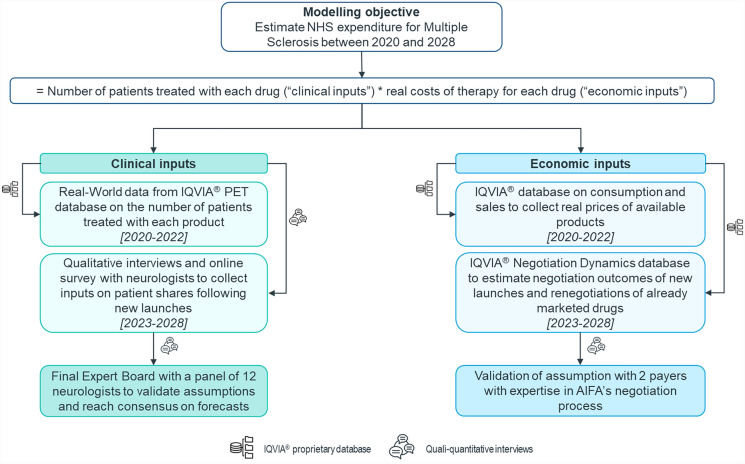
Methods: A horizon-scanning model was developed to estimate annual expenditure from 2023 to 2028. Annual expenditure for MS was calculated by combining the number of patients treated with each product (clinical inputs) and the yearly costs of therapy (economic inputs). Baseline inputs (2020-2022) were collected from IQVIA® real-world data, while input estimation for the 5-year forecast was integrated with analog analyses and the insights of clinicians and former payers.
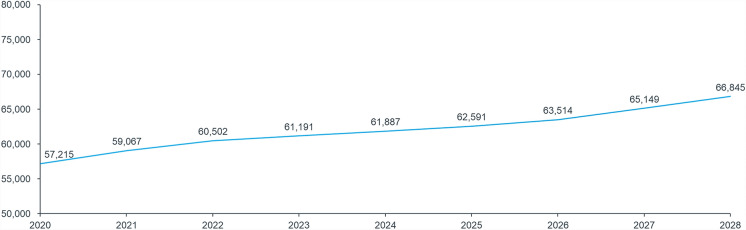
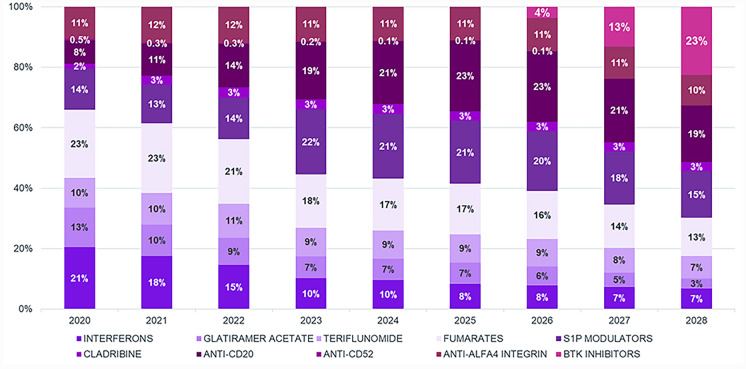
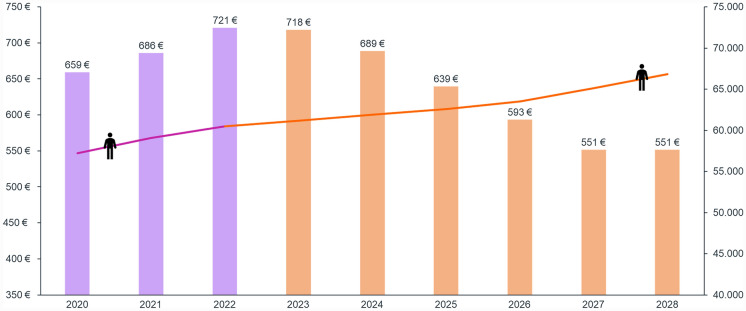
Results: The number of equivalent patients treated in 2028 in Italy was estimated at around 67,000, with an increase of 10% versus 2022. In terms of treatment pattern evolution, first-line treatments are expected to reduce their shares from 47% in 2022 to 27% in 2028, and Bruton tyrosine kinase inhibitors are expected to reach 23% of patient shares. Overall, expenditure for MS is estimated to decrease from €721 million in 2022 to €551 million in 2028, mainly due to losses of exclusivity and renegotiation of drug prices.
Conclusion: Despite the increase in the number of patients treated for MS and the launch of new molecules that will reach high market penetration, the model confirmed sustainability for the Italian National Healthcare Service.
Keywords: BTKi; Costs; Forecast; Italian National Healthcare Service expenditure; Multiple sclerosis; Treatment pattern.
© 2024. The Author(s).
Conflict of interest statement
Damiano Paolicelli, Giovanna Borriello, Raffaella Clerici, Elena Colombo, Davide Croce, Emanuele D’Amico, Nicola De Rossi, Alessia Di Sapio, Giuseppe Fenu, Davide Maimone, Girolama A. Marfia, Marcello Moccia, Paola Perini, Maria G. Piscaglia, Lorenzo Razzolini, Massimo Riccaboni, Elisabetta Signoriello, Carla Tortorella received honoraria from Sanofi S.r.l. to participate in the study. Giovanna Borriello received fees for participating to Advisory Boards and travel compensations from Almirall, Biogen, Bristol-Myers Squibb, Johnson and Johnson, Merck, Novartis, Roche, and Sanofi. Elena Colombo reports travel expenses, speaker honoraria, and advisory board work from Alexion, Biogen, Bristol-Myers Squibb, Janssen, Merck, Novartis, Roche, and Sanofi. Alessia Di Sapio received speaker and consulting personal compensation by Alexion, Alnylam, Amgen Biogen, Bristol-Myers Squibb, Janssen, Merck Serono, Novartis, Roche, and Sanofi and received reimbursement for attending conferences by Biogen, Merck Serono, Novartis, Roche, and Sanofi. Davide Maimone received honoraria for participating to Advisory Boards and lectures and received travel grants from Alexion, Biogen, Bristol-Myers Squibb, Merck, Novartis, Roche, and Sanofi. Giuseppe Fenu received honoraria for consultancy or speaking from Biogen, Bristol-Myers Squibb, Merck, Novartis, Roche, and Sanofi. Marcello Moccia has received financial support by the MUR PNRR Extended Partnership (MNESYS no. PE00000006, and DHEAL-COM no. PNC-E3-2022-23683267), research grants from the ECTRIMS-MAGNIMS, the UK MS Society, and Merck, and honoraria from Biogen, Bristol-Myers Squibb, Ipsen, Janssen, Merck, Novartis, Roche, and Sanofi. Elisabetta Signoriello received travel grants and performed consultancy for Almirall, Biogen, Bristol-Myers Squibb, Novartis, Merck, Roche, Sanofi, and Teva. Carla Tortorella received travel funding and/or speaker honoraria from Alexion, Almirall, Biogen, Bristol-Myers Squibb, Horizon, Merck, Novartis, Roche, and Sanofi.
Figures
References
-
- Niglio T, Mandolesi S, De Lucia O, d’Alessandro A. The incidence of the multiple sclerosis in Italy: 2011–2015. Clin Ter. 2022;173(5):453–7. - PubMed
LinkOut - more resources
Full Text Sources
