. 2024 Aug 2;15(1):6513.
doi: 10.1038/s41467-024-50926-5.

Ocean wave energy harvesting with high energy density and self-powered monitoring system

Affiliations

Ocean wave energy harvesting with high energy density and self-powered monitoring system

Ze-Qi Lu et al. Nat Commun. .

Abstract

Constructing a ocean Internet of Things requires an essential ocean environment monitoring system. However, the widely distributed existing ocean monitoring sensors make it impractical to provide power and transmit monitored information through cables. Therefore, ocean environment monitoring systems particularly need a continuous power supply and wireless transmission capability for monitoring information. Consequently, a high-strength, environmentally multi-compatible, floatable metamaterial energy harvesting device has been designed through integrated dynamic matching optimization of materials, structures, and signal transmission. The self-powered monitoring system breaks through the limitations of cables and batteries in the ultra-low-frequency wave environment (1 to 2 Hz), enabling real-time monitoring of various ocean parameters and wirelessly transmitting the data to the cloud for post-processing. Compared with solar and wind energy in the ocean environment, the energy harvesting device based on the defective state characteristics of metamaterials achieves a high-energy density (99 W/m3). For the first time, a stable power supply for the monitoring system has been realized in various weather conditions (24 h).


Conflict of interest statement

The authors declare no competing interests.

Figures
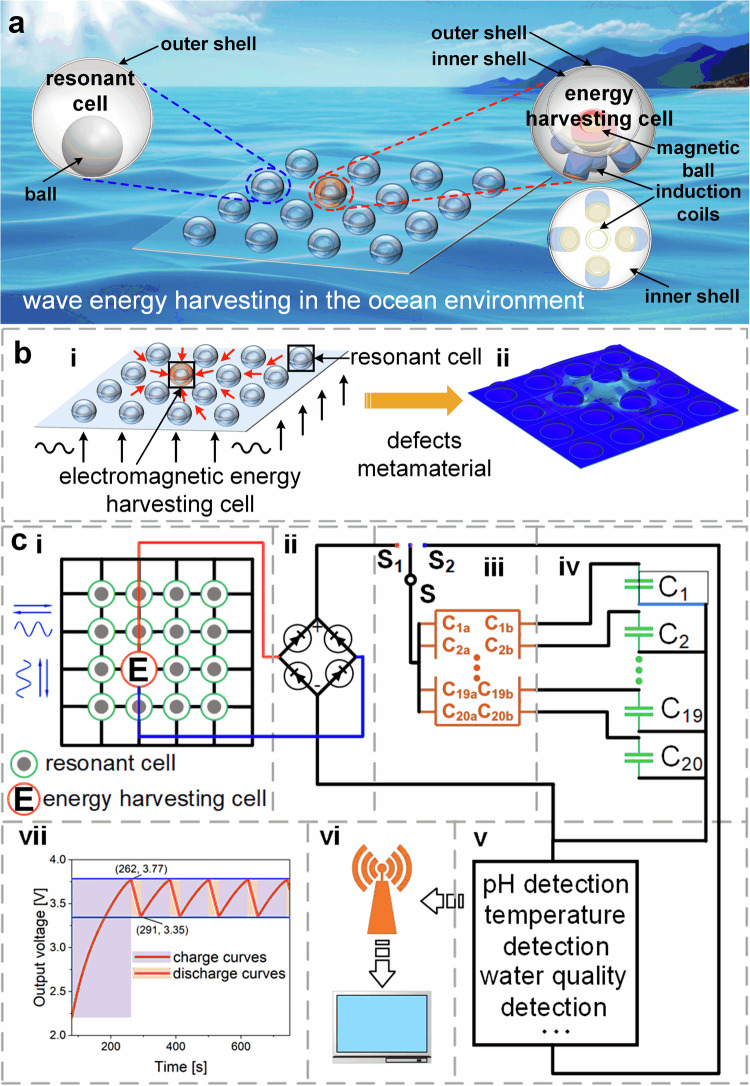
Fig. 1
Fig. 1. Design diagram of wave energy harvesting and self-powered health monitoring system in OIoT.
a Schematic of a metamaterial energy harvester harvesting wave energy from the ocean environment.the red dashed circle illustrates the electromagnetic energy harvesting cell and the blue dashed circle illustrates the resonant cell; b (i) Schematic of the energy concentration phenomenon of the metamaterial with defects under wave excitation; (ii) Simulated displacement clouds of metamaterial plates with point defects when excited by ocean waves, c schematic design of a self-powered ocean environmental health monitoring system: (i) high-density wave energy harvesting metamaterial panels. The green circle illustrates the resonant cell and the red circle illustrates the energy harvesting cell, (ii) rectifier module (AC → DC);(iii) Series/parallel conversion module for energy storage elements. (S is a single-patch double-throw switch (ADG719-EP) integrated into the circuit to achieve series/parallel conversion of the energy storage element. When S1 is closed, the capacitors are connected in parallel and the energy storage element is charged; when S2 is closed, the capacitors are connected in series and the energy storage element is discharged); This series/parallel coversion modulue allows the system to be able to charge the storage at low voltages and supply power to sensing subsystems at higher voltages, enhancing the energy harvesting capability; (iv) energy storage module; (v) environmental condition monitoring module (e.g. pH, temperature, and water quality); (vi) monitored information receiving module; and (vii) charge/discharge curves of the energy storage modules.
Fig. 2
Fig. 2. Finite element analysis of energy-harvesting metamaterials.
a High-density energy-harvesting metamaterial plates (0.3 m × 0.3 m) based on defect characteristics: ① ABS plastic plate; ② resonant cell; ③ energy harvesting cell; b simple Brillouin region for two-dimensional metamaterials; c finite element model of a defective metamaterial plate; d theoretical band structures of defective metamaterial plates; e displacement clouds when an acceleration excitation a = 1g is applied to the lower surface of a metamaterial plate containing a point defect: (i) f = 0.5 Hz; (ii) f = 1 Hz; (iii) f = 1.5 Hz; (iv) f = 1.9 Hz (Defective band); (v) f = 2.5 Hz; (vi) f = 3 Hz; f effect of geometrical parameters of high-density energy-harvesting metamaterial devices on the frequency range of defect bands: (i) plate thickness; (ii) cell size; (iii) outer shell size; (iv) rolling-ball size; (v) plate material.
Fig. 3
Fig. 3. Experiments of the response of a high-density energy-harvesting metamaterial device under various wave size conditions.
a schematic of the experimental rig; b photographs of the experimental rig: (i) oscilloscope, which shows the energy-harvesting metamaterial plate output voltage; (ii) computer; (iii) signal controller, which generates sinusoidal signals; (iv) power amplifier;(v) triaxial shakers that provide excitation in the x-, y- and z-directions;(vi) flume, which simulates the ocean wave environment; c motion state analysis and output voltage of a rolling magnetic ball in a metamaterial energy-harvesting device under various wave conditions:(i), (ii): a = 0.1 g, f = 2 Hz, x-direction excitation; (iii), (iv): a = 0.5g, f = 2 Hz, x -direction excitation; (v), (vi): a = 1.0 g, f = 2 Hz, x-direction excitation; (vii), (viii): a = 1.5 g, f = 2 Hz, z-direction excitation; when the energy harvesting metamaterial plate is in the multi-direction excitation state; (ix), (x): a = 1.5g, f = 2 Hz, x-y-direction excitation, when the energy harvesting metamaterial plate is in the multi-direction excitation state; (xi), (xii): a = 2.0 g, f = 2 Hz, z-direction excitation, when the energy harvesting metamaterial plate is in the overturning state; where (i)–(vi) simulate the motion state and energy output of the rolling ball in the metamaterial energy harvester in a steady wave environment, (vii)–(xii) simulate the motion state and energy output of the rolling ball in the metamaterial energy harvester in a harsh environment.
Fig. 4
Fig. 4. Schematic and characterization of a self-powered ocean environment monitoring system.
a Schematic of the components of an ocean environment monitoring system for wave energy harvesting by a high-density energy-harvesting metamaterial device (the self-powered energy monitoring system is sealed with hot melt adhesive and the connections between the energy harvesting device and the detection system are waterproofed); b Schematic of self-powered ocean environment monitoring system circuits; c capacitor charging and discharging experiments and results; d Output characterization of energy-harvesting metamaterials at different frequencies: (i) output voltage, (ii) output current, (iii) output power, and (iv) power density.
Fig. 5
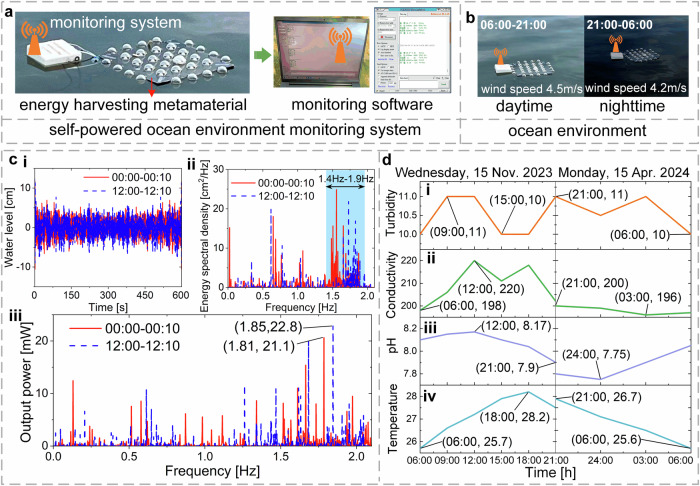
Fig. 5. Self-powered ocean environment monitoring system.
a Self-powered ocean environment monitoring system (High-density energy harvesting metamaterials and environmental monitoring software); b the real ocean environment: daytime test environment (wind speed of 4.5 m/s) and nighttime test environment (wind speed of 4.2 m/s); c testing results (red solid line: 00:00–00:10; blue dotted line: 12:00–12:10): (i) spectrum of the wave level; (ii) energy spectral density of the wave; (iii) Output power spectrum of the high-density energy harvesting metamaterial; d Real-time health monitoring results of the ocean environment in one day: (i) turbidity, (ii) conductivity, (iii) pH, and (iv) temperature.
Fig. 6
Fig. 6
Theoretical modeling of nonlinear ball-pendulum energy harvesters.

References

    1. Zhu, H. W. et al. A miniaturized bionic ocean-battery mimicking the structure of marine microbial ecosystems. Nat. Commun.13, 5608 (2022). 10.1038/s41467-022-33358-x - DOI - PMC - PubMed
    1. Jin, L., Deng, W. L., Su, Y. C. & Zhong, X. Self-powered wireless smart sensor based on maglev porous nanogenerator for train monitoring system. Nano Energy38, 185–192 (2017). 10.1016/j.nanoen.2017.05.018 - DOI
    1. Ellabban, O., Abu-Rub, H. & Blaabjerg, F. Renewable energy resources: current status, future prospects and their enabling technology. Renew. Sustain. Energy Rev.39, 748–764 (2014). 10.1016/j.rser.2014.07.113 - DOI
    1. Russell, J. Ocean sensors can track progress on climate goals. Nature15, 555 (2018). - PubMed
    1. Salter, S. H. Wave power. Nature249, 720 (1974). 10.1038/249720a0 - DOI

LinkOut - more resources