


Lack of standardisation in the management of complex tibial plateau fractures: a multicentre experience
- PMID: 39095621
- PMCID: PMC11666675
- DOI: 10.1007/s00068-024-02616-6
Lack of standardisation in the management of complex tibial plateau fractures: a multicentre experience
Abstract
Objective: In recent years, the trauma mechanisms and fracture types in tibial plateau fractures (TPF) have changed. At the same time, treatment strategies have expanded with the establishment of new classification systems, extension of diagnostics and surgical strategies. Evidence-based recommendations for treatment strategies are rare. The aim of this study is to assess the extent of standardization in the treatment of complex TPF.
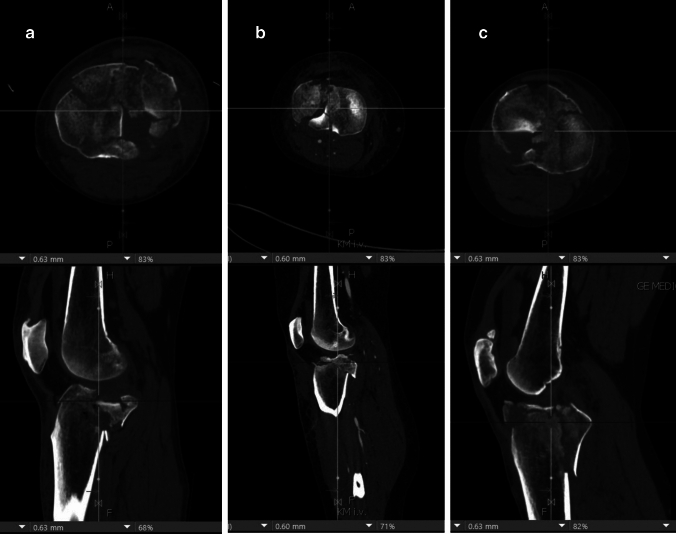
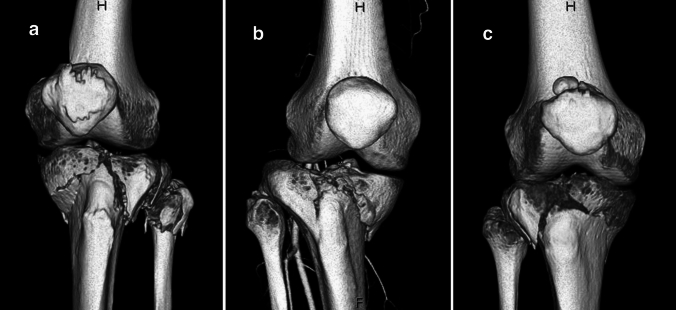
Material and methods: For the study, specialists in trauma surgery/orthopaedics were presented thin-slice CT data sets of three complex TPFs including 3D reconstructions. A standardized questionnaire on fracture morphology and planned treatment strategy was then completed.
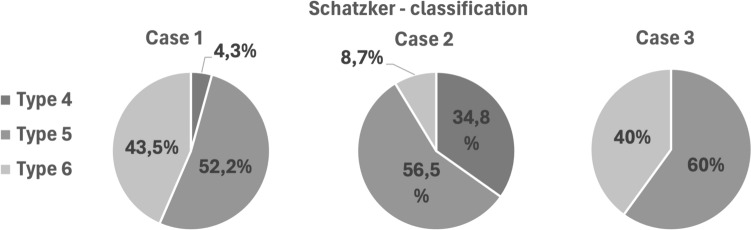
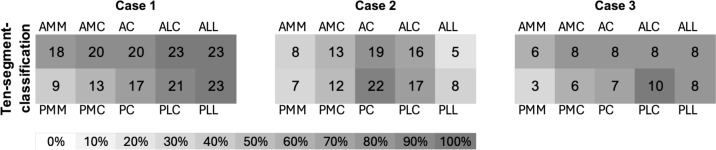
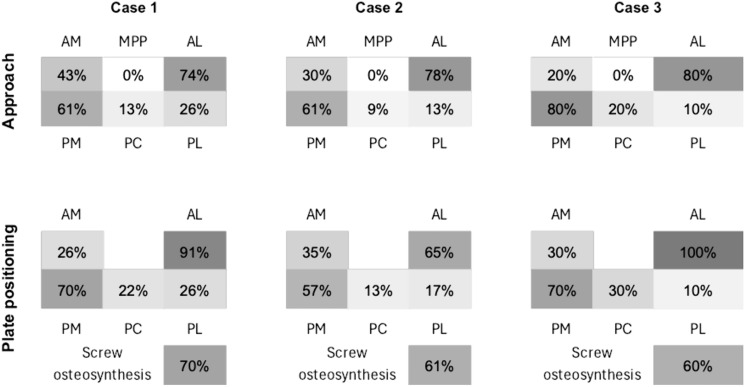
Results: A total of 23 surgeons from 7 hospitals (Trauma center levels I-III) were included. All three fractures were most frequently classified as Schatzker type V (fracture I: 52.2%, II: 56.5%, III: 60%). Averaged over all three fractures, 55% of the respondents chose the same patient positioning. The combination of a posteromedial and anterolateral approach was the most frequently chosen approach at 42.7%. Double plating was favored for the surgical treatment of all fractures (70.7%). Preoperative MRI, extended approaches and intraoperative fraturoscopy were significantly more common in level I trauma centres.
Conclusion: There are major differences in the management of complex TPF. 360° treatment is carried out in all departments regardless of the level of care, but without further standardization in terms of preoperative imaging, classification, initial treatment, approach, fixation and intraoperative imaging. There are major differences within the departments with different level of care.
Keywords: Fracture classification; Fracture register; Osteosynthesis; Perioperative imaging; Tibial plateau fracture (TPF); Treatment standard.
© 2024. The Author(s).
Conflict of interest statement
Declarations. Conflict of interest: All Authors certify that they have no affiliations with or involvement in any organization or entity with any financial interest (such as honoraria; educational grants; participation in speakers’ bureaus; membership, employment, consultancies, stock ownership, or other equity interest; and expert testimony or patentlicensing arrangements), or non-financial interest (such as personal or professional relationships, affiliations, knowledge or beliefs) in the subject matter or materials discussed in this manuscript. The authors declare no competing interests.
Figures
References
-
- Deutsche Gesellschaft für Orthopädie und Unfallchirurgie e.V. (DGOU). [Tibial head fractures. Version 1.0 (29.10.2021)] 2022. https://www.awmf.org/uploads/tx_szleitlinien/187-042l_S2k_Tibiakopffrakt... (accessed October 3, 2022).
Publication types
MeSH terms
LinkOut - more resources
Full Text Sources
Medical
