


An observational analysis of the impact of indoor residual spraying in two distinct contexts of Burkina Faso
- PMID: 39095782
- PMCID: PMC11295511
- DOI: 10.1186/s12936-024-05054-2
An observational analysis of the impact of indoor residual spraying in two distinct contexts of Burkina Faso
Abstract
Background: Indoor residual spraying (IRS) is a cornerstone malaria control intervention in Burkina Faso. From 2018 to 2021, non-pyrethroid IRS was implemented annually in two regions of Burkina Faso with distinct malaria transmission patterns, concurrently with annual seasonal malaria chemoprevention (SMC), and a mass insecticide-treated net (ITN) distribution in 2019.
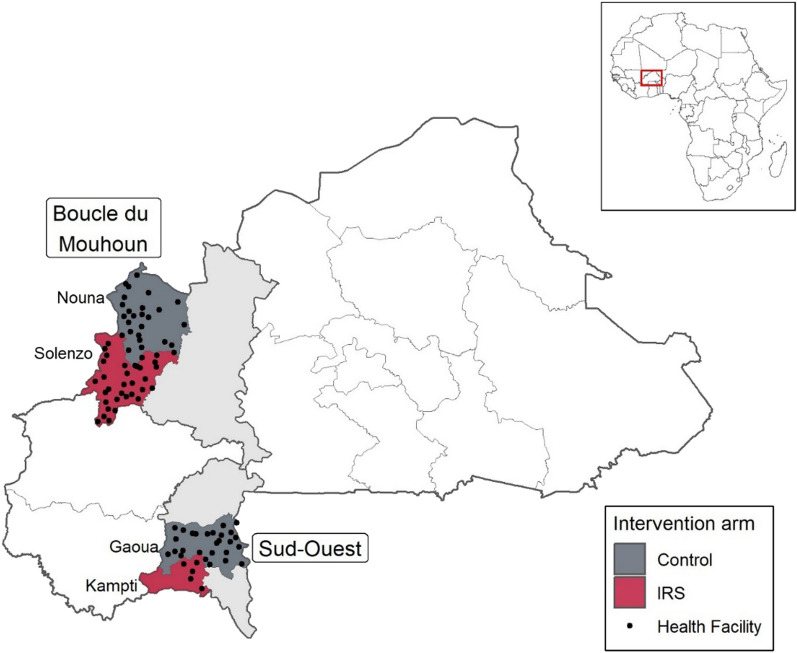
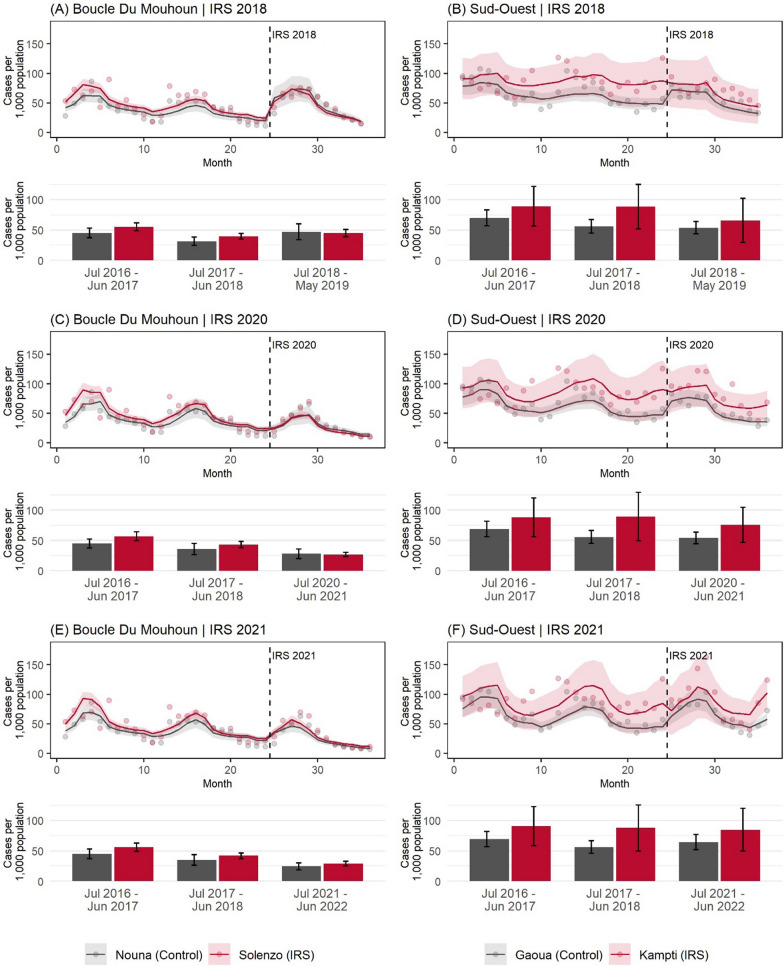
Methods: A retrospective quasi-experimental approach was used to evaluate the impact of the 2018, 2020, and 2021 IRS campaigns on routinely reported confirmed malaria case incidence at health facilities. The 2019 campaign was excluded due to lack of data reporting during a health sector strike. Controlled interrupted time series models were fit to detect changes in level and trend in malaria case incidence rates following each IRS campaign when compared to the baseline period 24-months before IRS. IRS districts Solenzo (Sudano-Sahelien climate), and Kampti (tropical climate) were compared with neighbouring control districts and the analyses were stratified by region. Modelled health facility catchment population estimates based on travel time to health facilities and weighted by non-malaria outpatient visits were used as an offset. The study period encompassed July 2016 through June 2022, excluding July 2018 to June 2019.
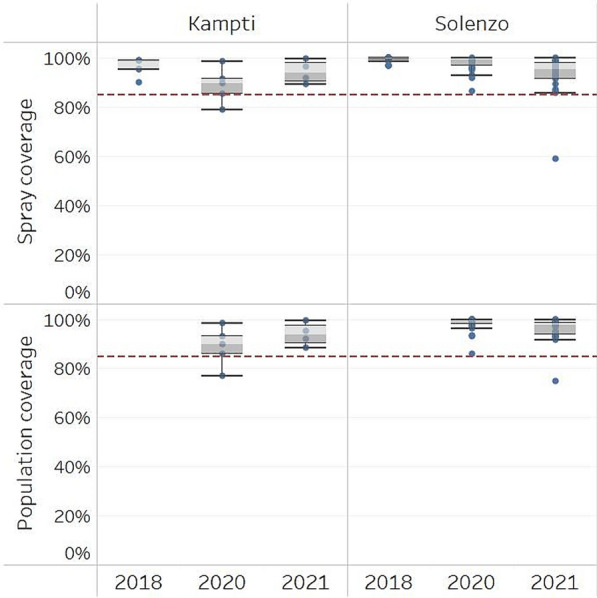
Results: District-level population and structure coverage achieved by IRS campaigns was greater than 85% in 2018, 2020, and 2021 in Solenzo and Kampti. In Solenzo a significant difference in malaria case incidence rates was detected after the 2018 campaign (IRR = 0.683; 95% CI 0.564-0.827) when compared to the control district. The effect was not detected following the 2020 or 2021 IRS campaigns. In Kampti, estimated malaria incidence rates were between 36 and 38% lower than in the control district following all three IRS campaigns compared to the baseline period.
Conclusions: Implementation of IRS in Kampti, a tropical region of Burkina Faso, appeared to have a consistent significant beneficial impact on malaria case rates. An initial positive impact in Solenzo after the first IRS campaign was not sustained in the successive evaluated IRS campaigns. This study points to a differential effect of IRS in different malaria transmission settings and in combination with ITN and SMC implementation.
Keywords: Combined malaria control strategies; Indoor residual spraying; Observational analysis.
© 2024. The Author(s).
Conflict of interest statement
The authors declare that they have no competing interests.
Figures


References
-
- World Health Organization. World malaria report 2021. Geneva: World Health Organization; 2021.
-
- WHO. Indoor residual spraying: an operational manual for indoor residual spraying (IRS) for malaria transmission control and elimination. Geneva: World Health Organization; 2015.
-
- WHO. Global technical strategy for malaria 2016–2030. Geneva: World Health Organization; 2015.
Publication types
MeSH terms
Substances
Grants and funding
LinkOut - more resources
Full Text Sources
Medical
