Review
. 2024 Aug 2;25(1):295.
doi: 10.1186/s12931-024-02920-0.

G12/13 signaling in asthma

Affiliations
Review

G12/13 signaling in asthma

Elizabeth L McDuffie et al. Respir Res. .

Erratum in

  • Correction to: G12/13 signaling in asthma.
    McDuffie EL, Panettieri RA Jr, Scott CP. McDuffie EL, et al. Respir Res. 2024 Oct 14;25(1):371. doi: 10.1186/s12931-024-02985-x. Respir Res. 2024. PMID: 39402568 Free PMC article. No abstract available.

Abstract

Shortening of airway smooth muscle and bronchoconstriction are pathognomonic for asthma. Airway shortening occurs through calcium-dependent activation of myosin light chain kinase, and RhoA-dependent calcium sensitization, which inhibits myosin light chain phosphatase. The mechanism through which pro-contractile stimuli activate calcium sensitization is poorly understood. Our review of the literature suggests that pro-contractile G protein coupled receptors likely signal through G12/13 to activate RhoA and mediate calcium sensitization. This hypothesis is consistent with the effects of pro-contractile agonists on RhoA and Rho kinase activation, actin polymerization and myosin light chain phosphorylation. Recognizing the likely role of G12/13 signaling in the pathophysiology of asthma rationalizes the effects of pro-contractile stimuli on airway hyperresponsiveness, immune activation and airway remodeling, and suggests new approaches for asthma treatment.

Keywords: Airway hyperresponsiveness; Airway remodeling; Anticholinergic agents; Asthma; Bronchoconstriction; Calcium sensitization; G12/13; Inflammation; Muscarinic 3 acetylcholine receptor; RhoA.


Conflict of interest statement

The authors declare no competing interests.

Figures
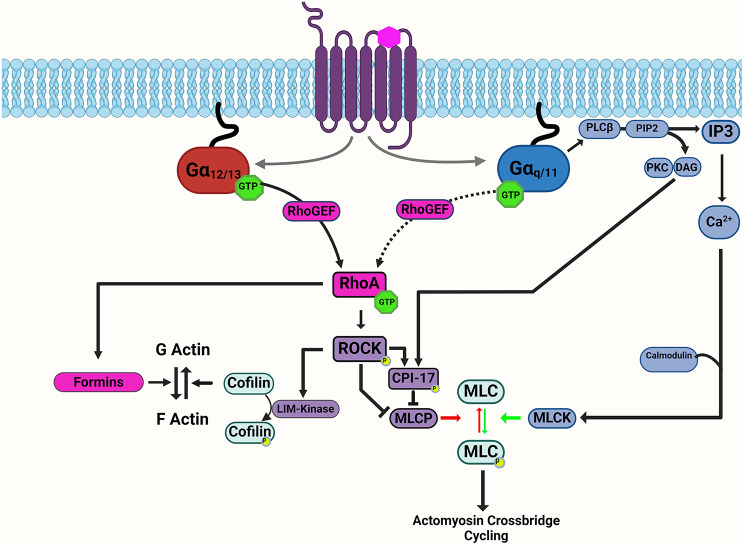
Fig. 1
Fig. 1
G protein signaling in smooth muscle contraction. Two G protein signaling pathways contribute to airway smooth muscle contraction. Activation of Gq/11 upon receptor-dependent guanine nucleotide exchange stimulates the calcium-dependent contractile pathway, whereby GTP-bound Gq/11 allosterically activates PLCβ-dependent hydrolysis of phosphoinositide bisphosphate (PIP2) into IP3 and DAG, which promote intracellular calcium flux, thereby activating MLCK-dependent phosphorylation of myosin light chain and actomyosin cross-bridge cycling (blue nodes on right side of figure). Calcium sensitization (fuchsia and violet nodes in the center and left of the figure) is mediated by GTP-bound RhoA, which can be generated downstream of activation of either Gq/11 or G12/13, although G12/13 are more potent activators [29]. PKC phosphorylation of CPI-17 promotes inhibition of myosin light chain phosphatase, which increases net MLC phosphorylation. GTP-bound RhoA stimulates actin polymerization through activation of formins (fuchsia nodes) and ROCK activity (violet nodes), which inhibit both filament severing and MLCP. ROCK also phosphorylates CPI-17, which further inhibits MLCP. (Created with BioRender.com)
Fig. 2
Fig. 2
G12/13 signaling in inflammation. G12/13-dependent activation of RhoA and ROCK promotes inflammation in both Th2-high (a) and Th2-low asthma (c). G12/13 can also stimulate NFκB-dependent production of inflammatory cytokines (b). (Created with BioRender.com)
Fig. 3
Fig. 3
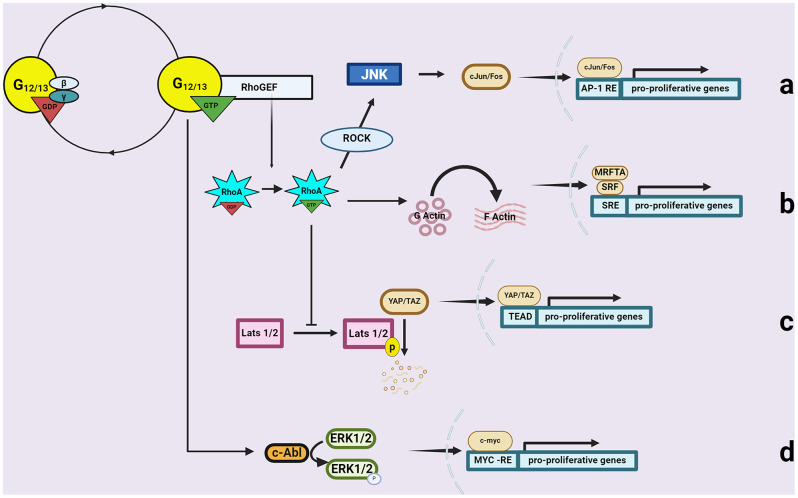
G12/13 signaling in proliferation. G12/13 activate RhoGEFs that generate GTP-bound RhoA, activating ROCK and stimulating proliferative gene transcription via AP-1 (a) and SRE (b) promoters. GTP-bound RhoA inhibits phosphorylation of Lats 1/2, thereby blocking negative regulation of the Hippo pathway (c). G12/13 bind to c-Abl, affecting ERK-dependent proliferation (d). (Created with BioRender.com)
Fig. 4
Fig. 4
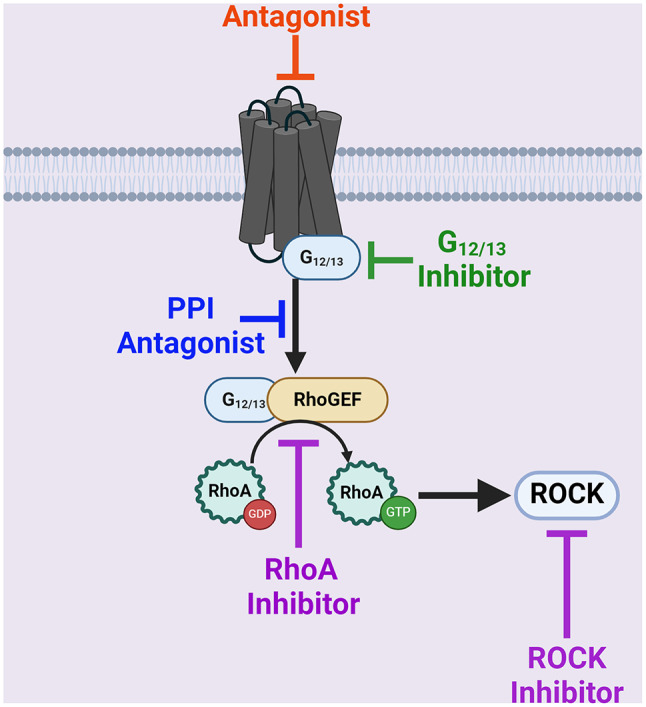
Targets for regulating G12/13 signaling. Hyperactive G12/13 signaling in airway smooth muscle can be attenuated by antagonizing upstream receptors (red), by developing direct inhibitors of G12, G13 (green) or complexes between G12/13 and RhoGEFs (blue), or by inhibiting RhoA or ROCK (purple). (Created with BioRender.com)

References

    1. Fredriksson R, Lagerstrom MC, Lundin LG, Schioth HB. The G-protein-coupled receptors in the human genome form five main families. Phylogenetic analysis, paralogon groups, and fingerprints. Mol Pharmacol. 2003;63(6):1256–72. - PubMed
    1. Pierce KL, Premont RT, Lefkowitz RJ. Seven-transmembrane receptors. Nat Rev Mol Cell Biol. 2002;3(9):639–50. - PubMed
    1. Yang D, Zhou Q, Labroska V, Qin S, Darbalaei S, Wu Y, et al. G protein-coupled receptors: structure- and function-based drug discovery. Signal Transduct Target Ther. 2021;6(1):7. - PMC - PubMed
    1. Hurowitz EH, Melnyk JM, Chen YJ, Kouros-Mehr H, Simon MI, Shizuya H. Genomic characterization of the human heterotrimeric G protein alpha, beta, and gamma subunit genes. DNA Res. 2000;7(2):111–20. - PubMed
    1. Hauser AS, Avet C, Normand C, Mancini A, Inoue A, Bouvier M et al. Common coupling map advances GPCR-G protein selectivity. Elife. 2022;11. - PMC - PubMed

MeSH terms

Substances