Review
. 2024 Aug 2;12(1):76.
doi: 10.1186/s40364-024-00612-x.

Monocyte-macrophages modulate intestinal homeostasis in inflammatory bowel disease

Affiliations
Review

Monocyte-macrophages modulate intestinal homeostasis in inflammatory bowel disease

Huiying Lu et al. Biomark Res. .

Abstract

Background: Monocytes and macrophages play an indispensable role in maintaining intestinal homeostasis and modulating mucosal immune responses in inflammatory bowel disease (IBD). Although numerous studies have described macrophage properties in IBD, the underlying mechanisms whereby the monocyte-macrophage lineage modulates intestinal homeostasis during gut inflammation remain elusive.

Main body: In this review, we decipher the cellular and molecular mechanisms governing the generation of intestinal mucosal macrophages and fill the knowledge gap in understanding the origin, maturation, classification, and functions of mucosal macrophages in intestinal niches, particularly the phagocytosis and bactericidal effects involved in the elimination of cell debris and pathogens. We delineate macrophage-mediated immunoregulation in the context of producing pro-inflammatory and anti-inflammatory cytokines, chemokines, toxic mediators, and macrophage extracellular traps (METs), and participating in the modulation of epithelial cell proliferation, angiogenesis, and fibrosis in the intestine and its accessory tissues. Moreover, we emphasize that the maturation of intestinal macrophages is arrested at immature stage during IBD, and the deficiency of MCPIP1 involves in the process via ATF3-AP1S2 signature. In addition, we confirmed the origin potential of IL-1B+ macrophages and defined C1QB+ macrophages as mature macrophages. The interaction crosstalk between the intestine and the mesentery has been described in this review, and the expression of mesentery-derived SAA2 is upregulated during IBD, which contributes to immunoregulation of macrophage. Moreover, we also highlight IBD-related susceptibility genes (e.g., RUNX3, IL21R, GTF2I, and LILRB3) associated with the maturation and functions of macrophage, which provide promising therapeutic opportunities for treating human IBD.

Conclusion: In summary, this review provides a comprehensive, comprehensive, in-depth and novel description of the characteristics and functions of macrophages in IBD, and highlights the important role of macrophages in the molecular and cellular process during IBD.

Keywords: Homeostasis; Immunopathology; Inflammatory bowel disease; Intestinal mucosa; Macrophage; Susceptibility genes.


Conflict of interest statement

The authors declare that they have no competing interests.

The authors declare no competing interests.

Figures
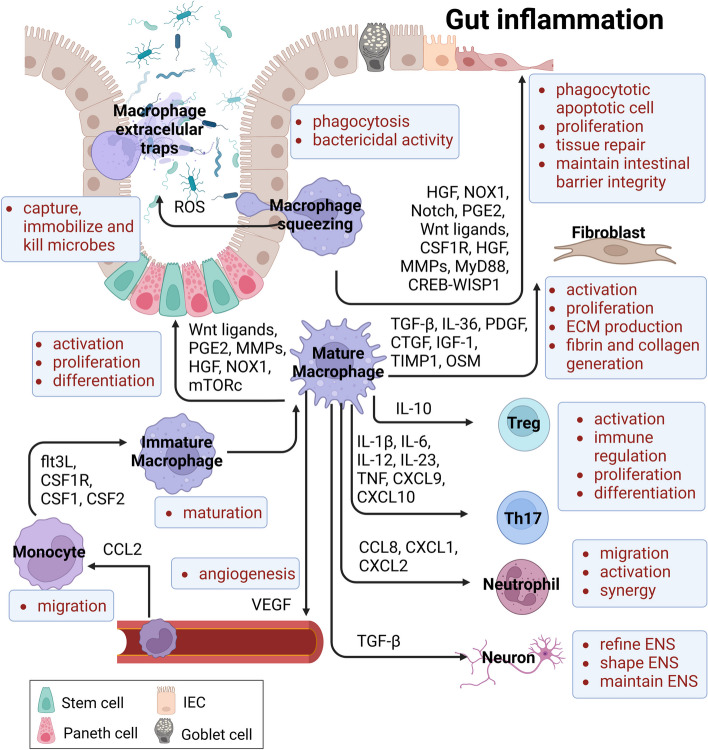
Fig. 1
Fig. 1
Potential roles of macrophages in intestinal mucosa. The infiltration of circulating monocytes is triggered by a CCL2-CCR2 axis, which consistently maturate into macrophages to modulate intestinal immunity and homeostasis. Macrophages involve in phagocytosis and bactericidal effects, and response to exogenous antigens and microbiotas. Macrophage extracellular traps (METs) are released to capture, immobilize and kill microorganisms. In addition, macrophages upregulate the production of cytokines (e.g., IL-1b, IL-6, IL-10, IL-12, IL-23, TGF-b, and TNF-a) and chemokines (e.g., CCL8, CXCL1, CXCL2, CXCL9, and CXCL10), resulting in the regulation of proliferation, differentiation and immune response of neutrophils and T cells. Additionally, macrophages also contribute to tissue repair with the enhancement of epithelial cell proliferation, angiogenesis and fibrosis
Fig. 2
Fig. 2
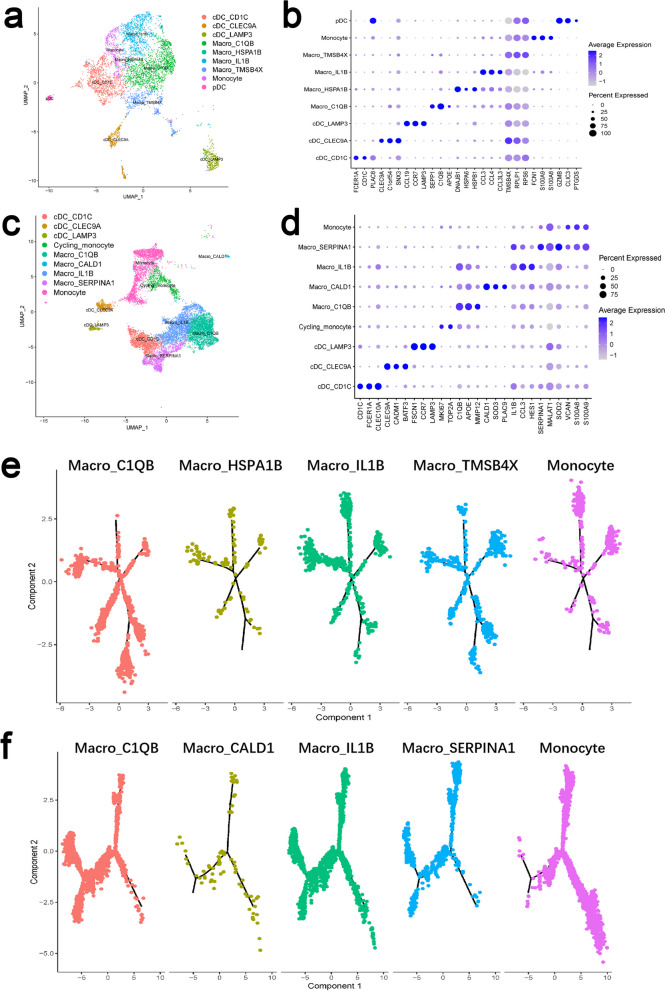
Identification and characteristics of the monocyte-macrophage lineage in intestinal mucosa from IBD patients. (A, C) UMAP plots defines 8 clusters in CD (A) and UC (C) patients, respectively. (B, D) Dot plots showing expression levels of selected signature genes of the monocyte-macrophage lineage subsets in intestinal mucosa from CD (B) and UC (D) patients. Dot size indicates fraction of expressing cells, colored based on the relative expression of specific gene. (E, F) The developmental trajectory of the monocyte-macrophage lineage subsets in CD patients (E) and UC patients (F) inferred by Monocle2
Fig. 3
Fig. 3
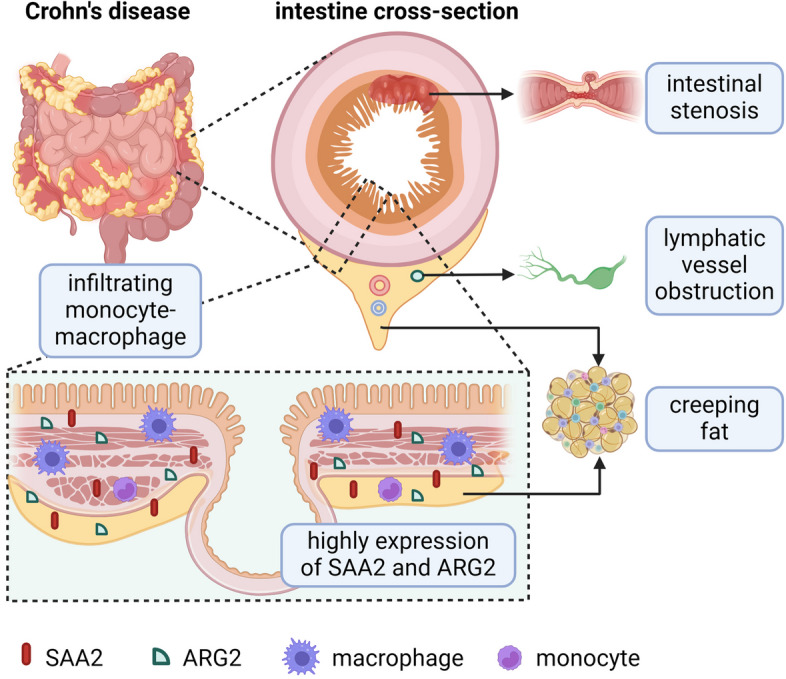
Macrophages modulate mesentery immune homeostasis in IBD patients. The development of creeping fat, mesenteric fibrosis as well as lymphatic vessel obstruction in the mesentery are reckoned as the characteristics of IBD patients. Macrophages infiltrate in the mesentery and involve in the modulation of extraintestinal immune homeostasis in IBD patients via macrophage-associated genes including SAA2 and ARG2, which are highly expressed in the mesentery and intestinal mucosa

References

    1. Schett G, McInnes IB, Neurath MF. Reframing immune-mediated inflammatory diseases through signature cytokine hubs. N Engl J Med. 2021;385:628–39. 10.1056/NEJMra1909094 - DOI - PubMed
    1. Na YR, Stakenborg M, Seok SH, Matteoli G. Macrophages in intestinal inflammation and resolution: a potential therapeutic target in IBD. Nat Rev Gastroenterol Hepatol. 2019;16:531–43. 10.1038/s41575-019-0172-4 - DOI - PubMed
    1. Mowat AM, Scott CL, Bain CC. Barrier-tissue macrophages functional adaptation to environmental challenges. Nat Med. 2017;23:1258–70. 10.1038/nm.4430 - DOI - PubMed
    1. He C, Yu T, Shi Y, Ma C, Yang W, Fang L, et al. MicroRNA 301A promotes intestinal inflammation and colitis-associated cancer development by inhibiting BTG1. Gastroenterology. 2017;152:1434-48.e15. 10.1053/j.gastro.2017.01.049 - DOI - PubMed
    1. Zhou G, Yu L, Fang L, Yang W, Yu T, Miao Y, et al. CD177+ neutrophils as functionally activated neutrophils negatively regulate IBD. Gut. 2018;67:1052–63. 10.1136/gutjnl-2016-313535 - DOI - PubMed

LinkOut - more resources