


Assessing health-related quality of life using the Wound-QoL-17 and the Wound-QoL-14-Results of the cross-sectional European HAQOL study using item response theory
- PMID: 39099173
- PMCID: PMC11298544
- DOI: 10.1111/iwj.70009
Assessing health-related quality of life using the Wound-QoL-17 and the Wound-QoL-14-Results of the cross-sectional European HAQOL study using item response theory
Abstract
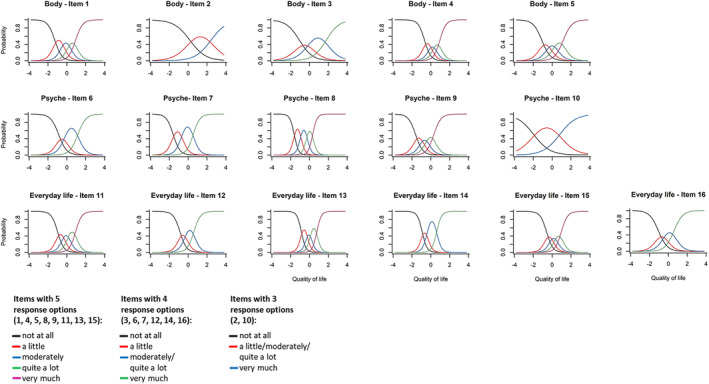
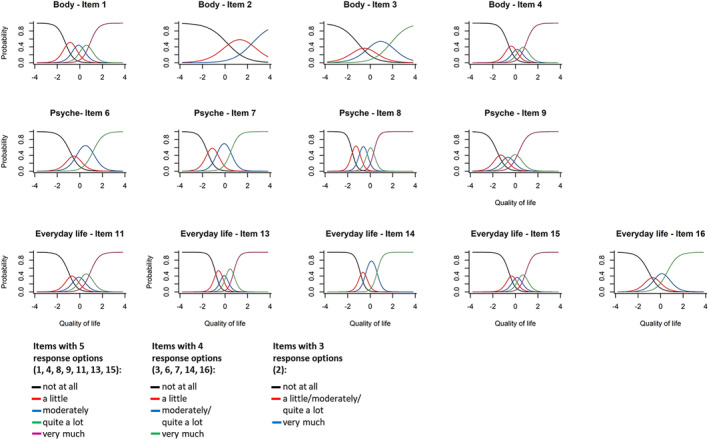
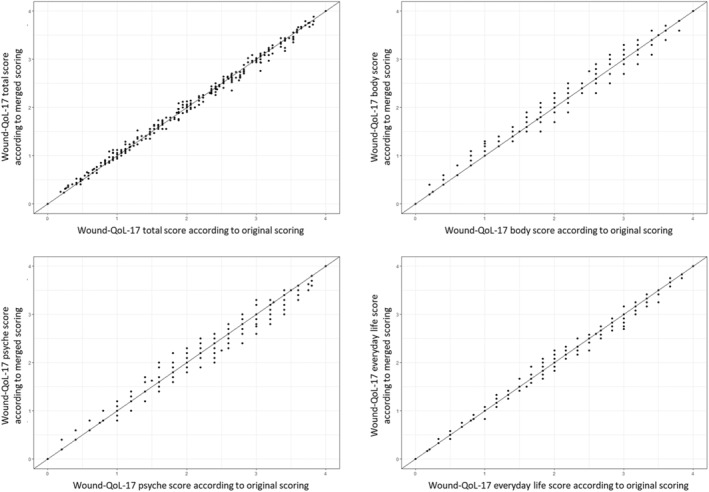
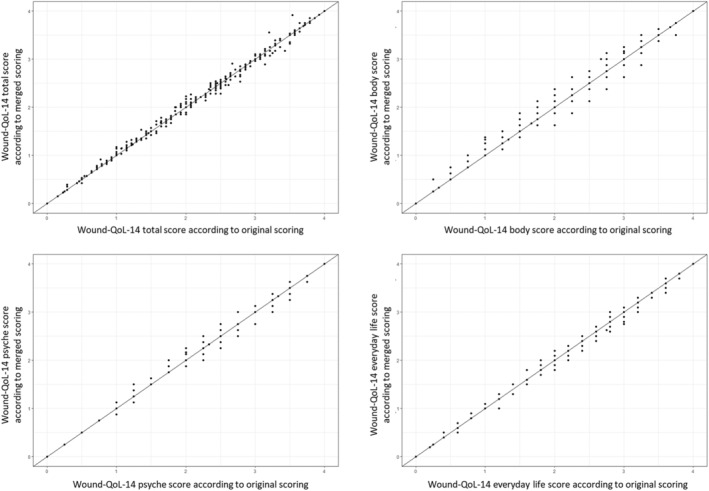
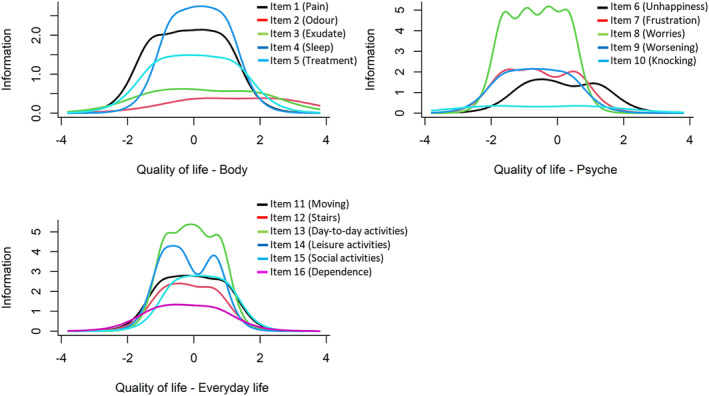
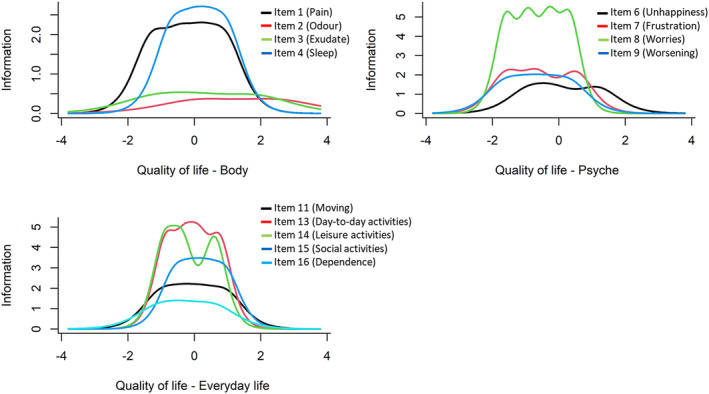
For assessing health-related quality of life in patients with chronic wounds, the Wound-QoL questionnaire has been developed. Two different versions exist: the Wound-QoL-17 and the Wound-QoL-14. For international and cross-cultural comparisons, it is necessary to demonstrate psychometric properties in an international study. Therefore, the aim of this study was to test both questionnaires in a European sample, using item response theory (IRT). Participants were recruited in eight European countries. Item characteristic curves (ICC), item information curves (IIC) and differential item functioning (DIF) were calculated. In both questionnaires, ICCs for most items were well-ordered and sufficiently distinct. For items, in which adjacent response categories were not sufficiently distinct, response options were merged. IICs showed that items on sleep and on pain, on worries as well as on day-to-day and leisure activities had considerably high informational value. In the Wound-QoL-14, the item on social activities showed DIFs regarding the country and age. The same applied for the Wound-QoL-17, in which also the item on stairs showed DIFs regarding age. Our study showed comparable results across both versions of the Wound-QoL. We established a new scoring method, which could be applied in international research projects. For clinical practice, the original scoring can be maintained.
Keywords: IRT; Wound‐QoL; chronic wounds; health‐related quality of life; item response theory.
© 2024 The Author(s). International Wound Journal published by Medicalhelplines.com Inc and John Wiley & Sons Ltd.
Conflict of interest statement
TMJ, VK, SV, LR, PC, MJ, CVM, SA, MB and ECM have no relevant financial or non‐financial interests to disclose. AR has been a consultant or speaker for AbbVie, Bioderma, Boehringer Ingelheim, Celgene, Chema Elektromet, Eli Lilly, Galderma, Janssen, Leo Pharma, Medac, Menlo Therapeutics, Novartis, Pierre‐Fabre, Sandoz and Trevi Therapeutics; and principal investigator or subinvestigator in clinical trials sponsored by Abbvie, Alvotech, Amgen, AnaptysBio, Argenx, Biothera, BMS, Celgene, Celltrion, Dermira, Galderma, Inflarx, Janssen, Kiniksa, Kymab, Leo Pharma, Novartis, Pfizer, Trevi Therapeutics, UCB. KS participated in clinical trials as subinvestigator sponsored by Amgen, Anaptys, Almirall, Celltrion, Galderma, Kiniksa, Novartis, Trevi Therapeutics and was an invited speaker by Medac and Novartis. MA has received fees for consulting and/or lectures and/or studies from the following companies: 3 M Medica, AOK Bundesverband, Bayer Healthcare, Beiersdorf, Birken, Bode, B. Braun, BSNmedical/Essity, BVmed, Coloplast, DAK, Diabet concept, Gerromed, GlaxoSmithKline, Johnson & Johnson, Lohmann & Rauscher, medi, Medovent, Mölnlycke, Smith & Nephew, Schülke & Mayr, Söring, Sorbion, Systagenix, Uluru, Urgo. Project proposal has been submitted by MA. CB is project lead of the HAQOL study, which has been partly funded by the EADV.
Figures
References
-
- Dissemond J, Bültemann A, Gerber V, Jäger B, Münter C, Kröger K. Definitionen für die Wundbehandlung. Hautarzt. 2016;67:265‐266. - PubMed
-
- Lazarus GS, Cooper DM, Knighton DR, et al. Definitions and guidelines for assessment of wounds and evaluation of healing. Wound Repair Regen. 1994;2(3):165‐170. - PubMed
-
- Werdin F, Tenenhaus M, Rennekampff H‐O. Chronic wound care. Lancet. 2008;372(9653):1860‐1862. - PubMed
-
- Martinengo L, Olsson M, Bajpai R, et al. Prevalence of chronic wounds in the general population: systematic review and meta‐analysis of observational studies. Ann Epidemiol. 2019;29:8‐15. - PubMed
-
- European Commission . The 2018 Ageing Report. Publication Office of the European Union; 2018.
MeSH terms
Grants and funding
LinkOut - more resources
Full Text Sources
Medical
