Improving HPV Vaccination Uptake Among Adolescents in Low Resource Settings: Sociocultural and Socioeconomic Barriers and Facilitators
- PMID: 39100520
- PMCID: PMC11296371
- DOI: 10.2147/AHMT.S394119
Improving HPV Vaccination Uptake Among Adolescents in Low Resource Settings: Sociocultural and Socioeconomic Barriers and Facilitators
Abstract
Background: Lower- and middle-income countries (LMICs) are disproportionately impacted by human papillomavirus (HPV) and would benefit from implementing the HPV vaccine. In the context of competing health priorities, utilizing scarce domestic infrastructure and human resources for HPV vaccination remains challenging for many LMICs. Given the high benefits of the HPV vaccine, the World Health Organization (WHO) is now encouraging for all countries, particularly LMICs, to introduce HPV vaccines into their routine immunization programs. Understanding the barriers and facilitators to HPV adolescent vaccine programs in LMICs may help strengthen how LMICs implement HPV vaccine programs, in turn, increasing HPV vaccine acceptance, uptake, and coverage.
Objective: To identify and assess barriers and facilitators to implementing adolescent HPV vaccination programs in LMICs.
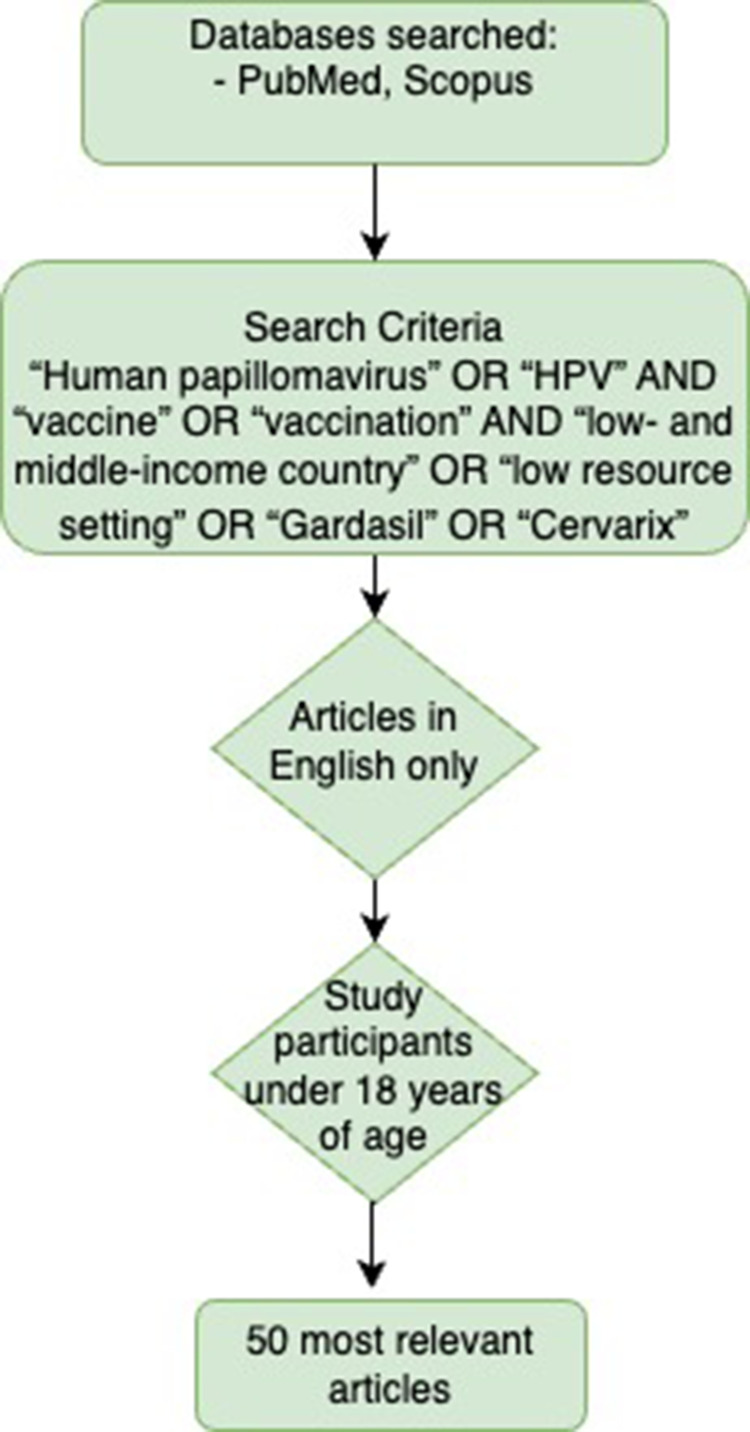
Methods: This study comprised a review of literature assessing adolescent HPV vaccination in LMICs published after 2020 from a sociocultural perspective.
Results: Overall, the findings showed that LMICs should prioritize increasing HPV vaccine availability and HPV vaccine knowledge, particularly focusing on cancer prevention, as knowledge reduces misinformation and increases vaccine acceptance. Evidence suggests that factors promoting HPV vaccine uptake include fostering low vaccine hesitancy, integrating HPV vaccination as a primary school routine vaccination, and vaccinating both genders. A one-dose HPV vaccine may enable many LMICs to increase vaccine acceptance, uptake, and coverage while controlling financial, infrastructure, and human resource costs.
Conclusion: As HPV is one of the leading causes of death in many LMICs, implementing the HPV vaccine may be highly beneficial. Cohesive national HPV vaccine buy-in and understanding the success and challenges of prior LMIC HPV vaccine implementation is crucial to developing effective, efficient, and sustainable HPV vaccination programs.
Keywords: HPV; HPV cost; LMICs; vaccine equity; vaccine hesitancy.
© 2024 Xu et al.
Conflict of interest statement
The authors declare no conflicts of interest in this work.
Similar articles
-
Acceptability of human papillomavirus vaccination in the United Kingdom: a systematic review of the literature on uptake of, and barriers and facilitators to HPV vaccination.Ther Adv Vaccines Immunother. 2024 Dec 25;12:25151355241308313. doi: 10.1177/25151355241308313. eCollection 2024. Ther Adv Vaccines Immunother. 2024. PMID: 39737330 Free PMC article. Review.
-
Leveraging health infrastructure to optimize HPV vaccination for adolescents in Zambia: Protocol for an implementation study.PLoS One. 2023 May 9;18(5):e0285031. doi: 10.1371/journal.pone.0285031. eCollection 2023. PLoS One. 2023. PMID: 37159471 Free PMC article.
-
Global perspectives of determinants influencing HPV vaccine introduction and scale-up in low- and middle-income countries.PLoS One. 2024 Jan 16;19(1):e0291990. doi: 10.1371/journal.pone.0291990. eCollection 2024. PLoS One. 2024. PMID: 38227567 Free PMC article.
-
Improving vaccination uptake among adolescents.Cochrane Database Syst Rev. 2020 Jan 17;1(1):CD011895. doi: 10.1002/14651858.CD011895.pub2. Cochrane Database Syst Rev. 2020. PMID: 31978259 Free PMC article.
-
Human papillomavirus (HPV) vaccine implementation in low and middle-income countries (LMICs): health system experiences and prospects.Vaccine. 2013 Aug 20;31(37):3811-7. doi: 10.1016/j.vaccine.2013.06.016. Epub 2013 Jun 15. Vaccine. 2013. PMID: 23777956 Free PMC article. Review.
Cited by
-
Association Between the Information Environment, Knowledge, Perceived Lack of Information, and Uptake of the HPV Vaccine in Female and Male Undergraduate Students in Belgrade, Serbia.Eur J Investig Health Psychol Educ. 2025 Feb 7;15(2):21. doi: 10.3390/ejihpe15020021. Eur J Investig Health Psychol Educ. 2025. PMID: 39997085 Free PMC article.
-
Determinants of cervical cancer knowledge and barriers to human papillomavirus vaccine uptake among female university students: A cross-sectional study.Womens Health (Lond). 2025 Jan-Dec;21:17455057251335446. doi: 10.1177/17455057251335446. Epub 2025 Apr 28. Womens Health (Lond). 2025. PMID: 40294016 Free PMC article.
-
Harnessing primary healthcare to reduce the burden of cervical cancer in the Eastern Mediterranean Region.BMJ Glob Health. 2025 Jun 8;10(6):e017622. doi: 10.1136/bmjgh-2024-017622. BMJ Glob Health. 2025. PMID: 40484410 Free PMC article. Review.
-
Factors Associated with Acceptance of Vaccination Against Human Papillomavirus in eThekwini District of South Africa.Vaccines (Basel). 2025 Jul 6;13(7):732. doi: 10.3390/vaccines13070732. Vaccines (Basel). 2025. PMID: 40733709 Free PMC article.
-
Papillomavirus Vaccination Programs and Knowledge Gaps as Barriers to Implementation: A Systematic Review.Vaccines (Basel). 2025 Apr 25;13(5):460. doi: 10.3390/vaccines13050460. Vaccines (Basel). 2025. PMID: 40432072 Free PMC article. Review.
References
-
- World Health Organization. Global Strategy to Accelerate the Elimination of Cervical Cancer as a Public Health Problem. World Health Organization; 2020.
Publication types
LinkOut - more resources
Full Text Sources
Research Materials
