Review
. 2024 Nov;17(11):484-495.
doi: 10.1007/s12178-024-09915-w. Epub 2024 Aug 5.

Tibial Tubercle Osteotomy: Indications, Outcomes, and Complications

Affiliations
Review

Tibial Tubercle Osteotomy: Indications, Outcomes, and Complications

Daniel J Stokes et al. Curr Rev Musculoskelet Med. 2024 Nov.

Abstract

Purpose of review: The tibial tubercle osteotomy (TTO) is a versatile surgical technique used to treat a range of patellofemoral disorders, including patellar instability, painful malalignment, focal chondral defects, and patellar maltracking that have failed conservative therapies. TTO is a personalized procedure that can be tailored to the pathoanatomy of the patient based on physical examination and imaging. The complication rate associated with TTO strongly depends on the indication for surgery, the severity of the patient's condition, and the surgical approach. Despite the literature on TTO, to our knowledge, no single source has addressed the indications, techniques, outcomes, and complications of this procedure. The purpose of this article is to serve as such a valuable resource.

Recent findings: Highlights from recent studies we would like to emphasize are two-fold. First, maintaining a distal cortical hinge yields lower complication rates than osteotomies involving complete tubercle detachment with classic or standard techniques. Second, based on current evidence, TTO consistently provides symptomatic relief, and most patients can return to work or sport at their pre-operative level within 3 and 6 months, respectively. TTO is a personalizable surgical technique that may be utilized for multiple patellofemoral disorders and is associated with good outcomes.

Keywords: Instability; Knee; Patellofemoral; Tibial tubercle osteotomy.


Conflict of interest statement

RMF reports consultant fees from Allosource, Arthrex, and JRF Ortho; speaking fees from Allosource, Arthrex, JRF Ortho, and Ossur; research support from Aesculap Biologics and Arthrex; publishing royalties from Elsevier. SLS reports consultant fees from Arthrex, BioVentus, CONMED Linvatec, JRF Ortho, Kinamed, Smith & Nephew, and Vericel; speaking fees from Arthrex, CONMED Linvatec, JRF Ortho, Kinamed, Smith & Nephew, and Vericel; research support from JRF Ortho and Ossio; IP royalties from CONMED Linvatec; stock or stock options held in Epic Bio, Reparel, Sarcio, and Vivorte. The other authors declare that they have no known competing financial interests or personal relationships that could have appeared to influence the work reported in this paper.

Figures
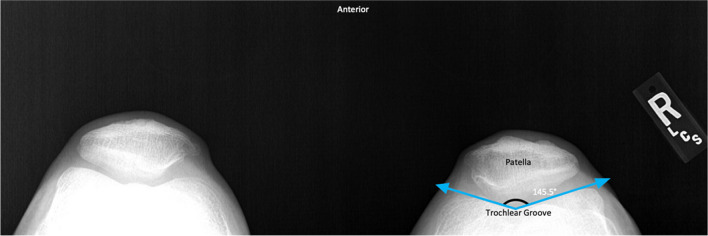
Fig. 1
Fig. 1
Sulcus Angle. Merchant view radiograph demonstrating an increased sulcus angle greater than 145° consistent with trochlear dysplasia of the right knee
Fig. 2
Fig. 2
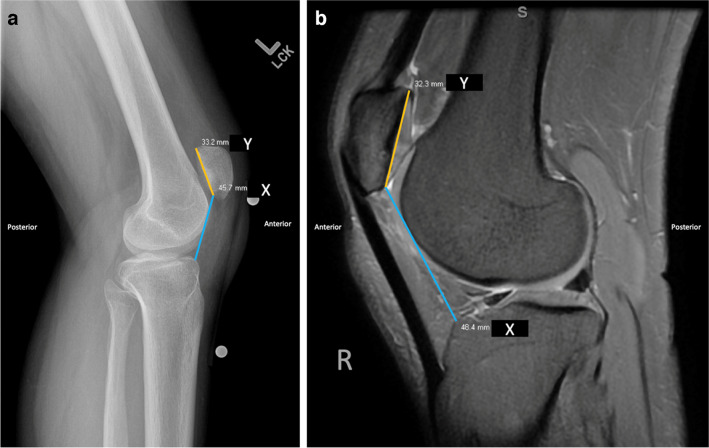
a Caton-Deschamps Index. Lateral radiograph of a left knee measuring the distance between the inferior patellar articular surface and the anterior angle of the tibial plateau (blue line) compared with the length of the patellar articular surface (yellow line). b: Caton-Deschamps Index. Sagittal T2-weighted MRI of a right knee demonstrating the Caton-Deschamps Index. A ratio (X:Y) greater than 1.2 indicates patella alta
Fig. 3
Fig. 3
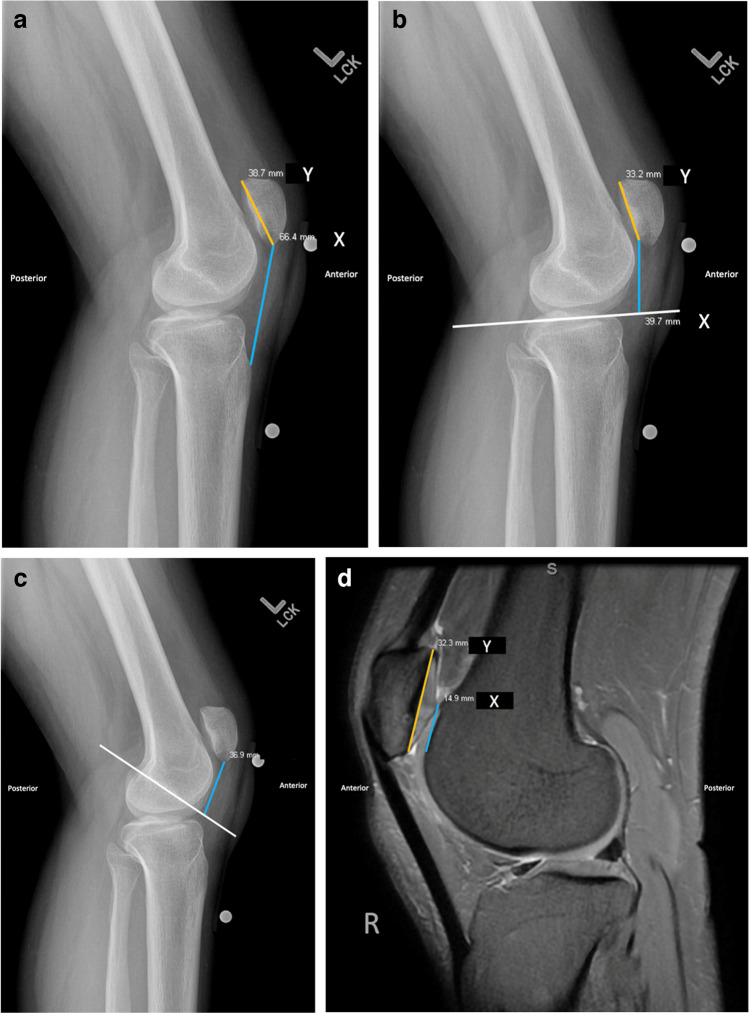
a Patellar Height Measurements. Lateral radiograph of a left knee demonstrating the Insall-Salvati Index (X:Y) by measuring the length of the patellar tendon (blue line) compared to the total patella length (yellow line). b: Patellar Height Measurements. Lateral radiograph of a left knee demonstrating the Blackburne-Peel Index (X:Y) by measuring the distance from the horizontal tibial plateau (white line) to the inferior patellar articular surface (blue line) compared to the length of the patellar articular surface (yellow line). c: Patellar Height Measurements. Lateral radiograph of a left knee demonstrating the Blumensaat Line by measuring the perpendicular distance from the intercondylar line of the femur (white line) to the inferior patella (blue line) d: Patellar Height Measurements. Sagittal T2-weighted MRI of a right knee demonstrating the patellotrochlear index by measuring the distance between the superior most trochlear cartilage to the inferior most patellar articular cartilage (blue line) compared to the length of the patellar articular surface (yellow line). A ratio (X:Y) less than 0.18 indicates patella alta
Fig. 4
Fig. 4
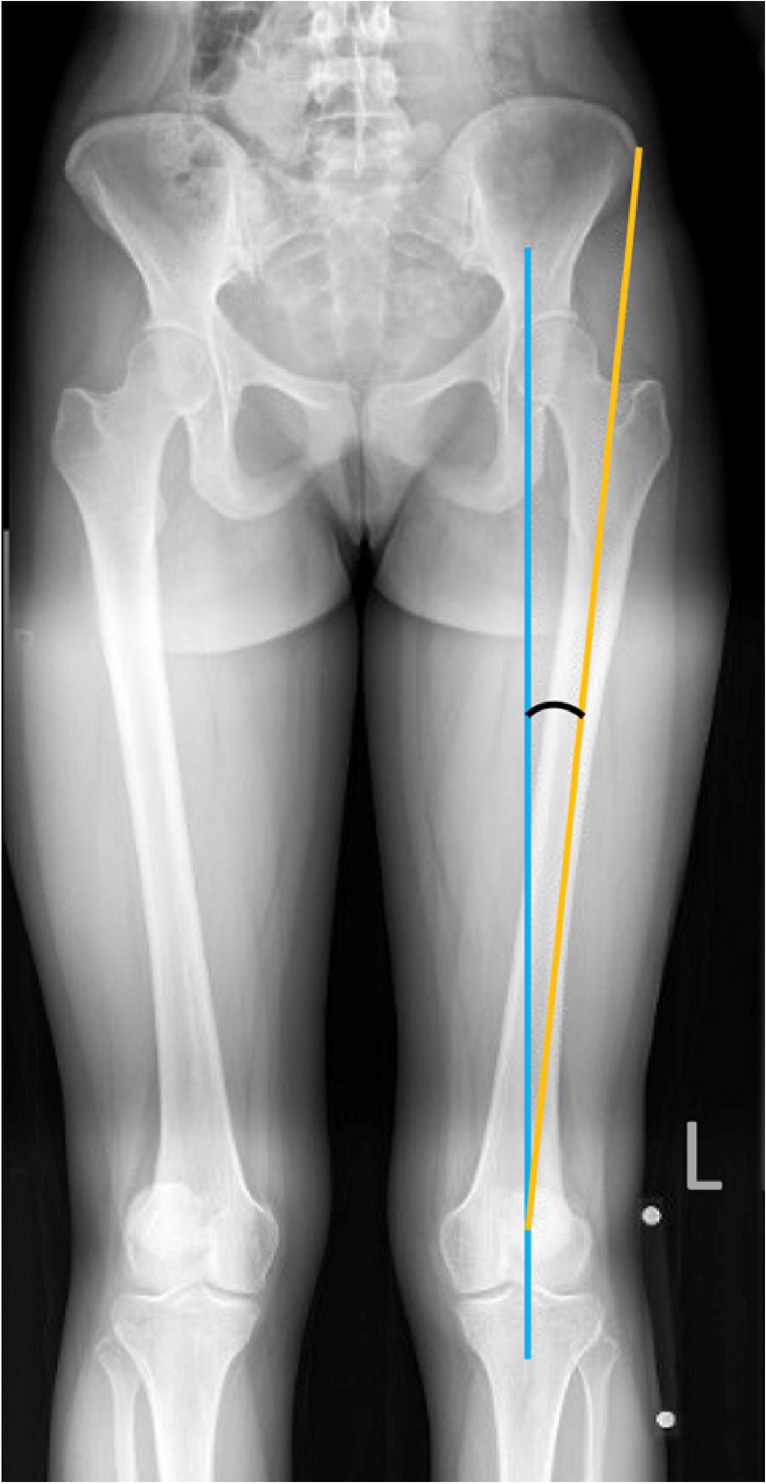
Q-Angle. AP radiograph measuring the angle between a line from the anterior superior iliac spine to the mid-patella and a vertical line connecting the center of the patella with the tibial tubercle. Normal values are between 14–16° for men and 16–18° for women
Fig. 5
Fig. 5
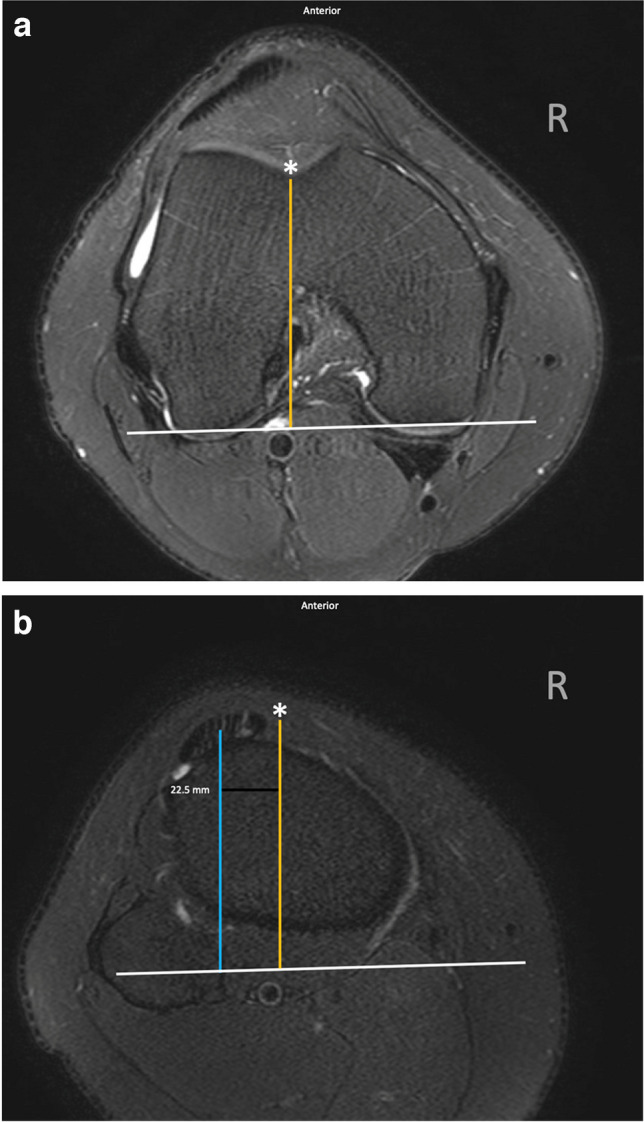
TT-TG. Axial T2-weighted MRI of a right knee demonstrating (a) the measurement between the deepest point of the trochlear groove (asterisk along the yellow line) along a line parallel to the posterior condylar axis (white line) superimposed with (b) the center of the tibial tuberosity (blue line). TT-TG values greater than 20 mm are considered abnormal
Fig. 6
Fig. 6
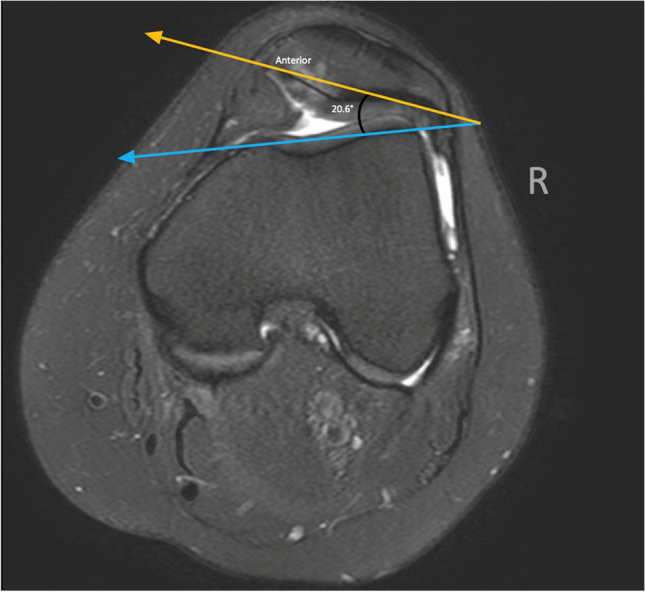
Patellar Tilt. Axial T2-weighted MRI of a right knee demonstrating lateral patellar tilt evaluated by measuring the angle between the anterior condylar line (blue line) and a line through the maximum width of the patella (yellow line). Patellar instability is often associated with a patellar tilt angle greater than 20 degrees

References

    1. Kingery MT, Bloom DA, Hoberman A, Fliegel B, Alaia MJ, Jazrawi LM, et al. Return to Work and Sport Following Tibial Tubercle Anteromedialization. Bull Hosp Jt Dis. 2022;80(4):226–9. - PubMed
    1. Belmont PJ Jr, Fisher TF, Bader JM, Lanzi JT, Owens BD, Waterman BR. Anteromedializing Tibial Tubercle Osteotomy for Patellofemoral Instability: Occupational and Functional Outcomes in U.S. Military Service Members. J Knee Surg. 2018;31(4):306–13. 10.1055/s-0037-1603639. - DOI - PubMed
    1. Rosso F, Rossi R, Cottino U, Bonasia DE. Tibial tubercle osteotomy for patellofemoral malalignment and chondral disease provided good outcomes: A systematic review. J isakos. 2022;7(2):78–86. 10.1016/j.jisako.2021.10.002. - DOI - PubMed
    1. Grawe B, Stein BE. Tibial Tubercle Osteotomy: Indication and Techniques. J Knee Surg. 2015;28(4):279–84. 10.1055/s-0035-1544973. - DOI - PubMed
    1. Burger D, Feucht M, Muench LN, Forkel P, Imhoff AB, Mehl J. Good clinical outcomes after patellar cartilage repair with no evidence for inferior results in complex cases with the need for additional patellofemoral realignment procedures: a systematic review. Knee Surg Sports Traumatol Arthrosc. 2022;30(5):1752–68. 10.1007/s00167-021-06728-z. - DOI - PMC - PubMed

LinkOut - more resources