Randomized Controlled Trial
. 2024 Aug 5;21(1):133.
doi: 10.1186/s12984-024-01430-w.

Brain modulation after exergaming training in advanced forms of Parkinson's disease: a randomized controlled study

Affiliations
Randomized Controlled Trial

Brain modulation after exergaming training in advanced forms of Parkinson's disease: a randomized controlled study

Anna Skrzatek et al. J Neuroeng Rehabil. .

Abstract

Background: Physical activity combined with virtual reality and exergaming has emerged as a new technique to improve engagement and provide clinical benefit for gait and balance disorders in people with Parkinson's disease (PD).

Objective: To investigate the effects of a training protocol using a home-based exergaming system on brain volume and resting-state functional connectivity (rs-FC) in persons with PD.

Methods: A single blind randomized controlled trial was conducted in people with PD with gait and/or balance disorders. The experimental (active) group performed 18 training sessions at home by playing a custom-designed exergame with full body movements, standing in front of a RGB-D Kinect® motion sensor, while the control group played using the computer keyboard. Both groups received the same training program. Clinical scales, gait recordings, and brain MRI were performed before and after training. We assessed the effects of both training on both the grey matter volumes (GVM) and rs-FC, within and between groups.

Results: Twenty-three patients were enrolled and randomly assigned to either the active (n = 11) or control (n = 12) training groups. Comparing pre- to post-training, the active group showed significant improvements in gait and balance disorders, with decreased rs-FC between the sensorimotor, attentional and basal ganglia networks, but with an increase between the cerebellar and basal ganglia networks. In contrast, the control group showed no significant changes, and rs-FC significantly decreased in the mesolimbic and visuospatial cerebellar and basal ganglia networks. Post-training, the rs-FC was greater in the active relative to the control group between the basal ganglia, motor cortical and cerebellar areas, and bilaterally between the insula and the inferior temporal lobe. Conversely, rs FC was lower in the active relative to the control group between the pedunculopontine nucleus and cerebellar areas, between the temporal inferior lobes and the right thalamus, between the left putamen and dorsolateral prefrontal cortex, and within the default mode network.

Conclusions: Full-body movement training using a customized exergame induced brain rs-FC changes within the sensorimotor, attentional and cerebellar networks in people with PD. Further research is needed to comprehensively understand the neurophysiological effects of such training approaches. Trial registration ClinicalTrials.gov NCT03560089.

Keywords: Brain magnetic resonance imaging; Exergaming; Gait disorders; Parkinson’s disease; Resting-state functional connectivity.


Conflict of interest statement

The authors declare that they have no known competing financial interests or personal relationships that could have appeared to influence the work reported in this paper.

Figures
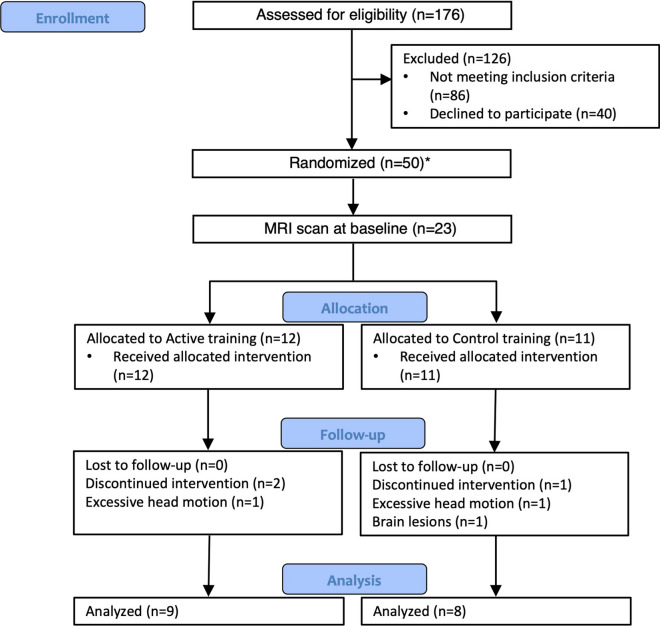
Fig. 1
Fig. 1
Study flow chart. * The Parkgame II project was carried out jointly at two hospitals: Brain and Spine Institute (Paris, France) and Radboud University Medical Centre (Nijmegen, The Netherlands). For this MRI substudy, we enrolled people with PD included at the Paris Brain Institute (France)
Fig. 2
Fig. 2
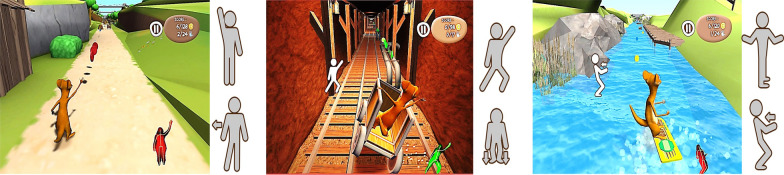
‘Toap Run’ exergaming. A ‘Toap run’ exergame. Active training involves full-body movements, performed in front of an RGB-D Kinect® motion sensor positioned approximately 2 m away from the patient. These movements encompass large-amplitude rapid movements of all four limbs, pelvis, and trunk, incorporating lateral, vertical, and forward displacements, which are schematically represented for each environment. As the patient moves, a small animal (the avatar) is simultaneously displaced in real time within three different environments: the garden (left), the mine (middle) and the river (right). The objective is for the avatar to collect coins while avoiding obstacles. In contrast, the control training patients underwent seated training, interacting by pushing buttons on the keyboard
Fig. 3
Fig. 3
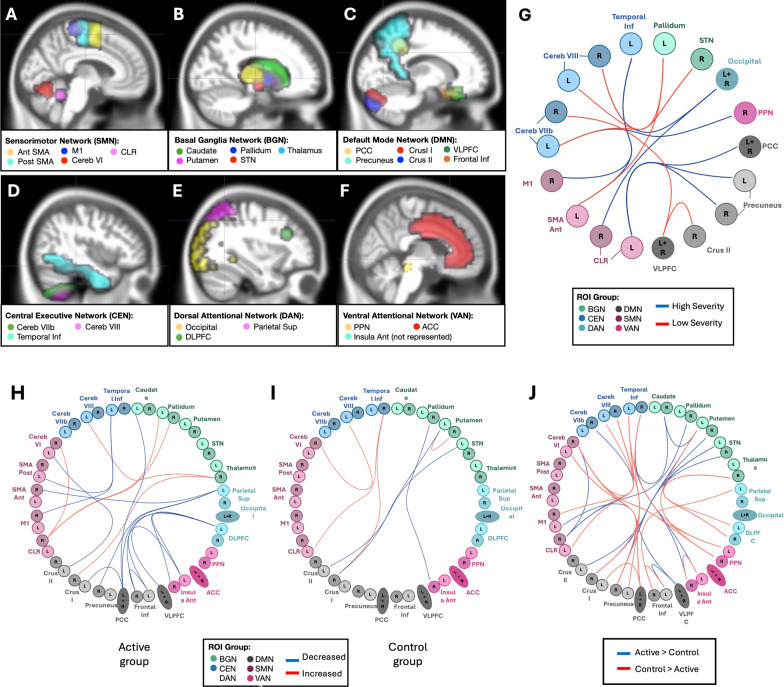
Brain resting-state functional connectivity networks, correlation with the severity of gait and balance disorders and effects of exergaming and control training. Upper Left panel: The images display the networks examined for rs-FC in people with PD before and after training. The networks included A sensorimotor, B basal ganglia, C default mode, D central executive, E dorsal attentional and F ventral attentional networks. In the images, specific regions of interest are labeled: ACC anterior cingulate cortex, CLR cerebellar locomotor region, DLPFC dorsolateral prefrontal cortex, SMA supplementary motor area, M1 primary motor cortex, PCC posterior cingulate cortex, PPN pedunculopontine nucleus, VLPFC ventrolateral prefrontal cortex. Upper Right panel: G The graph illustrates the positive (shown in red) and negative (shown in blue) correlations between the rs-FC and the first component, which reflects the severity of gait and balance disorders. Bottom panels: The graphs represent the significant changes in rs-FC after H active training and I control training. The blue lines represent decreases in rs-FC post-training, while the red lines represent increases in rs-FC. J The graph represents the differences post-training between patient groups. The blue lines represent higher rs-FC in the active group than in the control group, while the red lines represent higher rs-FC in the control group than in the active group
Fig. 4
Fig. 4
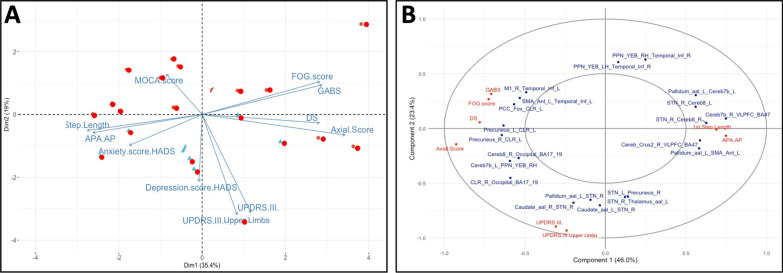
Principal components analysis. A The graph reports the results of the principal component analysis including clinical and gait recording data. This analysis revealed two principal components: the first component primarily comprises clinical and gait recording data that reflect the severity of gait and balance disorders, and the second component primarily consists of clinical data that indicate the severity of nonaxial parkinsonian symptoms, including cognition. B The graph reports the rs-FC accounting for interindividual behavioral variability along the two main components, which include clinical and gait recording data. APA. AP anteroposterior anticipatory postural adjustment, GABS Gait and Balance Scale, FOG Freezing of Gait Questionnaire, MOCA Montreal Cognitive Assessment, UPDRS III Unified Parkinson Disease Rating Scale part 3, DS Double stance, HADS Hospital Anxiety and Depression Scale

References

    1. Mirelman A, Bonato P, Camicioli R, Ellis TD, Giladi N, Hamilton JL, et al. Gait impairments in Parkinson’s disease. Lancet Neurol. 2019;18:697–708. 10.1016/S1474-4422(19)30044-4 - DOI - PubMed
    1. Nutt JG, Horak FB, Bloem BR. Milestones in gait, balance, and falling. Mov Disord. 2011;26:1166–74. 10.1002/mds.23588 - DOI - PubMed
    1. Fasano A, Aquino CC, Krauss JK, Honey CR, Bloem BR. Axial disability and deep brain stimulation in patients with Parkinson disease. Nat Rev Neurol. 2015;11:98–110. 10.1038/nrneurol.2014.252 - DOI - PubMed
    1. Bäckström D, Granåsen G, Domellöf ME, Linder J, Jakobson Mo S, Riklund K, et al. Early predictors of mortality in parkinsonism and Parkinson disease: a population-based study. Neurology. 2018;91:e2045–56. 10.1212/WNL.0000000000006576 - DOI - PMC - PubMed
    1. Kempster PA, Williams DR, Selikhova M, Holton J, Revesz T, Lees AJ. Patterns of levodopa response in Parkinson’s disease: a clinico-pathological study. Brain. 2007;130:2123–8. 10.1093/brain/awm142 - DOI - PubMed

Publication types

Associated data