


A sarcopenia screening test predicts mortality among hospitalized cancer patients
- PMID: 39104037
- PMCID: PMC11300306
- DOI: 10.14814/phy2.16173
A sarcopenia screening test predicts mortality among hospitalized cancer patients
Abstract
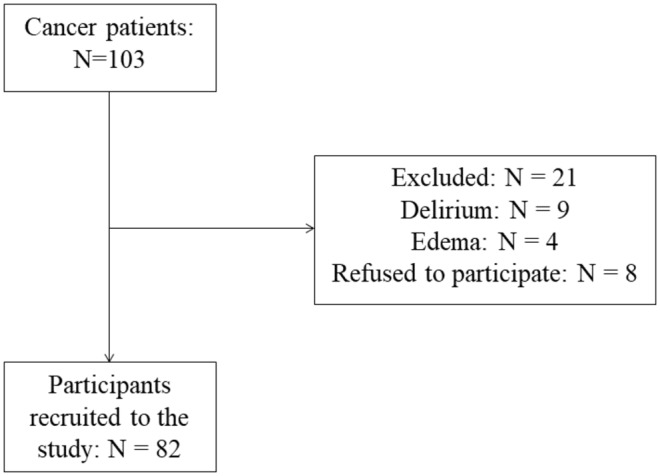
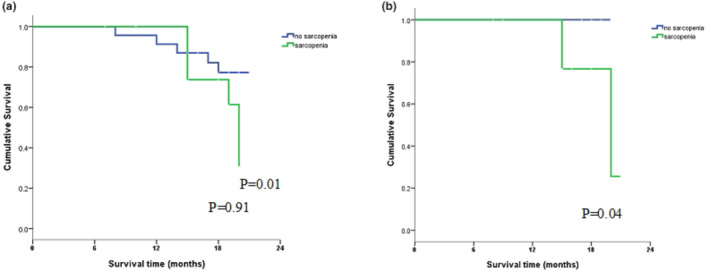
This study investigated the ability of a sarcopenia screening test to predict mortality among cancer inpatients. We conducted a prospective study of patients admitted to the oncology ward of a teaching hospital in southern Taiwan. Over a 5-month period, 82 patients were enrolled for evaluation and were followed for 3 years. All participants received a comprehensive assessment at the time of admission, including Eastern Cooperative Oncology Group (ECOG) performance status, cognitive ability, nutrition index, body mass index, and short physical performance battery (SPPB). Age, ECOG performance status, dementia, SPPB score, and albumin level were associated with sarcopenia. Of the enrolled participants, 53 (64.6%) were diagnosed with sarcopenia. Patients with sarcopenia were associated with worse overall survival (OS) than patients without sarcopenia (28.8% vs. 82%, p = 0.01). Metastasis (hazard ratio [HR]: 5.166; 95% confidence interval [CI]: 1.358-19.656) and albumin level (HR: 4.346; 95% CI: 1.493-12.654) were independent and significant predictors of OS for the whole study population. Age was a predictor of 2-year all-cause mortality among patients aged ≥65 years but not among those aged <65 years (OS: 25.6% vs. 100%, p = 0.04). To summarize, the sarcopenia screening results were found to predict OS and all-cause mortality and may be helpful for patient stratification during in-hospital care.
Keywords: cancer; hospitalization; mortality; prediction; sarcopenia; screening.
© 2024 The Author(s). Physiological Reports published by Wiley Periodicals LLC on behalf of The Physiological Society and the American Physiological Society.
Conflict of interest statement
The authors declare that the research reported here was conducted in the absence of any commercial or financial relationships that could be construed as a potential conflict of interest.
Figures

References
-
- Cerri, A. P. , Bellelli, G. , Mazzone, A. , Pittella, F. , Landi, F. , Zambon, A. , & Annoni, G. (2015). Sarcopenia and malnutrition in acutely ill hospitalized elderly: Prevalence and outcomes. Clinical Nutrition, 34(4), 745–751. - PubMed
-
- Chen, L. K. , Woo, J. , Assantachai, P. , Auyeung, T. W. , Chou, M. Y. , Iijima, K. , Jang, H. C. , Kang, L. , Kim, M. , Kim, S. , Kojima, T. , Kuzuya, M. , Lee, J. S. W. , Lee, S. Y. , Lee, W. J. , Lee, Y. , Liang, C. K. , Lim, J. Y. , Lim, W. S. , … Arai, H. (2020). Asian working Group for Sarcopenia: 2019 consensus update on sarcopenia diagnosis and treatment. Journal of the American Medical Directors Association, 21(3), 300–307.e2. - PubMed
-
- Cruz‐Jentoft, A. J. , Baeyens, J. P. , Bauer, J. M. , Boirie, Y. , Cederholm, T. , Landi, F. , Martin, F. C. , Michel, J. P. , Rolland, Y. , Schneider, S. M. , Topinková, E. , Vandewoude, M. , Zamboni, M. , & European Working Group on Sarcopenia in Older People . (2010). Sarcopenia: European consensus on definition and diagnosis: Report of the European working group on sarcopenia in older people. Age and Ageing, 39(4), 412–423. - PMC - PubMed
MeSH terms
Grants and funding
LinkOut - more resources
Full Text Sources
Medical
