. 2024 Aug 6;73(10):195.
doi: 10.1007/s00262-024-03778-3.

Conversion of anti-tissue factor antibody sequences to chimeric antigen receptor and bi-specific T-cell engager format

Affiliations

Conversion of anti-tissue factor antibody sequences to chimeric antigen receptor and bi-specific T-cell engager format

S C Saunderson et al. Cancer Immunol Immunother. .

Abstract

Background: The efficacy of antibody-targeted therapy of solid cancers is limited by the lack of consistent tumour-associated antigen expression. However, tumour-associated antigens shared with non-malignant cells may still be targeted using conditionally activated-antibodies, or by chimeric antigen receptor (CAR) T cells or CAR NK cells activated either by the tumour microenvironment or following 'unlocking' via multiple antigen-recognition. In this study, we have focused on tissue factor (TF; CD142), a type I membrane protein present on a range of solid tumours as a basis for future development of conditionally-activated BiTE or CAR T cells. TF is frequently upregulated on multiple solid tumours providing a selective advantage for growth, immune evasion and metastasis, as well as contributing to the pathology of thrombosis via the extrinsic coagulation pathway.

Methods: Two well-characterised anti-TF monoclonal antibodies (mAb) were cloned into expression or transposon vectors to produce single chain (scFv) BiTE for assessment as CAR and CD28-CD3-based CAR or CD3-based BiTE. The affinities of both scFv formats for TF were determined by surface plasmon resonance. Jurkat cell line-based assays were used to confirm the activity of the BiTE or CAR constructs.

Results: The anti-TF mAb hATR-5 and TF8-5G9 mAb were shown to maintain their nanomolar affinities following conversion into a single chain (scFv) format and could be utilised as CD28-CD3-based CAR or CD3-based BiTE format.

Conclusion: Because of the broad expression of TF on a range of solid cancers, anti-TF antibody formats provide a useful addition for the development of conditionally activated biologics for antibody and cellular-based therapy.

Keywords: Bi-specific T cell engager; Chimeric antigen receptor; Surface plasmon resonance; Tissue factor.


Conflict of interest statement

The authors declare no conflict of interests.

Figures
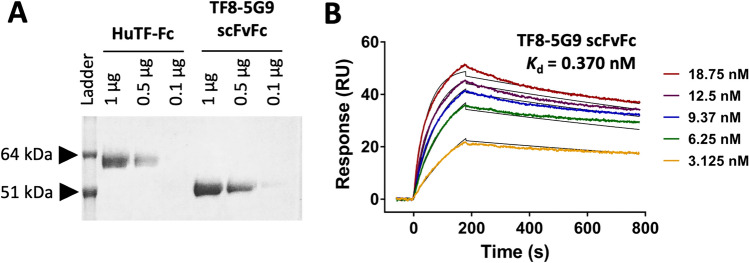
Fig. 1
Fig. 1
TF8-5G9 anti-TF scFvFc binding affinity for human TF-Fc. Expi293F cells were transfected with pcDNA3.1(-) plasmids containing either TF8-5G9 scFvFc or human TF-Fc. Cell culture supernatant was harvested and Fc fusion protein purified via Protein A affinity chromatography column, followed by size exclusion chromatography. A TF8-5G9 anti-TF scFvFc and human TF-Fc (boiled and reduced; 1000, 500 and 100 ng) were run on an SDS-PAGE gel and Coomassie blue stained. Gel result representative of two independent Fc-fusion protein preparations. B Purified human TF-Fc antigen was immobilised by amine-coupling to CM5 Biacore sensor chips. A titration of purified TF8-5G9 scFvFc was allowed to bind for a contact time of 180 s at a flow rate of 30 µL/min, followed by a dissociation time of 600 s with a Biacore X100 SPR machine at pH 7.4. Titration curves in descending order: 18.75, 12.5, 9.375, 6.25 and 3.125 nM. SPR results representative of two repeats
Fig. 2
Fig. 2
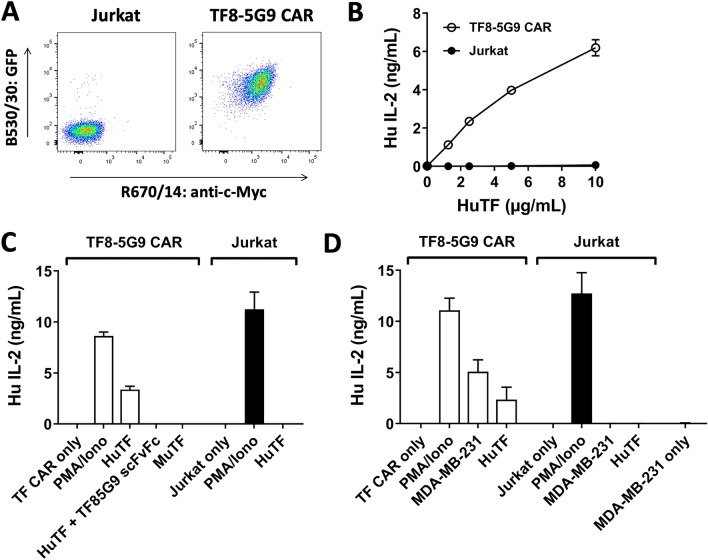
TF8-5G9 anti-TF CAR is specifically activated by human TF in vitro. A TF8-5G9 CAR-T or untransfected Jurkat cells were analysed for c-Myc and GFP expression by flow cytometry. IL-2 release from TF8-5G9 CAR-T or untransfected Jurkat was measured by ELISA following incubation for 24 h with B a titration of solid phase human TF, C negative controls nil antigen, murine TF or competitive inhibition with TF8-5G9 scFvFc, or D TF-expressing MDA-MB-231 cells, where stated positive controls PMA/ionomycin or 2.5 µg/mL solid phase human TF were included. Results representative of three independent repeats, B a single pilot experiment where points indicate mean ± SD of triplicate wells, and C and D bars indicate mean with SD error bars of three pooled independent experiments
Fig. 3
Fig. 3
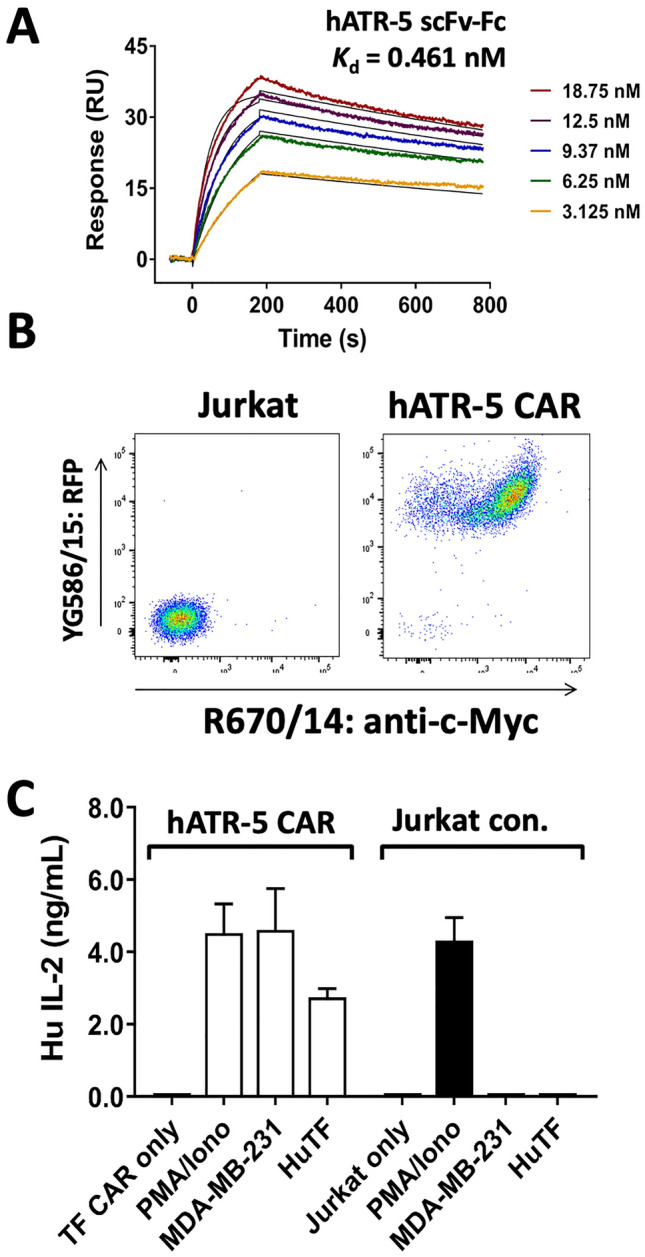
hATR-5 anti-TF CAR targets TF-expressing tumour cell line in vitro. A Purified human TF-Fc antigen was immobilised by amine-coupling to CM5 Biacore sensor chips. A titration of purified hATR-5 scFvFc was allowed to bind for a contact time of 180 s at a flow rate of 30 µL/min, followed by a dissociation time of 600 s with a Biacore X100 SPR machine at pH 7.4. Titration curves in descending order: 18.75, 12.5, 9.375, 6.25 and 3.125 nM. SPR results representative of two repeats. B hATR CAR-T or untransfected Jurkat cells were analysed for c-Myc and RFP expression by flow cytometry. C IL-2 release from hATR-5 CAR-T or untransfected Jurkat was measured by ELISA following incubation for 24 h with TF-expressing MDA-MB-231 cells, 2.5 μg/mL solid phase human TF, cell only controls or positive control PMA/ionomycin. Results representative of two independent experiments. Bar indicates mean with SD error bars
Fig. 4
Fig. 4
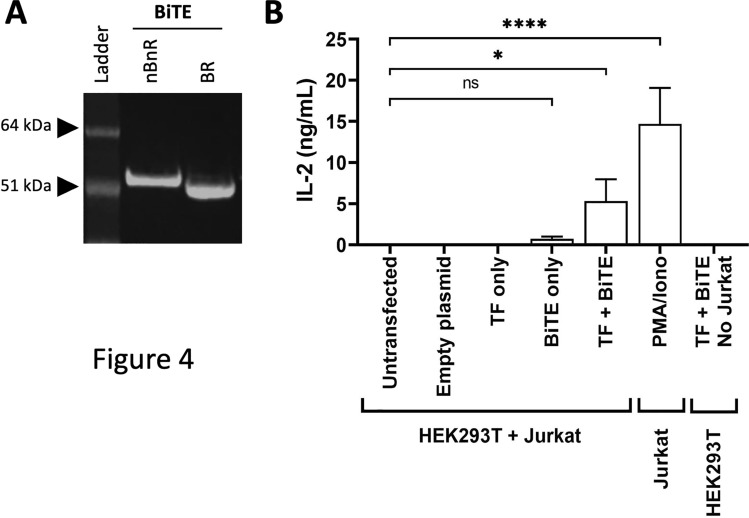
Anti-TF-anti-CD3 BiTE activates T cells in the presence of TF-expressing cells in vitro. A Expi293F cells were transfected with pSBbi-GP plasmid containing OKT3-TF85G9 BiTE. His-tagged protein was purified from cell culture supernatant via a Nickel-NTA column. OKT3-TF85G9 BiTE protein either not boiled/not reduced (nBnR) or boiled/reduced (BR) were run on an SDS-PAGE gel and Coomassie blue stained. Gel representative of at least two preparations. B HEK293T cells were transiently transfected or co-transfected with plasmids containing either human TF, anti-TF-anti-CD3 BiTE, or an empty vector as stated. At 16 h post-transfection, Jurkat T cells were added and further incubated for 24 h before IL-2 release was analysed by ELISA. Untransfected HEK293T with Jurkat cells or co-transfected TF/BiTE without Jurkat cells were used as additional negative controls, and PMA/ionomycin as a positive control. Bar indicates mean with SD error bars of three pooled independent experiments. One-way ANOVA with Bonferroni post-correction test performed: ns = not significant; * P < 0.05; **** P < 0.0001

References

    1. White LG, Goy HE, Rose AJ, McLellan AD (2022) Controlling cell trafficking: addressing failures in CAR T and NK cell therapy of solid tumours. Cancers 14:978. 10.3390/cancers14040978 10.3390/cancers14040978 - DOI - PMC - PubMed
    1. Flugel CL, Majzner RG, Krenciute G et al (2023) Overcoming on-target, off-tumour toxicity of CAR T cell therapy for solid tumours. Nat Rev Clin Oncol 20:49–62. 10.1038/s41571-022-00704-3 10.1038/s41571-022-00704-3 - DOI - PMC - PubMed
    1. Bailey SR, Berger TR, Graham C et al (2023) Four challenges to CAR T cells breaking the glass ceiling. Eur J Immunol 53:1–8. 10.1002/eji.20225003910.1002/eji.202250039 - DOI - PubMed
    1. Morgan RA, Yang JC, Kitano M et al (2010) Case report of a serious adverse event following the administration of T cells transduced with a chimeric antigen receptor recognizing ERBB2. Mol Ther 18:843–851. 10.1038/mt.2010.24 10.1038/mt.2010.24 - DOI - PMC - PubMed
    1. Li J, Li W, Huang K et al (2018) Chimeric antigen receptor T cell (CAR-T) immunotherapy for solid tumors: lessons learned and strategies for moving forward. J Hematol Oncol 11:22. 10.1186/s13045-018-0568-6 10.1186/s13045-018-0568-6 - DOI - PMC - PubMed

MeSH terms

LinkOut - more resources