


Mitigating disuse-induced skeletal muscle atrophy in ageing: Resistance exercise as a critical countermeasure
- PMID: 39106083
- PMCID: PMC11442788
- DOI: 10.1113/EP091937
Mitigating disuse-induced skeletal muscle atrophy in ageing: Resistance exercise as a critical countermeasure
Abstract
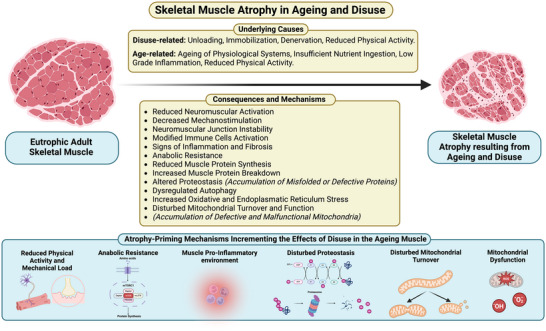
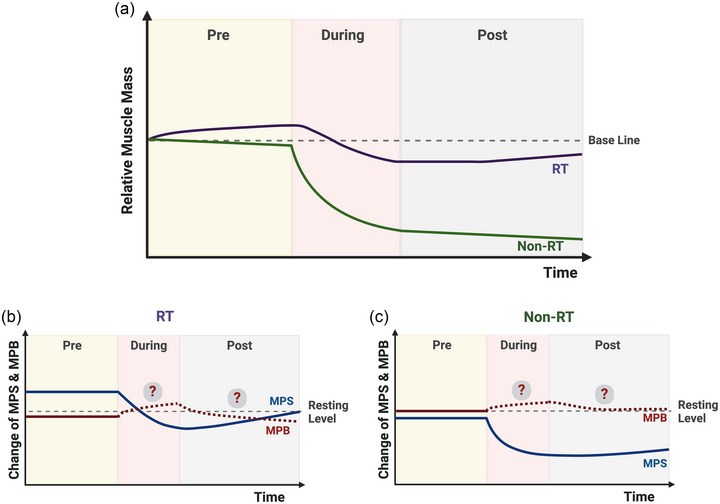
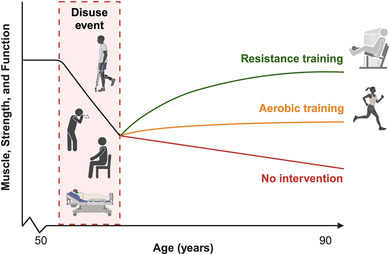
The gradual deterioration of physiological systems with ageing makes it difficult to maintain skeletal muscle mass (sarcopenia), at least partly due to the presence of 'anabolic resistance', resulting in muscle loss. Sarcopenia can be transiently but markedly accelerated through periods of muscle disuse-induced (i.e., unloading) atrophy due to reduced physical activity, sickness, immobilisation or hospitalisation. Periods of disuse are detrimental to older adults' overall quality of life and substantially increase their risk of falls, physical and social dependence, and early mortality. Disuse events induce skeletal muscle atrophy through various mechanisms, including anabolic resistance, inflammation, disturbed proteostasis and mitochondrial dysfunction, all of which tip the scales in favour of a negative net protein balance and subsequent muscle loss. Concerningly, recovery from disuse atrophy is more difficult for older adults than their younger counterparts. Resistance training (RT) is a potent anabolic stimulus that can robustly stimulate muscle protein synthesis and mitigate muscle losses in older adults when implemented before, during and following unloading. RT may take the form of traditional weightlifting-focused RT, bodyweight training and lower- and higher-load RT. When combined with sufficient dietary protein, RT can accelerate older adults' recovery from a disuse event, mitigate frailty and improve mobility; however, few older adults regularly participate in RT. A feasible and practical approach to improving the accessibility and acceptability of RT is through the use of resistance bands. Moving forward, RT must be prescribed to older adults to mitigate the negative consequences of disuse atrophy.
Keywords: anabolism; catabolism; muscle unloading; physical activity; sarcopenia.
© 2024 The Author(s). Experimental Physiology published by John Wiley & Sons Ltd on behalf of The Physiological Society.
Conflict of interest statement
J.M., G.C., E.A.N and C.L. declare no conflicts of interest. S.M.P. reports grants or research contracts from the US National Dairy Council, Canadian Institutes for Health Research, Cargill, Friesland Campina, Dairy Farmers of Canada, Roquette Freres, Ontario Centre of Innovation, Nestle Health Sciences, Myos, National Science and Engineering Research Council, and the US NIH during the conduct of the study; personal fees from Nestle Health Sciences, non‐financial support from Enhanced Recovery, outside the submitted work. S.M.P. has patents licensed to Exerkine but reports no financial gains from patents or related work.
Figures
References
-
- Abou Sawan, S. , Nunes, E. A. , Lim, C. , McKendry, J. , & Phillips, S. M. (2023). The health benefits of resistance exercise: Beyond hypertrophy and big weights. Exercise, Sport, and Movement, 1(1), e00001.
-
- Allen, S. K. , Brown, V. , White, D. , King, D. , Hunt, J. , Wainwright, J. , Emery, A. , Hodge, E. , Kehinde, A. , Prabhu, P. , Rockall, T. A. , Preston, S. R. , & Sultan, J. (2022). Multimodal Prehabilitation during neoadjuvant therapy prior to esophagogastric cancer resection: Effect on cardiopulmonary exercise test performance, muscle mass and quality of life‐a pilot randomized clinical trial. Annals of Surgical Oncology, 29(3), 1839–1850. - PubMed
-
- Andreux, P. A. , Blanco‐Bose, W. , Ryu, D. , Burdet, F. , Ibberson, M. , Aebischer, P. , Auwerx, J. , Singh, A. , & Rinsch, C. (2019). The mitophagy activator urolithin A is safe and induces a molecular signature of improved mitochondrial and cellular health in humans. Nature Metabolism, 1(6), 595–603. - PubMed
-
- Arc‐Chagnaud, C. , Py, G. , Fovet, T. , Roumanille, R. , Demangel, R. , Pagano, A. F. , Delobel, P. , Blanc, S. , Jasmin, B. J. , Blottner, D. , Salanova, M. , Gomez‐Cabrera, M. C. , Viña, J. , Brioche, T. , & Chopard, A. (2020). Evaluation of an antioxidant and anti‐inflammatory cocktail against human hypoactivity‐induced skeletal muscle deconditioning. Frontiers in Physiology, 11, 71. - PMC - PubMed
Publication types
MeSH terms
Grants and funding
LinkOut - more resources
Full Text Sources
Medical
