


Complex Sequence-Defined Heteropolymers Enable Controlled Film Growth in Layer-By-Layer Assembly
- PMID: 39108056
- PMCID: PMC11583292
- DOI: 10.1002/marc.202400482
Complex Sequence-Defined Heteropolymers Enable Controlled Film Growth in Layer-By-Layer Assembly
Abstract
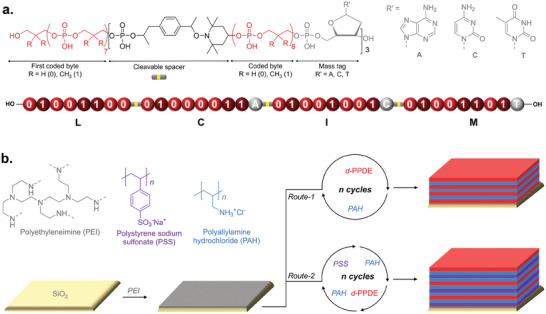
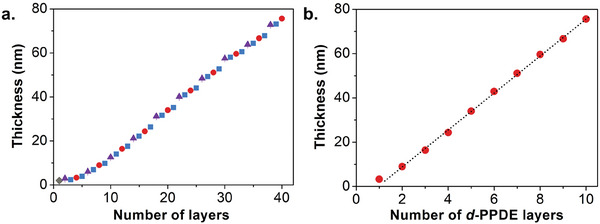
Digitally-encoded poly(phosphodiesters) (d-PPDE) with highly complex primary structures are evaluated for layer-by-layer (LbL) assembly. To be easily decoded by mass spectrometry (MS), these digital polymers contain many different monomers: 2 coding units allowing binary encryption, 1 cleavable spacer allowing controlled MS fragmentation, and 3 mass tags allowing fragment identification. These complex heteropolymers are therefore composed of 6 different motifs. Despite this strong sequence heterogeneity, it is found that they enable a highly controlled LbL film formation. For instance, a regular growth is observed when alternating the deposition of negatively-charged d-PPDE and positively-charged poly(allyl amine hydrochloride) (PAH). Yet, in this approach, the interdistance between consecutive coded d-PPDE layers remains relatively small, which may be an issue for data storage applications, especially for the selective decoding of the stored information. Using poly(sodium 4-styrene sulfonate) (PSS) as an intermediate non-coded polyanion, it is shown that a controlled interdistance between d-PPDE layers can be easily achieved, while still maintaining a regular LbL growth. Last but not least, it is found in this work that d-PPDE of relatively small molecular weight (i.e., significantly smaller than those of PAH and PSS) still enables a controlled LbL assembly.
Keywords: data storage; digital polymers; layer‐by‐layer assembly; sequence‐controlled polymers; thin films.
© 2024 The Author(s). Macromolecular Rapid Communications published by Wiley‐VCH GmbH.
Conflict of interest statement
The authors declare no conflict of interest.
Figures
References
MeSH terms
Substances
Grants and funding
LinkOut - more resources
Full Text Sources
