[Preprint]. 2024 Jul 25:rs.3.rs-4559624.
doi: 10.21203/rs.3.rs-4559624/v1.

Relationships between tryptophan-related gut metabolites, brain activity, and autism symptomatology

Affiliations

Relationships between tryptophan-related gut metabolites, brain activity, and autism symptomatology

Lisa Aziz-Zadeh et al. Res Sq. .

Update in

Abstract

Gut microbial metabolites have been theorized to play a causative role in the pathophysiology of autism spectrum disorder (ASD). This hypothesis is based on results from mechanistic preclinical studies and several correlational studies showing differences in gut microbial composition between ASD subjects and neurotypical (NT) controls. However, alterations in how the human brain interacts with the gut microbiome in ASD have not been examined. In this cross-sectional, case-control observational study, fecal metabolomics, task-based functional magnetic resonance imaging (fMRI), and behavioral assessments were obtained from 43 ASD and 41 NT children aged 8-17. The fMRI tasks were based on socio-emotional and sensory paradigms that commonly show strong evoked brain differences in ASD participants. General linear models and mediational modeling were applied to examine the links between tryptophan metabolism and evoked brain activity and behavior. Results indicated that fecal levels of specific tryptophan-related metabolites were associated with: 1) brain activity atypicalities in regions previously implicated in ASD (i.e., insula and cingulate); and 2) ASD severity and symptomatology (i.e., ADOS scores, disgust propensity, and sensory sensitivities). Importantly, activity in the mid-insula and mid-cingulate significantly mediated relationships between the microbial tryptophan metabolites, indolelactate and tryptophan betaine, and ASD severity and disgust sensitivity. To our knowledge, this is the first study to elucidate how interactions between gut metabolites and brain activity may impact autism symptomatology, particularly in functional brain pathways associated with vagal and interoceptive/emotion processing.


Figures
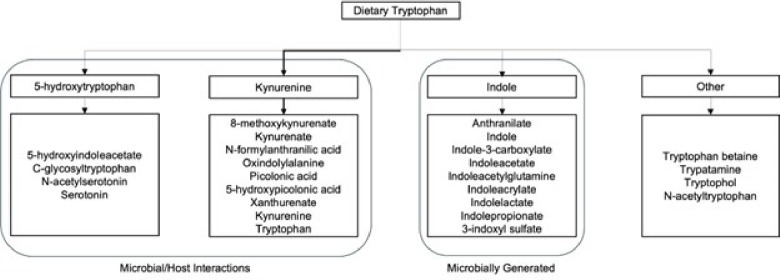
Figure 1
Figure 1
Metabolites within the tryptophan pathway Note. Arrow thickness represents the strength of the pathway under normal conditions.
Figure 2
Figure 2
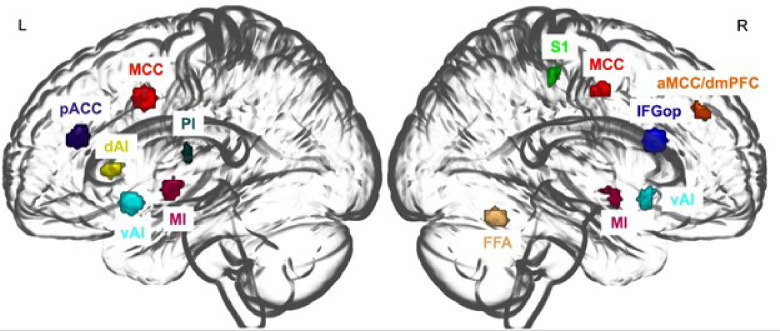
Regions of Interest (ROIs) based on between-group differences in fMRI tasks Note. See Supplemental Table 3 for peak MNI coordinates for each ROI. While our predominant focus was on subregions of the insula and cingulate due to their involvement in interoceptive and emotional processing, we additionally considered other ROIs with significant ASD vs. TD differences in our fMRI tasks and from prior ASD studies. Please see Methods for how ROIs were selected. R: Right; L: Left; Insular subregions (dAI: left dorsal anterior insula; vAI: ventral anterior insula; MI: mid-insula; PI: posterior insula); Cingulate subregions (pACC: pregenual anterior cingulate cortex; MCC: mid-cingulate cortex; aMCC/dmPFC:anterior mid-cingulate cortex/ dorsal medial prefrontal corte); IFGop: inferior frontal gyrus, pars opercularis; S1: primary somatosensory cortex.
Figure 3
Figure 3
Significant mediation models in the ASD group. Note. Mediation models within the ASD group, with the brain as the mediator between specific metabolites and behavior. For each mediation model, the figure contains the standardized beta and standard error: Std. β (SE) for direct effects. The indirect effect between the metabolite and behavior is listed below the arrow in brackets. A: Right mid-insula: disgusting foods vs. rest, indolelactate, and ADOS RRB. B: Right mid-insula: disgusting foods vs rest, indolelactate, and ADOS total score. C: Left mid-cingulate: non-emotional faces vs rest, tryptophan betaine, and disgust sensitivity, ADOS: Autism Diagnosis Observation Schedule; ADI-R: Autism Diagnostic Interview-Revised; RRB: Restricted and Repetitive Behaviors; DPSS-R: Disgust Propensity and Sensitivity Scale - Revised; r_MI: right mid-insula; l_ MCC: mid-cingulate cortex.

References

    1. Rojo D, Méndez-García C, Raczkowska BA, et al. Exploring the human microbiome from multiple perspectives: factors altering its composition and function. FEMS microbiology reviews. 2017;41(4):453–478. doi: 10.1093/femsre/fuw046 - DOI - PMC - PubMed
    1. Miri S, Yeo J, Abubaker S, Hammami R. Neuromicrobiology, an emerging neurometabolic facet of the gut microbiome? Frontiers in microbiology. 2023;14:1098412–1098412. doi: 10.3389/fmicb.2023.1098412 - DOI - PMC - PubMed
    1. Alharthi A, Alhazmi S, Alburae N, Bahieldin A. The Human Gut Microbiome as a Potential Factor in Autism Spectrum Disorder. International journal of molecular sciences. 2022;23(3):1363. doi: 10.3390/ijms23031363 - DOI - PMC - PubMed
    1. Forsythe P, Bienenstock J, Kunze WA. Vagal Pathways for Microbiome-Brain-Gut Axis Communication. Advances in experimental medicine and biology. 2014;817:115–133. doi: 10.1007/978-1-4939-0897-4_5 - DOI - PubMed
    1. Chernikova MA, Flores GD, Kilroy E, Labus JS, Mayer EA, Aziz-Zadeh L. The brain-gut-microbiome system: Pathways and implications for autism spectrum disorder. Nutrients. 2021;13(12):4497. doi: 10.3390/nu13124497 - DOI - PMC - PubMed

Publication types

LinkOut - more resources