


Investigate-Design-Practice-Reflect: An Iterative Community-Engaged Action Process to Improve Population Health
- PMID: 39110360
- PMCID: PMC11413050
- DOI: 10.1007/s10900-024-01385-y
Investigate-Design-Practice-Reflect: An Iterative Community-Engaged Action Process to Improve Population Health
Abstract
Background: Community-based coalitions are a common strategy for community engagement efforts targeting the improvement of a variety of population health outcomes. The typical processes that coalitions follow to organize efforts include steps that are sequential, slow, and time intensive. These processes also limit local decision-making to the selection of evidence-based policies or programs.
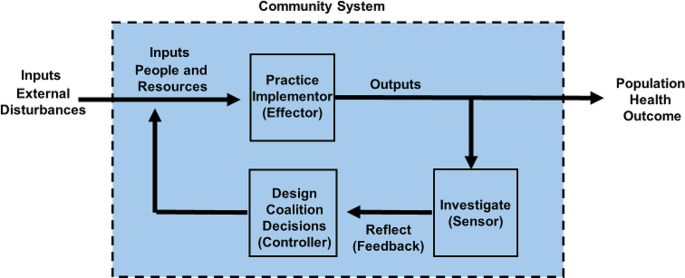
Methods: We present a process control theory-based Community Action Process, Investigate-Design-Practice-Reflect (IDPR), where community hubs (i.e., coalitions) organize agile efforts in a non-sequential, rapid, and efficient manner to harness local assets and data to make decisions regarding the provision and production of population health services. Using qualitative methods, we illustrate and analyze the use of IDPR in a one community case study as part of Wellscapes, a Type 3-hybrid implementation-effectiveness community randomized controlled trial to improve children's population health physical activity.
Results: We found community members followed the IDPR Community Action Process to rapidly design, organize, deliver, and receive feedback on a community-based, children's population physical activity prototype, an afterschool Play-in-the-Park opportunity for all children.
Discussion: Following IDPR afforded the community coalition timely learning through feedback within a process that coordinated decisions regarding what community services met community needs (provision decisions) and how to organize the production of the population health services (production decisions).
Keywords: Coalitions; Community Action; Community Engagement; Cross-sector Collaboration; Quality Improvement.
© 2024. The Author(s).
Conflict of interest statement
The authors have no relevant financial or non-financial interests to disclose.
Figures
References
-
- CTSA Community Engagement Key Function Committee Task Force. (2011). Principles of Community Engagement (2nd ed., Vol. 197p.). National Institutes of Health & Centers for Disease Control and Prevention.
-
- Wallerstein, N., Duran, B., Oetzel, J. G., & Minkler, M. (2018). Community-based participatory research for health
-
- Minkler, M. (2004). Community organizing and community building for health and welfare (2nd ed.). Rutgers University Press. 10.36019/9780813553146
MeSH terms
Grants and funding
LinkOut - more resources
Full Text Sources
Miscellaneous
