. 2024 Aug 13;121(33):e2407400121.
doi: 10.1073/pnas.2407400121. Epub 2024 Aug 7.

Role of RNA structural plasticity in modulating HIV-1 genome packaging and translation

Affiliations

Role of RNA structural plasticity in modulating HIV-1 genome packaging and translation

Saif Yasin et al. Proc Natl Acad Sci U S A. .

Abstract

HIV-1 transcript function is controlled in part by twinned transcriptional start site usage, where 5' capped RNAs beginning with a single guanosine (1G) are preferentially packaged into progeny virions as genomic RNA (gRNA) whereas those beginning with three sequential guanosines (3G) are retained in cells as mRNAs. In 3G transcripts, one of the additional guanosines base pairs with a cytosine located within a conserved 5' polyA element, resulting in formation of an extended 5' polyA structure as opposed to the hairpin structure formed in 1G RNAs. To understand how this remodeling influences overall transcript function, we applied in vitro biophysical studies with in-cell genome packaging and competitive translation assays to native and 5' polyA mutant transcripts generated with promoters that differentially produce 1G or 3G RNAs. We identified mutations that stabilize the 5' polyA hairpin structure in 3G RNAs, which promote RNA dimerization and Gag binding without sequestering the 5' cap. None of these 3G transcripts were competitively packaged, confirming that cap exposure is a dominant negative determinant of viral genome packaging. For all RNAs examined, conformations that favored 5' cap exposure were both poorly packaged and more efficiently translated than those that favored 5' cap sequestration. We propose that structural plasticity of 5' polyA and other conserved RNA elements place the 5' leader on a thermodynamic tipping point for low-energetic (~3 kcal/mol) control of global transcript structure and function.

Keywords: HIV-1; dimerization; packaging; polyA; translation.


Conflict of interest statement

Competing interests statement:The authors declare no competing interest.

Figures
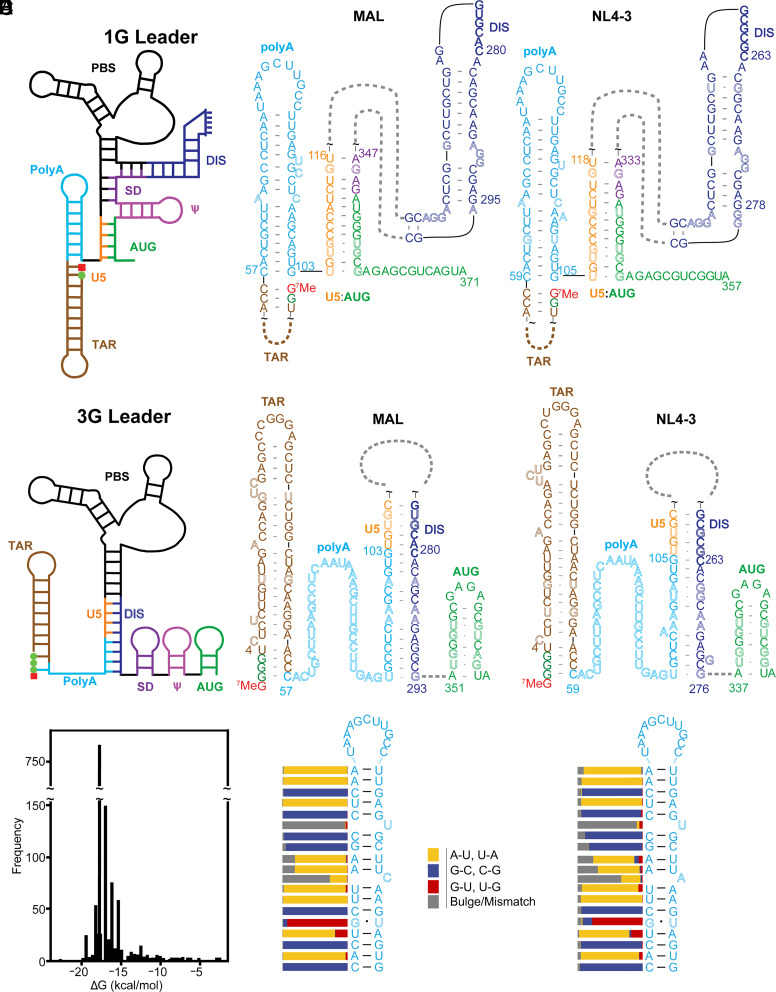
Fig. 1.
Fig. 1.
Conserved HIV-1 5′ polyA element forms hairpin and extended structures in 1G (A) and 3G (B) 5′ leader RNAs, respectively. (A and B) Folding cartoon (Left) and regions of NMR-derived secondary structures of 1G (A) and 3G (B) of HIV-1MAL and HIV-1NL4-3 leader RNAs. Base pairings between U5 and DIS of the HIV-1NL4-3 leader were detected by NMR (18) and the DIS-polyA base pairs were inferred from the MAL structure (9). Residue colors denote different secondary structure elements; noncanonical base pairs and bulges are shown in outlined fonts; green dots and red squares denote guanosines and 5' cap residues, respectively. (C) Histogram of 5′ polyA hairpin free energies showing a narrow distribution about −17.0 kcal/mol. (D) Consensus 5′ polyA secondary structure identified by locARNA (–21) showing the locations of conserved bulges across all 5′ polyA hairpins identified. (E) Consensus secondary structure and conserved bulge locations for the 186 unique 5′ polyA hairpins identified. Bars denote % conservation at each position.
Fig. 2.
Fig. 2.
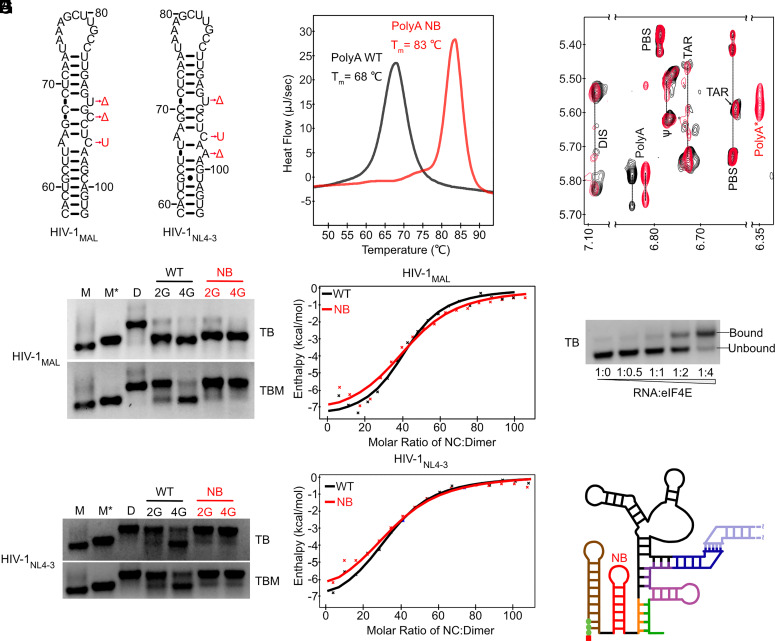
polyANB-modified 3G RNAs form cap-exposed dimers. (A) NMR-derived 5′ polyA secondary structures [HIV-1MAL (9) and HIV-1NL4-3 (12)] and polyA-stabilizing mutations (polyANB; Δ = deletion, U = uracil substitution. (B) Increased melting temperature of the HIV-1MAL polyANB hairpin (+15 °C; measured by DSC). (C and D) In vitro dimerization assays for wild-type (WT) and polyANB-mutated (NB) HIV-1MAL and HIV-1NL4-3 leader RNAs performed with (TBM) and without (TB) 0.2 mM MgCl2 in the gel and running buffer. Controls showing the monomer (M), monomer in dimeric conformation (M*) (9), and dimer (D) bands. (E and F) HIV-1MAL (E) and HIVNL4-3 (F) leader RNAs exhibit similar NC binding properties by ITC. (G) Regions of NOESY spectra obtained for HIV-1MAL-2G (black) and HIV-1MAL 4G polyANB (red) leader RNAs prepared with nucleotide-specific 2H-labeling (A2GrUr; protons only at adenosine C-2 and ribose and guanosine/uridine ribose positions). Assignments are from ref. . polyA* denotes shifted signal due to polyANB mutations. (H and I) Dimeric HIV-1MAL Cap3G polyANB binds eIF4E (H), consistent with an exposed 5′ cap (I).
Fig. 3.
Fig. 3.
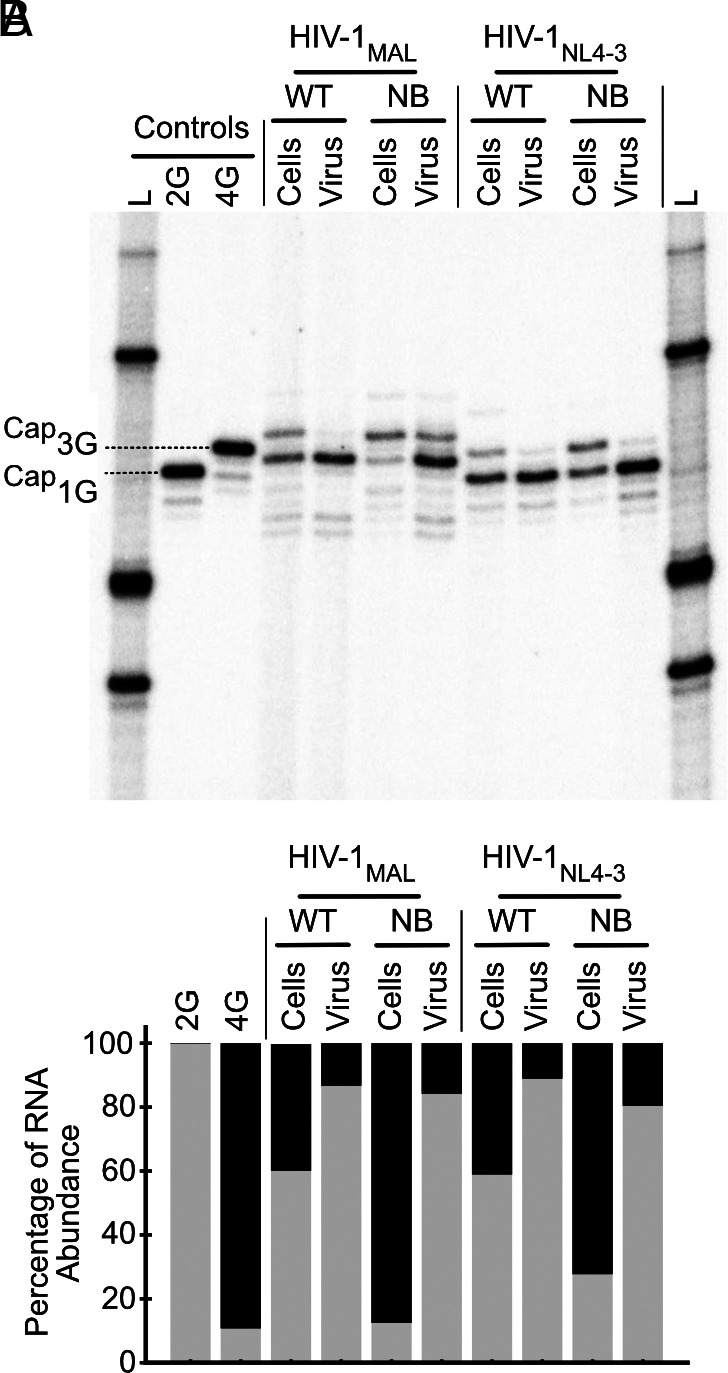
Dimeric, cap-exposed 3G polyANB RNAs are not competitively packaged. (A) In vitro packaging assay via cap-dependent adaptor ligation assay comparing RNA proportions in cells to that in virus. Single nucleotide resolution allows discrimination of RNA start via comparisons to controls corresponding to HIV-1NL4-3 5′-capped 1G (2G) and HIV-1NL4-3 5′-capped 3G (4G). Note that a 5′ cap leads to incorporation of a G in the final PCR product obtained using the cap-dependent adaptor ligation assay employed; thus, 5′ capped 1G RNA and 3G RNAs generate products with two and four 5′ guanosines, respectively, which exhibit mobilities of noncapped 2G and 4G controls (Left-most lanes). (B) Densitometric quantification of packaging propensities (1G and 3G RNAs shown in gray and black, respectively).
Fig. 4.
Fig. 4.
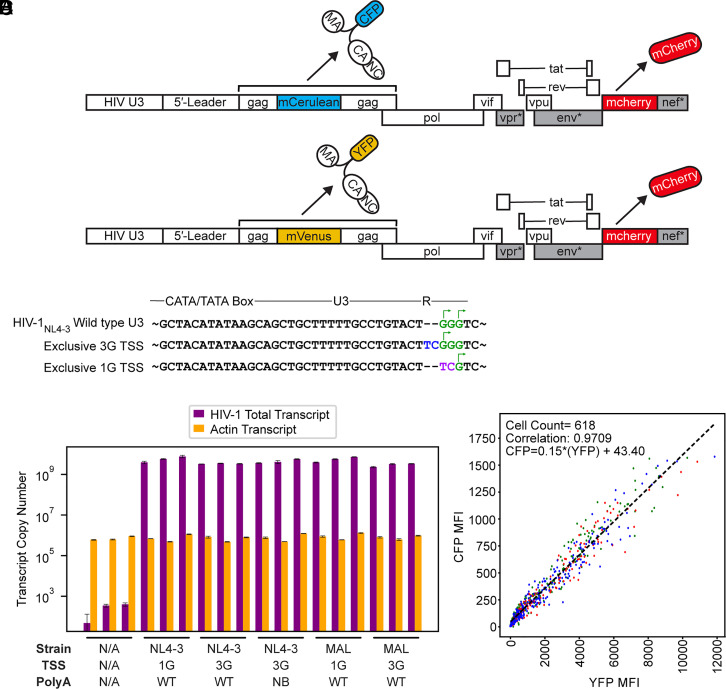
In-cell competitive assay for evaluating the effect of TTSS on translation. (A) Three color reporter system for monitoring competitive translation via cotransfection of two separate full-length proviral plasmids. Leader-driven translation was monitored by measuring changes to Gag-CFP or Gag-YFP expression over time, with mCherry also expressed by each virus as a fluid phase marker for cell tracking (* denotes inactivating mutations within gene regions intended to prohibit viral replication in vivo, for biosafety). (B) Mutations in U3 that control TSS usage (51) showing residue additions (blue), substitutions (purple), and potential and actual transcription start sites (green and arrows, respectively). (C) RT-qPCR assays for quantification of HIV-1 total transcript production (55). Error bars denote SD from three separate experiments. (D) Example of YFP versus CFP mean fluorescence intensities (MFI) used to calculate correlation coefficients (NL43-3G-YFP versus NL43-3G-CFP control at 30 h posttransfection). Each point represents an individual cell identified by Cellpose (56) with colors based on the three regions of interest (ROI) collected for each well. The best fit linear trendline is shown.
Fig. 5.
Fig. 5.
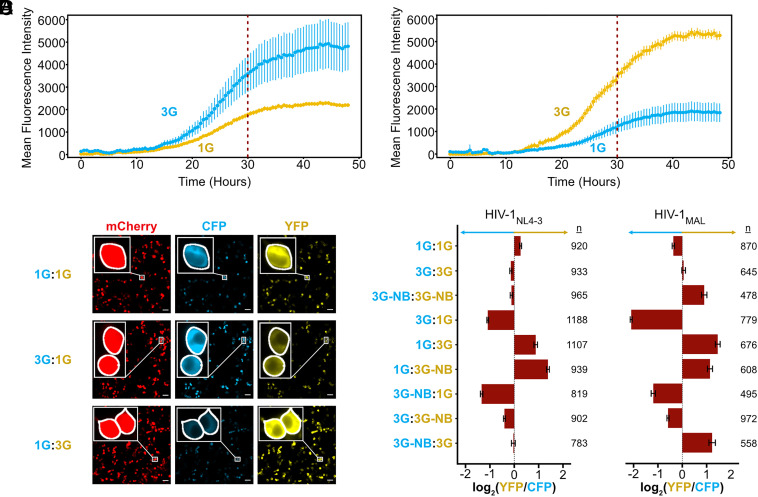
Cap-exposed RNAs exhibit enhanced translation efficiencies. (A and B) Average mean fluorescent intensity across all cells identified at each timepoint in CFP (blue) and YFP (yellow) channels for NL43-3G-CFP in competition with NL43-1G-YFP (3G:1G) (A) and an inverted experiment showing NL43-1G-CFP in competition with NL43-3G-YFP (1G:3G) (B). Error bars represent the SEM of the MFI at each time point. 30-h time point used for subsequent analysis indicated by a dashed line. (C) Representative images at 30 h post transfection for a control (NL43-1G-CFP vs NL43-1G-YFP, 1G:1G), 3G:1G, and 1G:3G in mCherry, CFP, and YFP channels. Insets show zoomed (10×) images of individual cells identified by Cellpose, which highlights similar CFP and YFP detection in our control and differences between channels in 1G:3G and 3G:1G images. White scale bars represent 50 μm. (D) Average log2(YFP/CFP) ratios for single cells 30 h post transfection across two separate transfections normalized for differences in YFP and CFP using control samples from matching transfections (Supplemental Information). Error bars show the 95% CI of the mean across all cells from two separate transfections (n = number of cells).

References

    1. Coffin J. M., Hughes S. H., Varmus H. E., Retroviruses (Cold Spring Harbor Laboratory Press, Plainview, N.Y., 1997). - PubMed
    1. Kharytonchyk S., et al. , Transcriptional start site heterogeneity modulates the structure and function of the HIV-1 genome. Proc. Natl. Acad. Sci. U.S.A. 113, 13378–13383 (2016). - PMC - PubMed
    1. Ding P., et al. , 5’-Cap sequestration is an essential determinant of HIV-1 genome packaging. Proc. Natl. Acad. Sci. U.S.A. 118, 1–8 (2021). - PMC - PubMed
    1. Rawson J. M. O., et al. , Transcription start site heterogeneity and preferential packaging of specific full-length RNA species are conserved features of primate lentiviruses. Microbiol. Spectr. 10, e0105322 (2022), 10.1128/spectrum.01053-22. - DOI - PMC - PubMed
    1. Masuda T., et al. , Fate of HIV-1 cDNA intermediates during reverse transcription is dictated by transcription initiation site of virus genomic RNA. Sci. Rep. 5, 17680 (2015). - PMC - PubMed

LinkOut - more resources