


Esophagectomy after definitive chemoradiation in esophageal cancer: a safe therapeutic strategy
- PMID: 39110921
- PMCID: PMC11518934
- DOI: 10.1093/dote/doae059
Esophagectomy after definitive chemoradiation in esophageal cancer: a safe therapeutic strategy
Abstract
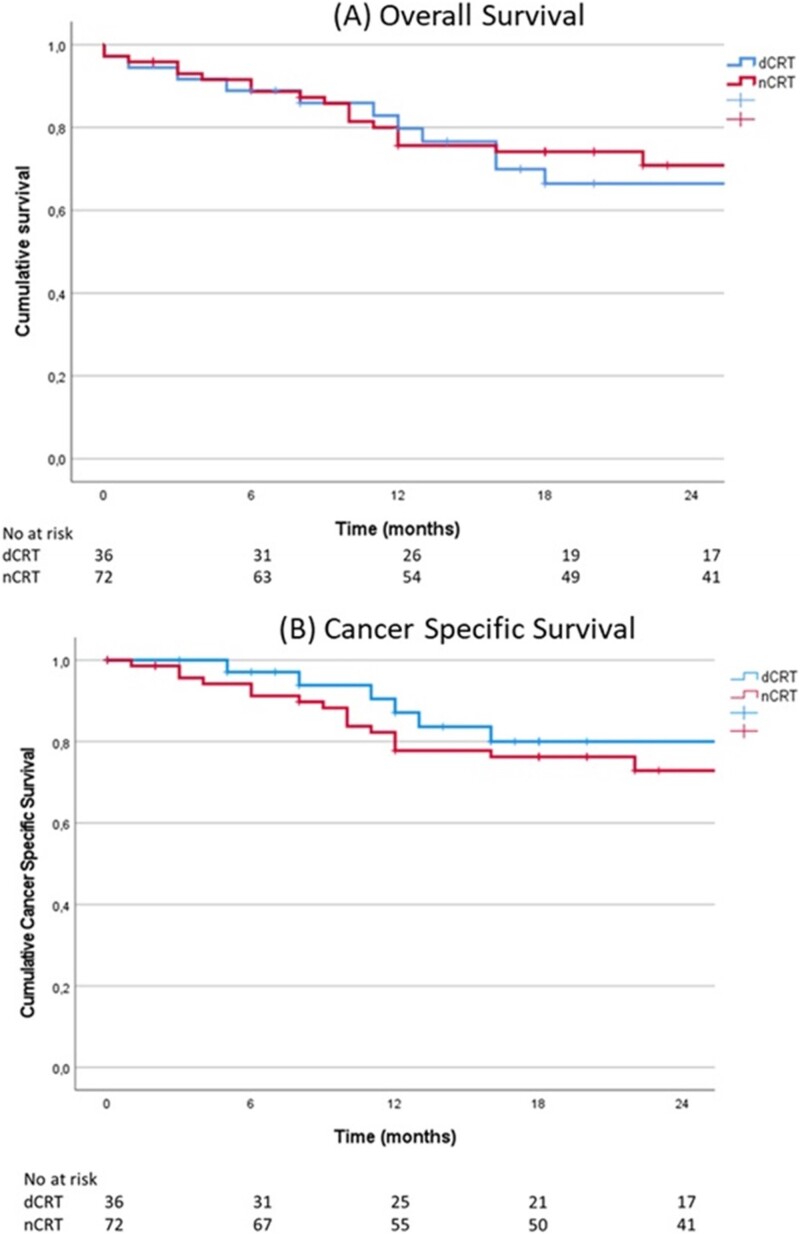
The standard treatment regimen for esophageal cancer is chemoradiation followed by esophagectomy. However, the use of neoadjuvant chemoradiotherapy damages the surrounding tissue, which potentially increases the risk of postoperative complications, including anastomotic leakage. The impact of definitive chemoradiotherapy (dCRT, 50.4 Gy radiotherapy) compared to the standard neoadjuvant scheme (nCRT, 41.4 Gy radiotherapy) prior to surgery on the incidence of anastomotic leakage remains poorly understood. To study this, all patients who received dCRT between 2011 and 2021 followed by esophagectomy were included. For each patient, two patients who received nCRT were selected as matched controls. Outcomes included postoperative anastomotic leakage, pulmonary and other complications, anastomotic stenosis, pulmonary and other postoperative complications (Clavien Dindo Classification ≥1), and overall survival. One hundred and eight patients were included with a median follow-up of 28 months. The time between neoadjuvant treatment and surgery was longer in the dCRT group compared to the nCRT group (65 vs. 48 days, P < 0.001). Postoperatively, significantly more patients in the dCRT group suffered from anastomotic leakage (11% vs. 1%, P = 0.04) and anastomotic stenosis (42% vs. 17%, P < 0.01). No differences were found for other complications or overall survival between both groups. In conclusion, preoperative dCRT is associated with a higher risk of anastomotic leakage and stenosis. These complications, however, can be treated effectively. Therefore, esophagectomy after dCRT is considered to be an appropriate treatment strategy in a selected patient group.
Keywords: anastomotic leakage; chemoradiation; esophageal cancer surgery; esophagectomy; therapy; treatment.
© The Author(s) 2024. Published by Oxford University Press on behalf of International Society for Diseases of the Esophagus.
Figures
References
-
- Sung H, Ferlay J, Siegel R L et al. Global cancer statistics 2020: GLOBOCAN estimates of incidence and mortality worldwide for 36 cancers in 185 countries. CA Cancer J Clin 2021; 71(3): 209–49. - PubMed
-
- van Hagen P, Hulshof M C C M, Van Lanschot J J B et al. Preoperative chemoradiotherapy for esophageal or junctional cancer. New Eng J Med 2012; 366(22): 2074–84. - PubMed
-
- Ajani J A, D’Amico T A, Bentrem D J et al. Esophageal and esophagogastric junction cancers, version 2.2019, NCCN clinical practice guidelines in oncology. J Natl Compr Canc Netw 2019; 17(7): 855–83. - PubMed
-
- Shapiro J, Van Lanschot J J B, Hulshof M C et al. Neoadjuvant chemoradiotherapy plus surgery versus surgery alone for esophageal or junctional cancer (CROSS): long-term results of a randomised controlled trial. Lancet Oncol 2015; 16(9): 1090–8. - PubMed
-
- Rodemann H P, Bamberg M. Cellular basis of radiation-induced fibrosis. Radiother Oncol 1995; 35(2): 83–90. - PubMed
MeSH terms
LinkOut - more resources
Full Text Sources
Medical
