


Longer ICU stay and invasive mechanical ventilation accelerate telomere shortening in COVID-19 patients 1 year after recovery
- PMID: 39113075
- PMCID: PMC11308640
- DOI: 10.1186/s13054-024-05051-6
Longer ICU stay and invasive mechanical ventilation accelerate telomere shortening in COVID-19 patients 1 year after recovery
Abstract
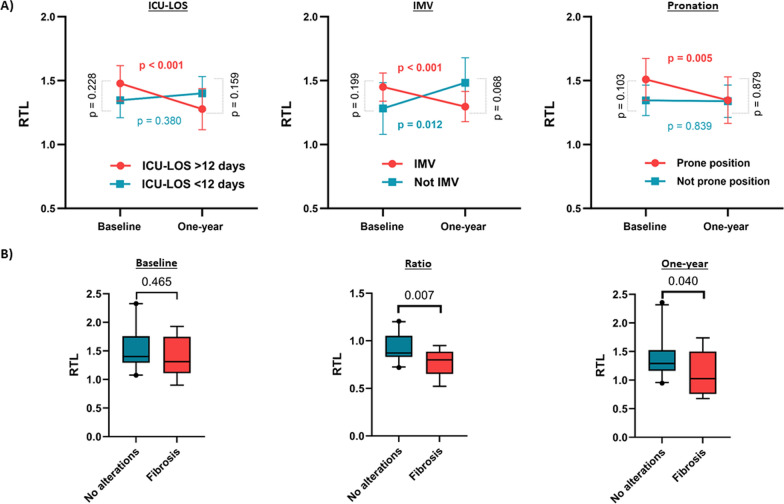
Severe acute respiratory syndrome coronavirus 2 (SARS-CoV-2) causes virus-induced-senescence. There is an association between shorter telomere length (TL) in coronavirus disease 2019 (COVID-19) patients and hospitalization, severity, or even death. However, it remains unknown whether virus-induced-senescence is reversible. We aim to evaluate the dynamics of TL in COVID-19 patients 1 year after recovery from intensive care units (ICU). Longitudinal study enrolling 49 patients admitted to ICU due to COVID-19 (August 2020 to April 2021). Relative telomere length (RTL) quantification was carried out in whole blood by monochromatic multiplex real-time quantitative PCR (MMqPCR) assay at hospitalization (baseline) and 1 year after discharge (1-year visit). The association between RTL and ICU length of stay (LOS), invasive mechanical ventilation (IMV), prone position, and pulmonary fibrosis development at 1-year visit was evaluated. The median age was 60 years, 71.4% were males, median ICU-LOS was 12 days, 73.5% required IMV, and 38.8% required a prone position. Patients with longer ICU-LOS or who required IMV showed greater RTL shortening during follow-up. Patients who required pronation had a greater RTL shortening during follow-up. IMV patients who developed pulmonary fibrosis showed greater RTL reduction and shorter RTL at the 1-year visit. Patients with longer ICU-LOS and those who required IMV had a shorter RTL in peripheral blood, as observed 1 year after hospital discharge. Additionally, patients who required IMV and developed pulmonary fibrosis had greater telomere shortening, showing shorter telomeres at the 1-year visit. These patients may be more prone to develop cellular senescence and lung-related complications; therefore, closer monitoring may be needed.
Keywords: ARDS; COVID-19; ICU; IMV; Relative telomere length; SARS-CoV2.
© 2024. The Author(s).
Conflict of interest statement
The authors declare no competing interests.
Figures
References
Publication types
MeSH terms
Grants and funding
LinkOut - more resources
Full Text Sources
Medical
Miscellaneous
