


The Camp fire and perinatal health: an example of the generalized synthetic control method to identify susceptible windows of exposure
- PMID: 39117573
- PMCID: PMC11879561
- DOI: 10.1093/aje/kwae261
The Camp fire and perinatal health: an example of the generalized synthetic control method to identify susceptible windows of exposure
Abstract
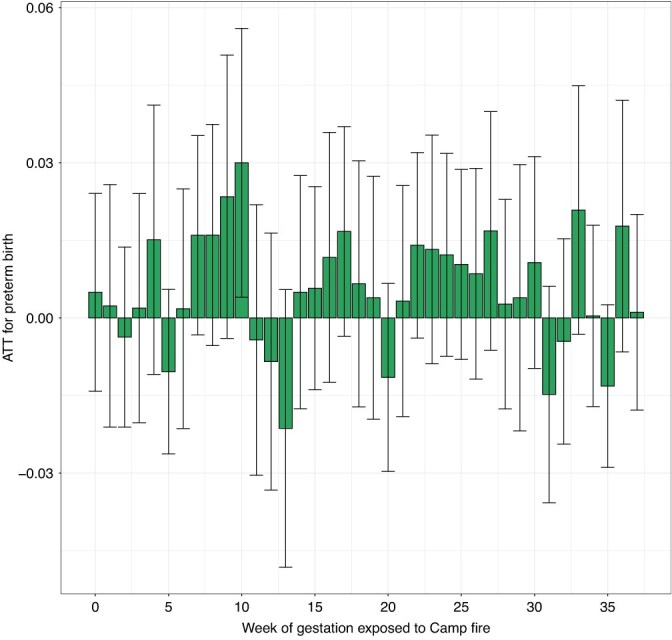
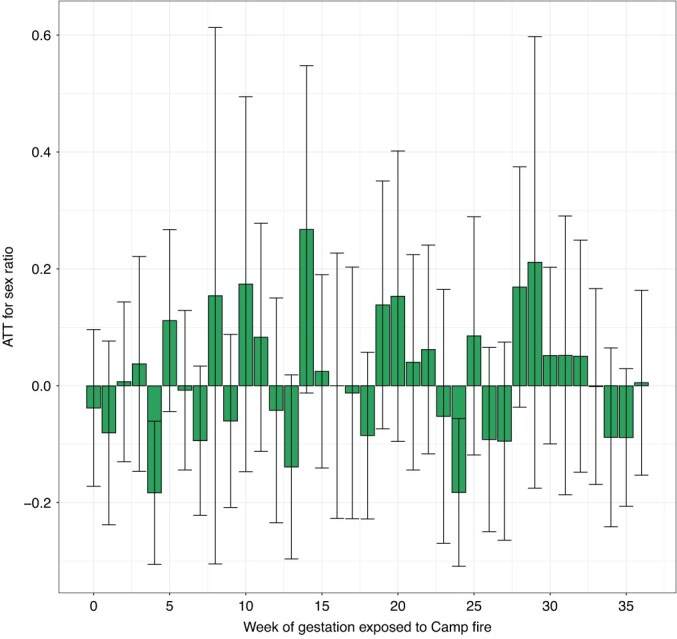
The November 2018 Camp fire was the most destructive wildfire in California history, but its effects on reproductive health are not known. We linked California birth records from 2017-2019 to daily smoke levels using US EPA Air Quality System (AQS) PM2.5 data and NOAA Hazard Mapping System smoke plume polygons during the Camp fire. In the main analysis, pregnancies were considered exposed if they had median AQS PM2.5 levels above 50 μg/m3 for at least 7 days during November 8-22, 2018. We calculated rates of preterm birth and the infant sex ratio based on week of conception and used the generalized synthetic control method to estimate the average treatment effect on the treated and to propose a novel approach to identify potential critical weeks of exposure during pregnancy. We found associations between Camp fire-related smoke exposure and rates of preterm birth, with a risk difference (RD) of 0.005 and a 95% confidence interval (CI) of 0.001-0.010. Exposure during week 10 of pregnancy was consistently associated with increased preterm birth (RD, 0.030; 95% CI, 0.004-0.056). We did not observe differences in the infant sex ratio. Camp fire smoke exposure was associated with increased rates of preterm birth, with sensitive windows in the first trimester. This article is part of a Special Collection on Environmental Epidemiology.
Keywords: natural experiment; pregnancy; preterm birth; sex ratio; susceptible windows; wildfire.
© The Author(s) 2024. Published by Oxford University Press on behalf of the Johns Hopkins Bloomberg School of Public Health. All rights reserved. For permissions, please e-mail: journals.permissions@oup.com.
Conflict of interest statement
The authors report no conflicts of interest.
Figures

References
-
- Cal Fire . Remembering the Camp Fire. 2023. Accessed October 25, 2023. Available from: https://www.fire.ca.gov/our-impact/remembering-the-camp-fire#
-
- Pavlovic N, Huang S, McClure C, et al. Modeling of smoke impacts on air quality using direct observation of hourly fire activity from geostationary satellites. Presentation at the Fire Behavior and Fuels Conference. Albuquerque, New Mexico; 2019.
-
- Jones BA, McDermott S. Infant health outcomes in mega-fire affected communities. Appl Econ Lett. 2022;29(14):1325-1335. 10.1080/13504851.2021.1927959 - DOI
MeSH terms
Substances
Grants and funding
LinkOut - more resources
Full Text Sources
Medical
Research Materials
Miscellaneous
