


The effect of a combined cooling intervention on cognitive function in the heat during an intermittent running protocol
- PMID: 39117584
- PMCID: PMC11369344
- DOI: 10.1002/ejsc.12178
The effect of a combined cooling intervention on cognitive function in the heat during an intermittent running protocol
Abstract
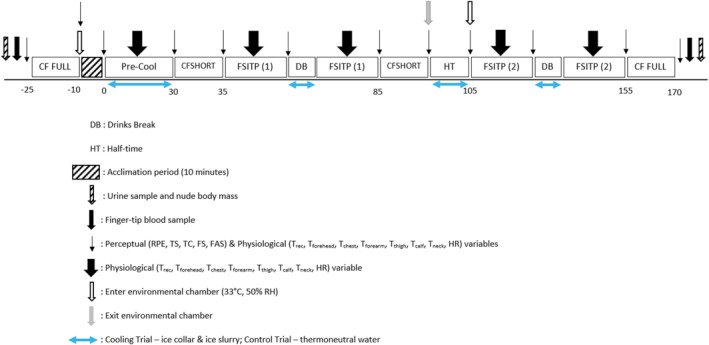
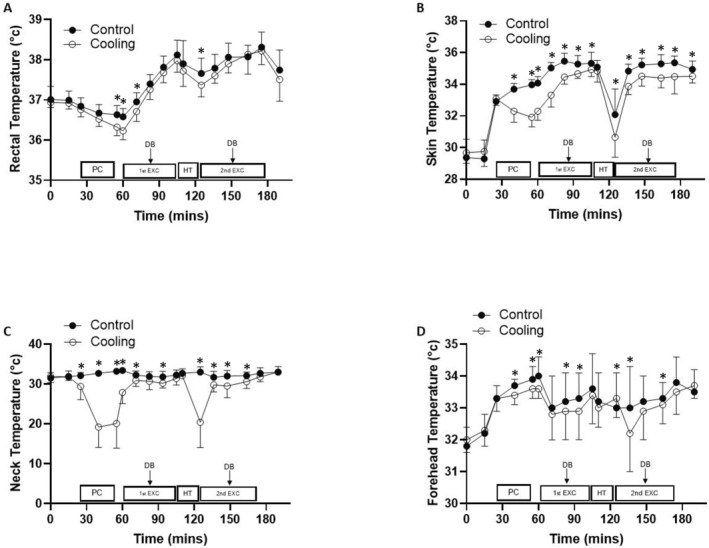
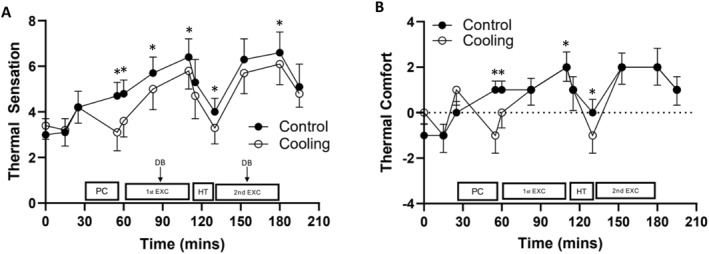
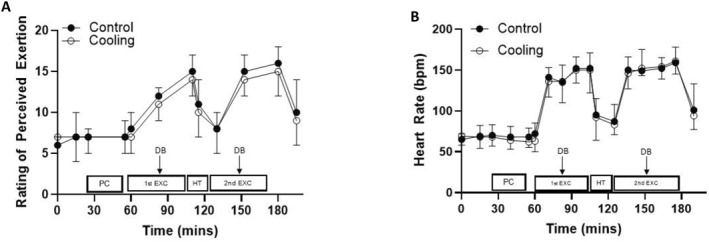
Despite optimal cognitive function being essential for performance, there is a lack of research on the effectiveness of combined cooling interventions on team sport athlete's cognitive function when exercising in the heat. In a randomised, crossover design, 12 unacclimatised men (age: 22.3 ± 3.0 years, body mass: 73.4 ± 5.1 kg, height: 181.0 ± 5.3 cm and max: 51.2 ± 9.5 mL/kg/min) participated in a control (CON) and combined cooling trial (ice slurry and ice collar; COOL). A battery of cognitive tests were completed prior to, during (at half-time) and following a 90-min intermittent running protocol in the heat (33°C, 50% relative humidity (RH)). Perceptual and physiological measures were taken throughout the protocol. In CON, response times were quicker on the Stroop task complex level (p = 0.002) and the visual search test complex level at full-time (p = 0.014) compared to COOL. During COOL, response times were quicker at half-time on the Stroop task complex level (p = 0.024) compared to CON. Lower rectal temperatures were seen during COOL (CON: 37.44 ± 0.65°C and COOL: 37.28 ± 0.68°C) as well as lower skin, neck and forehead temperatures (main effect of trial, all p < 0.05). Lower ratings of thermal sensation and perceived exertion and enhanced thermal comfort were recorded during COOL (main effect of trial, all p < 0.05). Whilst minimal differences in cognitive function were found when using the combined cooling intervention, the findings highlight a practical and effective strategy to improving many physiological and perceptual responses to intermittent exercise in the heat.
Keywords: football; ice slurry; neck cooling; soccer; team sports.
© 2024 The Author(s). European Journal of Sport Science published by Wiley‐VCH GmbH on behalf of European College of Sport Science.
Conflict of interest statement
The authors declare that they have no conflicts of interest.
Figures
References
-
- Aldous, Jeffrey William Frederick , Chrismas Bryna Catherine Rose, Akubat Ibrahim, Stringer Charlotte Anne, Abt Grant, and Taylor Lee. 2019. “Mixed‐methods Pre‐match Cooling Improves Simulated Soccer Performance in the Heat.” European Journal of Sport Science 19(2): 156–165. 10.1080/17461391.2018.1498542. - DOI - PubMed
-
- Bandelow, S. , Maughan R., Shirreffs S., Ozgünen K., Kurdak S., Ersöz G., Binnet M., and Dvorak J.. 2010. “The Effects of Exercise, Heat, Cooling and Rehydration Strategies on Cognitive Function in Football Players.” Scandinavian Journal of Medicine & Science in Sports 20(s3): 148–160. 10.1111/j.1600-0838.2010.01220.x. - DOI - PubMed
-
- Bangsbo, J. 2000. “Team Sports.” Nutrition in Sport: 574.
-
- Bangsbo, Jens , and Mohr Magni. 2005. “Variations in Running Speeds and Recovery Time after a Sprint during Top‐Class Soccer Matches.” Medicine & Science in Sports & Exercise 37(5): S87. 10.1097/00005768-200505001-00471. - DOI
Publication types
MeSH terms
Substances
LinkOut - more resources
Full Text Sources
