


Specific antigen-based stratification of membranous nephropathy in patients after haematopoietic stem cell allotransplantation - a case series and literature review
- PMID: 39118046
- PMCID: PMC11312175
- DOI: 10.1186/s12882-024-03675-y
Specific antigen-based stratification of membranous nephropathy in patients after haematopoietic stem cell allotransplantation - a case series and literature review
Abstract
Background: Nephrotic syndrome (NS) is a rare complication that can occur after haematopoietic stem cell transplantation (HSCT). In patients with membranous nephropathy (MN) who have undergone allogeneic HSCT, a new antigen called protocadherin FAT1 has been identified. Our objective is to present a case series of MN patients after HSCT with a novel antigen-based stratification.
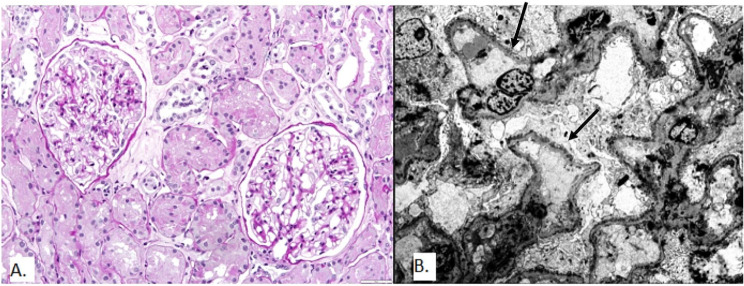
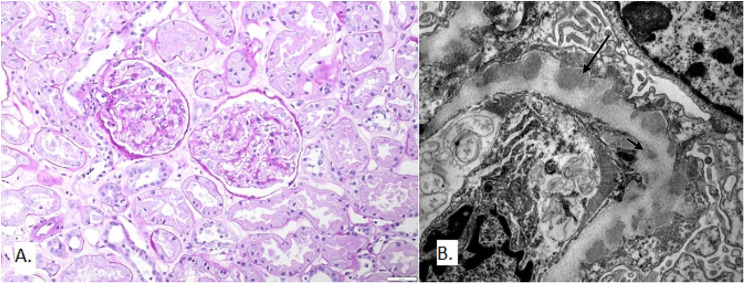
Case presentations: Patients who developed full-blown NS due to MN after an HSCT were enrolled in the University Hospital Centre Zagreb study. The first two patients were treated with an HSCT for acute myeloid leukaemia, and both developed NS after cessation of graft versus host disease (GVHD) prophylaxis. The first patient had reduced kidney function, while the second had completely preserved function. Kidney biopsy showed MN with only subepithelial deposits. A thorough examination revealed that there was no secondary cause of the disease. The patients achieved complete remission after undergoing immunosuppression treatment. The third patient underwent HSCT for acute lymphoblastic leukaemia. He developed both acute and chronic GVHD and also experienced avascular hip necrosis. After sixteen years, the patient developed NS with preserved kidney function. The kidney specimen showed membranous nephropathy (MN) with mesangial and subepithelial deposits. Extensive research was conducted, but no secondary cause for the MN was detected. All three cases tested negative for anti-PLA2R antibodies. Biopsy tissue samples were analysed using laser microdissection and tandem mass spectrometry of glomeruli for the detection of different specific antigens. Patients one and two tested positive for FAT1, whereas patient three tested positive for PCSK6.
Conclusions: MN can develop at various time intervals after HSCT. Specific antigen testing can help establish the relationship between MN and HSCT. In the future, serum testing for anti-FAT1 antibodies in HSCT patients could be significant in diagnosing FAT1-associated MN, similar to how anti-PLA2R antibodies are significant in diagnosing PLA2R-associated MN.
Keywords: FAT1; Hematopoietic stem cell transplant; Membranous nephropathy; PCSK6.
© 2024. The Author(s).
Conflict of interest statement
The authors declare no competing interests.
Figures


References
-
- Dhakal B, Singavi A, Cohen E, Dangal M, Palmer J, Dall A, et al. Chronic GVHD and concurrent new-onset nephrotic syndrome in allogeneic transplant recipients. Incidence, pattern and therapeutic outcomes. Bone Marrow Transpl. 2015;50(3):449–51. 10.1038/bmt.2014.261. 10.1038/bmt.2014.261 - DOI - PubMed
Publication types
MeSH terms
LinkOut - more resources
Full Text Sources
Miscellaneous
