Review
. 2024 Jul 12;15(31):12234-12257.
doi: 10.1039/d3sc07006a. eCollection 2024 Aug 7.

Recent advances for enhanced photodynamic therapy: from new mechanisms to innovative strategies

Affiliations
Review

Recent advances for enhanced photodynamic therapy: from new mechanisms to innovative strategies

Xia Wang et al. Chem Sci. .

Abstract

Photodynamic therapy (PDT) has been developed as a potential cancer treatment approach owing to its non-invasiveness, spatiotemporal control and limited side effects. Currently, great efforts have been made to improve the PDT effect in terms of safety and efficiency. In this review, we highlight recent advances in innovative strategies for enhanced PDT, including (1) the development of novel radicals, (2) design of activatable photosensitizers based on the TME and light, and (3) photocatalytic NADH oxidation to damage the mitochondrial electron transport chain. Additionally, the new mechanisms for PDT are also presented as an inspiration for the design of novel PSs. Finally, we discuss the current challenges and future prospects in the clinical practice of these innovative strategies. It is hoped that this review will provide a new angle for understanding the relationship between the intratumoural redox environment and PDT mechanisms, and new ideas for the future development of smart PDT systems.


Conflict of interest statement

There are no conflicts to declare.

Figures

Fig. 1
Fig. 1. The photosensitization process and photochemical reaction mechanisms of type I and type II PDT.
Fig. 2
Fig. 2. The innovative strategies for enhanced PDT.
Fig. 3
Fig. 3. Schematic illustration of the photogeneration of H˙, O2˙/, ˙NO, ONOO, and 1O2 upon coactivation of DANO with GSH and light. Reproduced with permission from ref. . Copyright 2021 American Chemical Society.
Fig. 4
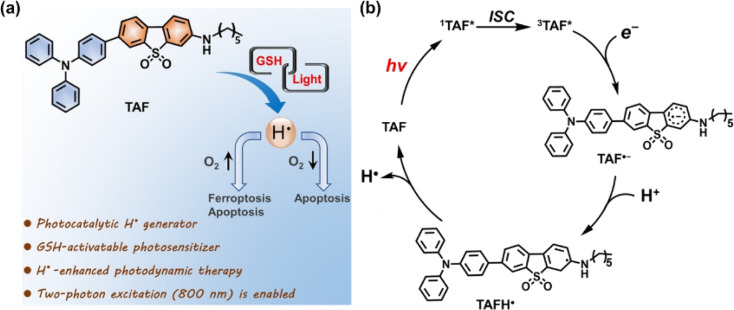
Fig. 4. (a) Schematic presentation of GSH-driven H˙ photogeneration for PDT. (b) Proposed mechanism for photocatalytic H˙ generation. Reproduced with permission from ref. . Copyright 2022 Wiley-VCH.
Fig. 5
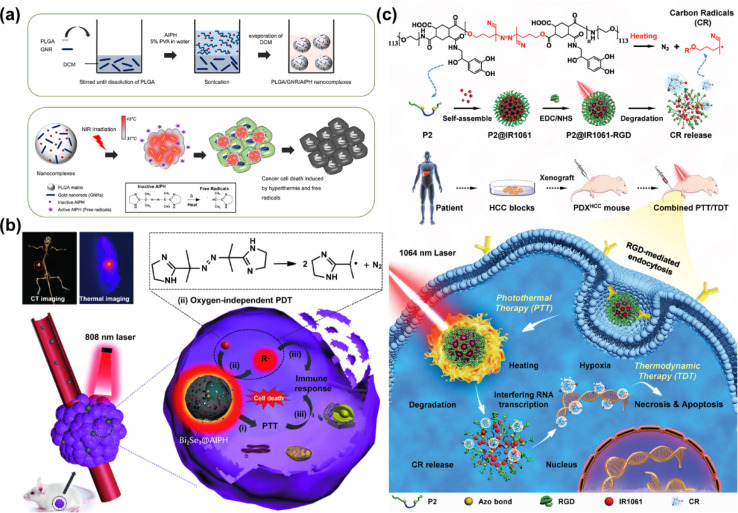
Fig. 5. (a) Synthesis of poly(lactic-co-glycolic acid) (PLGA)/gold nanorod (GNR)/2,2′-azobis[2-(2-imidazolin-2-yl)propane] dihydrochloride (AIPH) nanocomplexes and schematic illustration of the PLGA/GNR/AIPH nanocomplexes allowing near-infrared (NIR) induced heat and free radical generation for efficient dual cancer treatment. Reproduced with permission from ref. . Copyright 2018 Elsevier B.V. (b) Theranostic process of Bi2Se3@AIPH for CT and thermal imaging-guided cascaded photothermal and oxygen-independent photodynamic therapy along with immune response. Reproduced with permission from ref. . Copyright 2019 Springer Nature. (c) Preparation of P2@IR1061-RGD for combined PTT and TDT in a NIR II window (1000–1700 nm) of the PDXHCC mouse model. Reproduced with permission from ref. . Copyright 2021 Wiley-VCH.
Fig. 6
Fig. 6. (a) Proposed schematic illustration of the PDT mechanism of the Ir4 complex. Reproduced with permission from ref. . Copyright 2020 Wiley-VCH. (b) Schematic illustration of the mechanism of the action of the Ir(iii) complex by PDT/PACT. Reproduced with permission from ref. . Copyright 2022 American Chemical Society.
Fig. 7
Fig. 7. (a) Principle of DHQ-Cl-Azo for PDT and chemotherapy. Reproduced with permission from ref. . Copyright 2022 Elsevier Inc. (b) A reversible hypoxia–normoxia responsive type I photosensitizer for PDT. Reproduced with permission from ref. . Copyright 2023 Wiley-VCH. (c) Molecular structures of compounds 1–3. Reproduced with permission from ref. . Copyright 2019 American Chemical Society. (d) ICy-N for hypoxia imaging and cancer therapy. Reproduced with permission from ref. . Copyright 2019 The Royal Society of Chemistry.
Fig. 8
Fig. 8. (a) The pH-activatable BODIPY derivative for 1O2 generation and PDT. Reproduced with permission from ref. . Copyright 2018 American Chemical Society. (b) Illustration of the TDPP@PEG–TPZ nanoformulation for phototherapy-enhanced chemotherapy. Reproduced with permission from ref. . Copyright 2023 The Royal Society of Chemistry. (c) Reversible switching of ISC and potential application in PDT. Reproduced with permission from ref. . Copyright 2019 Wiley-VCH.
Fig. 9
Fig. 9. (a) TPE–TThPy as a mitochondria-targeting photosensitizer for MAO-A-activatable PDT. Reproduced with permission from ref. . Copyright 2022 Wiley-VCH. (b) Enzyme KIAA1363-activated mechanism for NBS-L-AX based PDT. Reproduced with permission from ref. . Copyright 2023 The Royal Society of Chemistry. (c) Cathepsin-activated AuNPs–Pc158 conjugates for selective PDT. Reproduced with permission from ref. . Copyright 2020 American Chemical Society. (d) Molecular structure of the double-locked PMB 1 and its dual-enzyme-unlocked mechanism. Reproduced with permission from ref. . Copyright 2023 American Chemical Society.
Fig. 10
Fig. 10. (a) Formulation of PDA-Dox-Pc-QRH for PDT. Reproduced with permission from ref. . Copyright 2021 The Royal Society of Chemistry. (b) Construction of H2O2-responsive Ce6@P(EG-a-CPBE) NPs for chemo-PDT synergistic cancer therapy. Reproduced with permission from ref. . Copyright 2023 Elsevier B.V. (c) The illustration of TPE–TeV–PPh3-based H2O2-activatable PDT. Reproduced with permission from ref. . Copyright 2022 Wiley-VCH. (d) GSH-responsive shape-transformable GdCFS for dual-modal T1/T2 MRI-guided enhanced PDT. Reproduced with permission from ref. . Copyright 2024 Wiley-VCH. (e) The activatable photosensitizer (mitoaPS) for GSH and H2O2 mutually responsive PDT. Reproduced with permission from ref. . Copyright 2020 Wiley-VCH. (f) Construction of HSeC/IR nanoparticles for cascaded cancer phototherapy. Reproduced with permission from ref. . Copyright 2022 Elsevier Ltd.
Fig. 11
Fig. 11. Photoactivatable theranostic probes for simultaneous imaging of LDs and PDT. Reproduced with permission from ref. . Copyright 2022 Wiley-VCH.
Fig. 12
Fig. 12. (a) The photocleavable PolyTHCRu nanoparticles for PDT. Reproduced with permission from ref. . Copyright 2023 Wiley-VCH. (b) Formulation of Ru–HA@DOX NPs for chemotherapy–PDT. Reproduced with permission from ref. . Copyright 2023 American Chemical Society.
Fig. 13
Fig. 13. (a) Plausible mechanism for PC-mediated photocatalytic NADH oxidation under normoxia and hypoxia. (b) Schematic diagram of photocatalytic NADH oxidation via ROS produced by PS.
Fig. 14
Fig. 14. (a) The complex 1 used for photocatalytic NADH oxidation. Reproduced with permission from ref. . Copyright 2019 Springer Nature. (b–d) The complexes Ir1–Ir9 used for photocatalytic NADH oxidation. Reproduced with permission from ref. . Copyright 2021 Wiley-VCH. Reproduced with permission from ref. and . Copyright 2022 The Royal Society of Chemistry.
Fig. 15
Fig. 15. The mechanism of NADH detection with QAIC and laser triggered therapeutic mechanism of N-QAIC. Reproduced with permission from ref. . Copyright 2022 Elsevier B.V.
Fig. 16
Fig. 16. (a) The UCSRF nanoparticle for NIR light-driven photocatalytic NADH oxidation. Reproduced with permission from ref. . Copyright 2023 Elsevier Ltd. (b) The prodrug RuAzNM used for chemotherapy and PDT. Reproduced with permission from ref. . Copyright 2023 Wiley-VCH.
Fig. 17
Fig. 17. (a) The Os(ii)-terpyridine complexes used for PDT and photooxidation therapy. Reproduced with permission from ref. . Copyright 2020 The Royal Society of Chemistry. (b) The photocatalytic NADH oxidation by light-activating Os2. Reproduced with permission from ref. . Copyright 2022 Springer Nature.
Fig. 18
Fig. 18. (a) CatER-based photocatalytic NADH oxidation. Reproduced with permission from ref. . Copyright 2022 National Academy of Science. (b) Se–NH2 based photoredox catalysis for phototherapy against a hypoxic solid tumour. Reproduced with permission from ref. . Copyright 2022 American Chemical Society.
Fig. 19
Fig. 19. (a) Formulation of LSC NPs. (b) Application of LSC NPs for overcoming the cancer drug resistance. Reproduced with permission from ref. . Copyright 2018 Springer Nature.
Fig. 20
Fig. 20. (a) Chemical structures of the photosensitizer (D) and electron acceptors (A1, A2, and A3). (b) Supramolecular photodynamic system for photo-induced oxidation of NADH and generation of O2˙. Reproduced with permission from ref. . Copyright 2022 Springer Nature.

References

    1. Sung H. Ferlay J. Siegel R. L. Laversanne M. Soerjomataram I. Jemal A. Bray F. Ca-Cancer J. Clin. 2021;71:209–249. doi: 10.3322/caac.21660. - DOI - PubMed
    1. Burstein H. J. J. Clin. Oncol. 2000;18:693. doi: 10.1200/JCO.2000.18.3.693. - DOI - PubMed
    1. Rullier E. Rouanet P. Tuech J.-J. Valverde A. Lelong B. Rivoire M. Faucheron J.-L. Jafari M. Portier G. Meunier B. Sileznieff I. Prudhomme M. Marchal F. Pocard M. Pezet D. Rullier A. Vendrely V. Denost Q. Asselineau J. Doussau A. Lancet. 2017;390:469–479. doi: 10.1016/S0140-6736(17)31056-5. - DOI - PubMed
    1. Wang K. Tepper J. E. Ca-Cancer J. Clin. 2021;71:437–454. doi: 10.3322/caac.21689. - DOI - PubMed
    1. Tian J. Huang B. Nawaz M. H. Zhang W. Coord. Chem. Rev. 2020;420:213410. doi: 10.1016/j.ccr.2020.213410. - DOI

LinkOut - more resources