


ZEBRA study: The Z stitch Early Bed Rest Assessment study
- PMID: 39119024
- PMCID: PMC11305879
- DOI: 10.1016/j.hroo.2024.06.002
ZEBRA study: The Z stitch Early Bed Rest Assessment study
Abstract
Background: Safe and effective management of venous vascular access is a key component of electrophysiology (EP) procedures. Recently, the Z-stitch method has been developed for effective venous hemostasis. However, the standard postprocedure protocol often includes prolonged bed rest, which may affect patient satisfaction. The ZEBRA (Z stitch Early Bed Rest Assessment) study aims to systematically investigate and quantify patient satisfaction metrics and safety parameters associated with the early mobilization after Z-stitch placement.
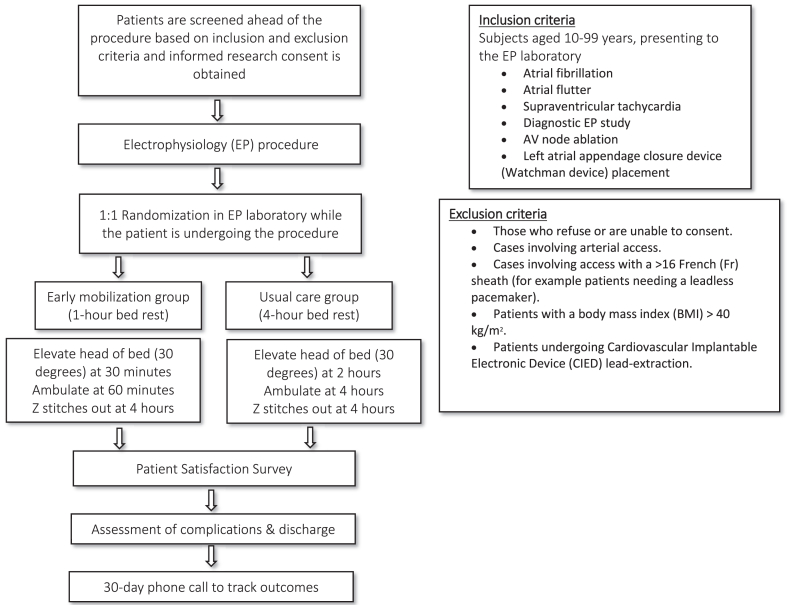
Objective: This study primarily investigates whether early mobilization following Z-stitch placement in venous vascular access management during EP procedures enhances patient satisfaction without compromising safety.
Methods: In this prospective, multicenter, randomized clinical trial, approximately 200 patients undergoing various EP procedures at Oregon Health and Science University and Veterans Affairs Portland Health Care System will be randomly assigned to either a 1- or 4-hour bed rest regimen post-Z stitch. Patient satisfaction will be assessed through survey, alongside monitoring for hematomas, bleeding complications, and other safety endpoints. The study includes stratification based on heparin administration and sheath size to ensure robust and nuanced data analysis.
Results: We anticipate that early mobilization will lead to higher patient satisfaction scores. We also expect to closely monitor and report the incidence of hematomas, pain medication use, healthcare costs, patient outcomes at 30 days, time to ambulation, and hospital readmissions or emergency visits related to groin complications.
Conclusion: The ZEBRA study is poised to fill a critical knowledge gap in postprocedure care in EP labs. By rigorously evaluating the impact of early mobilization on patient satisfaction and safety, this study could significantly influence future guidelines and improve patient experiences in EP procedures.
Keywords: Electrophysiology procedures; Postprocedure management; Randomized clinical trial; Venous vascular hemostasis; Z stitch.
© 2024 Heart Rhythm Society. Published by Elsevier Inc.
Figures
References
-
- Ding W.Y., Khanra D., Kozhuharov N., et al. Incidence of vascular complications for electrophysiology procedures in the ultrasound era: a single-centre experience over 10,000 procedures in the long term. J Interv Card Electrophysiol. 2023;66:693–700. - PubMed
-
- Sanghai S., Sandhu U., Verdick C., et al. Figure-of-eight sutures in fully anticoagulated patients after left atrial appendage occlusion may obviate need for anticoagulation reversal: vascular management after LAAO. Circ Arrhythm Electrophysiol. 2021;14 - PubMed
-
- Payne J., Bickel T., Gautam S. Figure-of-eight sutures for hemostasis result in shorter lab recovery time after ablation for atrial fibrillation. Pacing Clin Electrophysiol. 2018;41:1017–1021. - PubMed
-
- Pracon R., Bangalore S., Henzel J., et al. A randomized comparison of modified subcutaneous “Z”-stitch versus manual compression to achieve hemostasis after large caliber femoral venous sheath removal. Catheter Cardiovasc Interv. 2018;91:105–112. - PubMed
-
- Mujer M.T., Al-Abcha A., Flores J., Saleh Y., Robinson P. A comparison of figure-of-8-suture versus manual compression for venous access closure after cardiac procedures: An updated meta-analysis. Pacing Clin Electrophysiol. 2020;43:856–865. - PubMed
LinkOut - more resources
Full Text Sources
Miscellaneous
