. 2024 Aug 22;67(16):13572-13593.
doi: 10.1021/acs.jmedchem.3c01927. Epub 2024 Aug 9.

Exploring 2-Sulfonylpyrimidine Warheads as Acrylamide Surrogates for Targeted Covalent Inhibition: A BTK Story

Affiliations

Exploring 2-Sulfonylpyrimidine Warheads as Acrylamide Surrogates for Targeted Covalent Inhibition: A BTK Story

Ruxandra Moraru et al. J Med Chem. .

Abstract

Targeted covalent inhibitors (TCIs) directing cysteine have historically relied on a narrow set of electrophilic "warheads". While Michael acceptors remain at the forefront of TCI design strategies, they show variable stability and selectivity under physiological conditions. Here, we show that the 2-sulfonylpyrimidine motif is an effective replacement for the acrylamide warhead of Ibrutinib, for the inhibition of Bruton's tyrosine kinase. In a few iterations, we discovered new derivatives, which inhibit BTK both in vitro and in cellulo at low nanomolar concentrations, on par with Ibrutinib. Several derivatives also displayed good plasma stability and reduced off-target binding in vitro across 135 tyrosine kinases. This proof-of-concept study on a well-studied kinase/TCI system highlights the 2-sulfonylpyrimidine group as a useful acrylamide replacement. In the future, it will be interesting to investigate its wider potential for developing TCIs with improved pharmacologies and selectivity profiles across structurally related protein families.


Conflict of interest statement

The authors declare no competing financial interest.

Figures
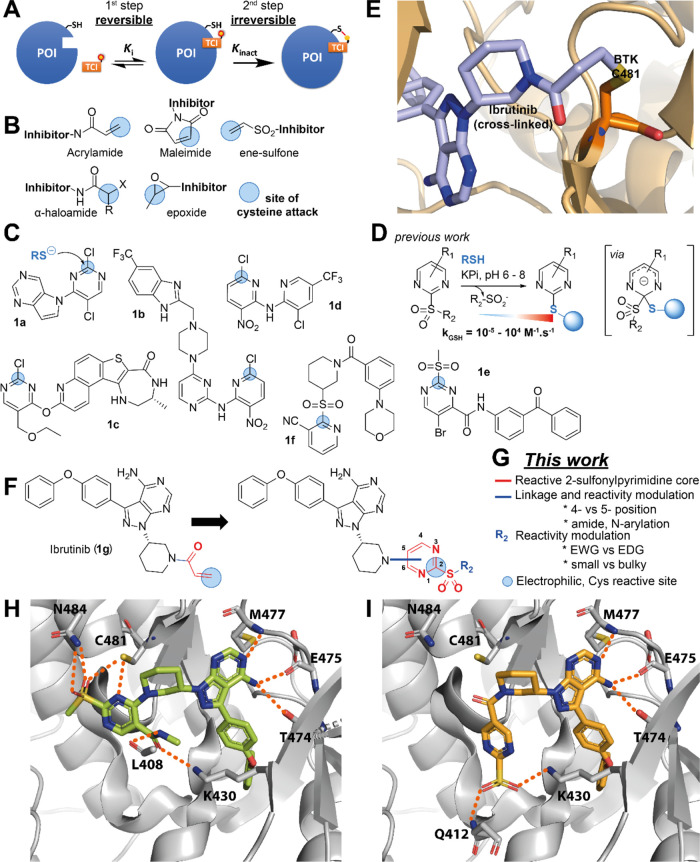
Figure 1
Figure 1
(A) General inhibitory mode of action of TCIs against the protein of interest (POI): Reversible noncovalent complex formation (step 1) followed by the formation of the irreversible covalent complex where the red lines indicate covalent bonds (step 2). E/I: enzyme/inhibitor; (B) representative examples of the most common chemical warheads used in the development of TCIs targeting protein cysteine; (C) recent examples of TCIs reacting with cysteine via an SNAr mechanism; (D) our previous work on characterizing the in vitro reactivity of 2-SPs with thiols using NMR, UV, MS, and XRD; (E) crystal structure of Ibrutinib (1g) covalently bound to BTK (PDB 5P9J). The cross-link between Ibrutinib (1g) and BTK C481 is highlighted; (F) structure of Ibrutinib (1g); (G) this work: The design of new drug analogues using 2-SP as warheads linked via amide bonds and N-arylation (vide infra); and docking poses of representative 2-SP derivatives of Ibrutinib (1g) with functionalization at the 4-position (H) and 5-position (I). Recurring hydrogen bonding interactions are shown as dashed orange lines. The example molecules presented in each panel are described later in the manuscript.
Scheme 1
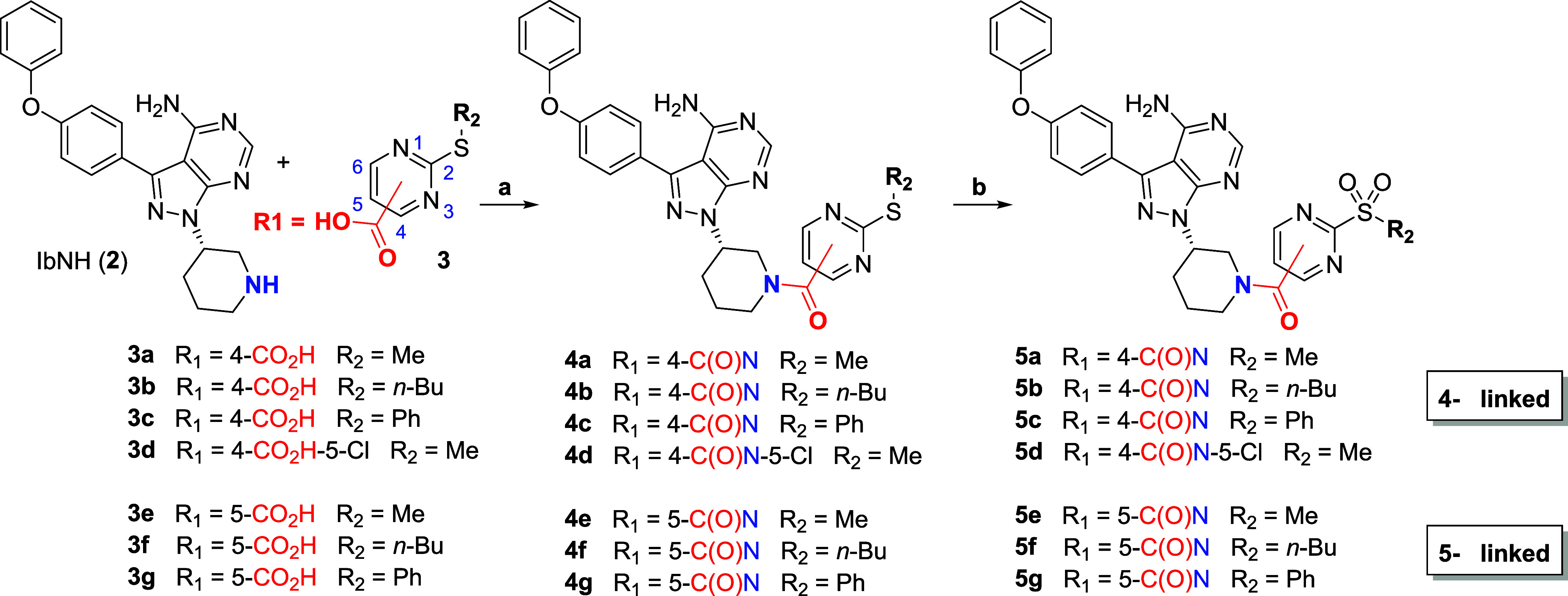
Scheme 1. Chemical Synthesis,
Amide coupling and 3-step protection/oxidation/deprotection strategy for the synthesis of Ibrutinib derivatives functionalized with representative 2-sulfonylpyrimidine warheads. Isolated yields are provided in the caption. 2 and 3d were commercially available. Conditions: (a) HATU, Et3N, DMF, rt, 16 h, 42–83%; (b) i/Boc2O (3.0 equiv, double Boc protection), DMAP, CH2Cl2, rt, 16 h; ii/ m-CPBA, CH2Cl2, rt, 2 h; iii/TFA, CH2Cl2, rt, 4 h, 17–75% over three steps.
Scheme 2
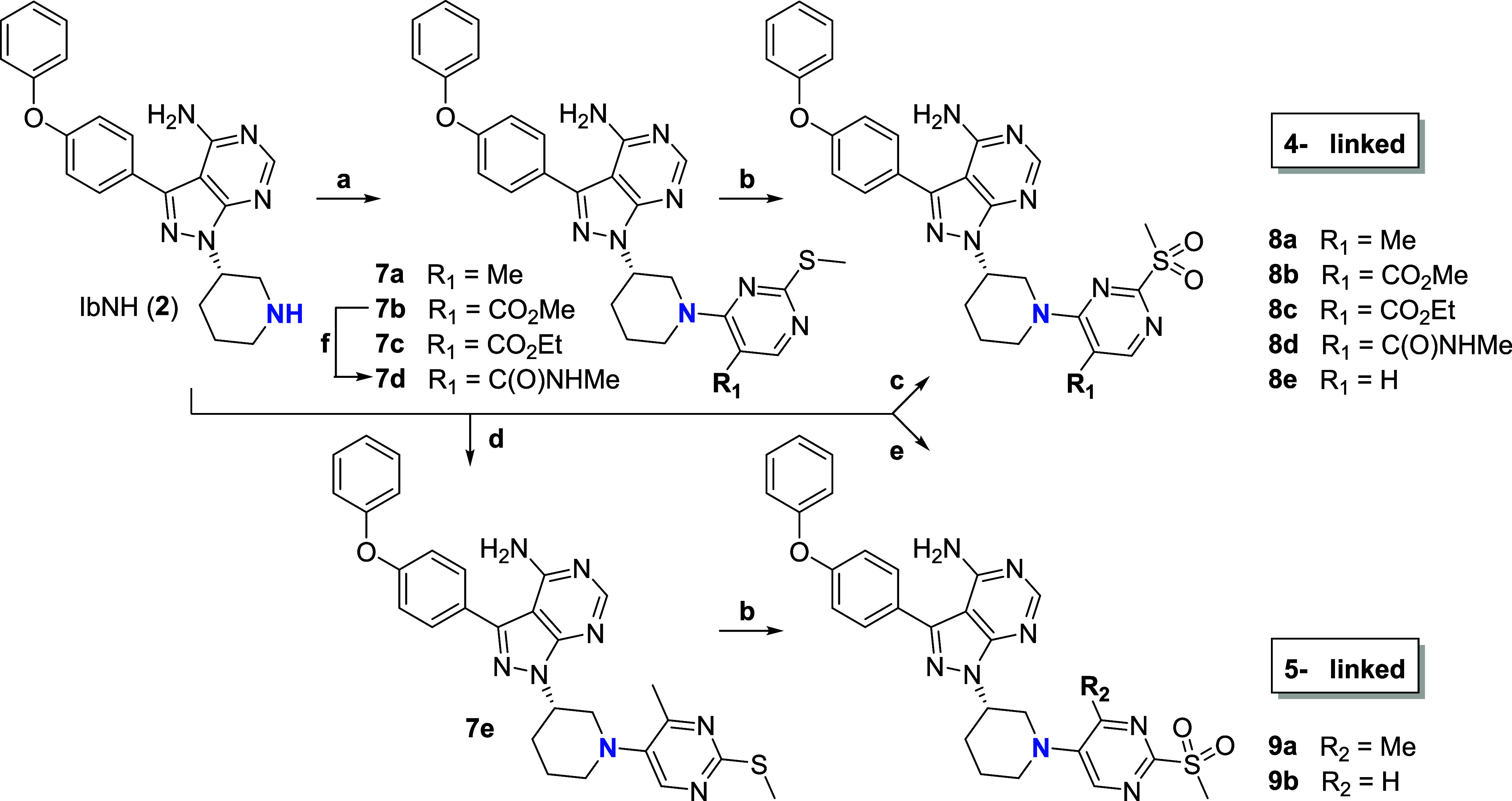
Scheme 2. Chemical Synthesis,
SNAr, cross-coupling and 3-step protection/oxidation/deprotection strategy to access N-arylated Ibrutinib derivatives functionalized with representative 2-methylsulfonylpyrimidine warheads. Isolated yields are provided in the caption. See Scheme 1 for numbering of positions on the pyrimidine ring. Conditions: (a) pyrimidines 6ac, Et3N, DMF, rt, 16 h, 30–93%; (b) i/Boc2O, DMAP, CH2Cl2, rt, 16 h; ii/m-CPBA, CH2Cl2, rt, 2h; iii/TFA, CH2Cl2, rt, 4h, 15–46% over three steps; (c) 4-chloro-2-(methylsulfonyl)pyrimidine, CHCl3, rt, 16h, 74%; (d) 5-bromo-4-methyl-2-(methylthio)pyrimidine, Pd2(dba)3, XantPhos, t-BuONa, toluene, 100 °C, 16 h, 77%; (e) 5-fluoro-2-(methylsulfonyl)pyrimidine, CHCl3, rt, 16 h, 17%; (f) i/10% NaOH, THF, reflux, 4 h; ii/HATU, Et3N, MeNH2, DMF, rt, 16 h, (89% over 2 steps).
Scheme 3
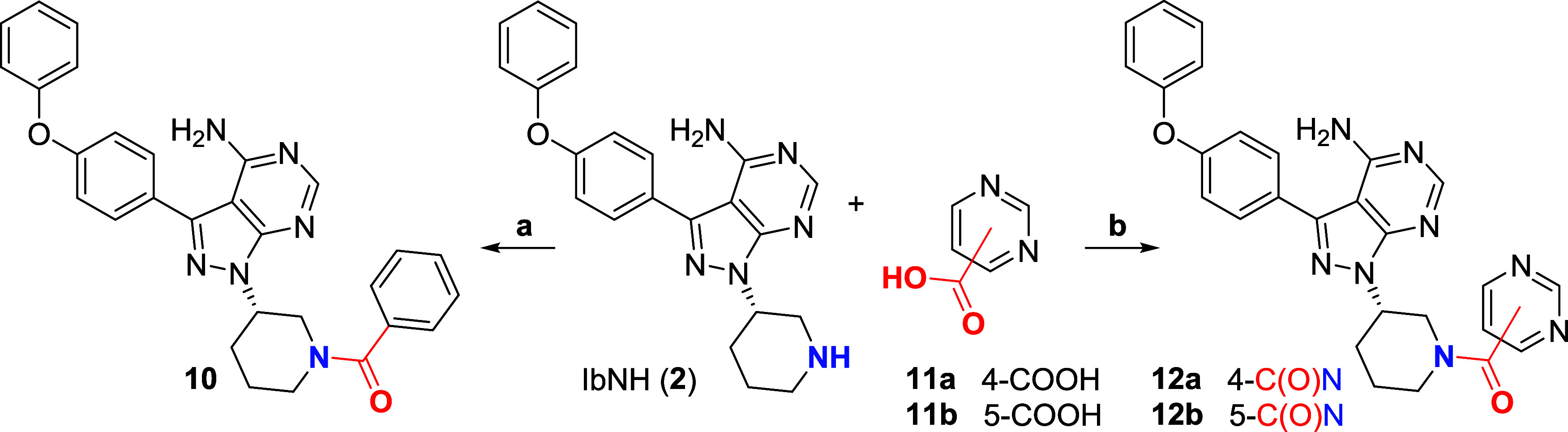
Scheme 3. Chemical Synthesis,
Preparation and isolated yields of noncovalent control compounds lacking the sulfonyl leaving group at position 2. See Scheme 1 for numbering of positions on the pyrimidine ring. Conditions: (a) Bz2O, Et3N, CH2Cl2, 16 h, 90%; (b) HATU, Et3N, DMF, rt, 16 h, 44–71%.
Figure 2
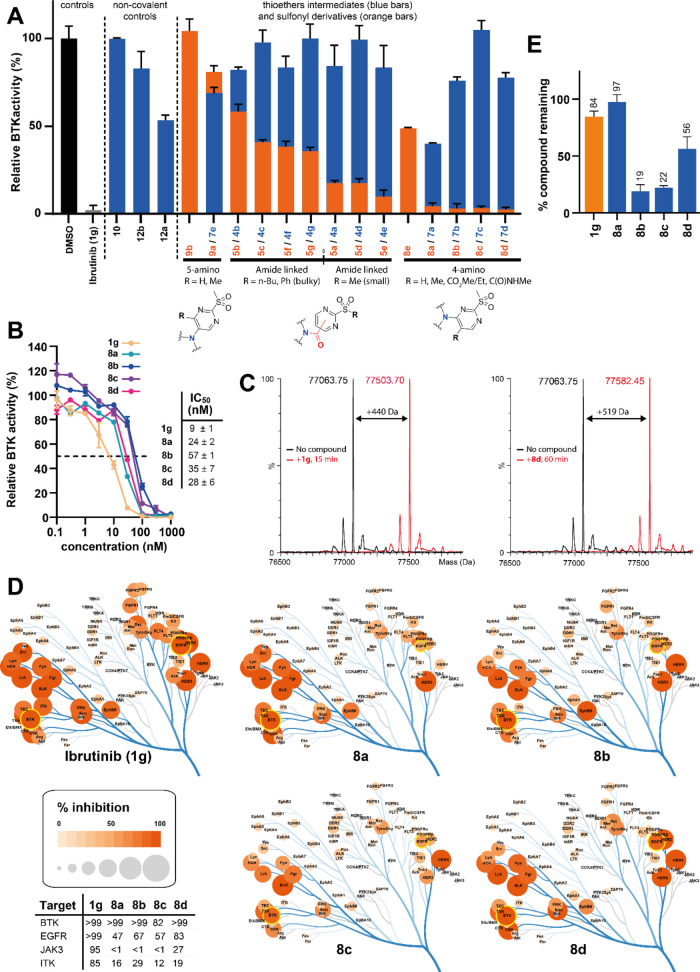
Figure 2
BTK engagement by Ibrutinib (1g) and synthetic derivatives in vitro: (A) Inhibition of poly-Glu:Tyr in in vitro phosphorylation by BTK by 2-SP functionalized Ibrutinib analogues. Relative BTK activity (%, mean ± range, 2–12 replicates) in the presence of compounds (single concentration, 100 nM) normalized against the DMSO control. Note: (tris(2-carboxyethyl)phosphine) (TCEP) was used as a reducing agent in the assay in place of thiol-based ones, to prevent reaction and inactivation of the 2-SP warheads; (B) BTK dose–response inhibition and IC50 determination for Ibrutinib (1g) and derivatives 8ad. Top panel: % remaining BTK activity for all compounds in a concentration range of 0.1–1000 nM in duplicate (top panel) and IC50 calculation (bottom panel); (C) modification of intact full-length WT BTK by Ibrutinib (1g, left panel) and derivative 8d (right panel). Data for 8ac are presented in the Supporting Information, along with all data on the corresponding C481S mutant; and (D) percentage inhibition (ScanTK assay) of a panel of 135 tyrosine kinases by Ibrutinib (1g) and new synthetic derivatives 8ad. (E) Human plasma stability (% remaining) of Ibrutinib (1g) and 8ad after 3 h incubation time at 37 °C.
Figure 3
Figure 3
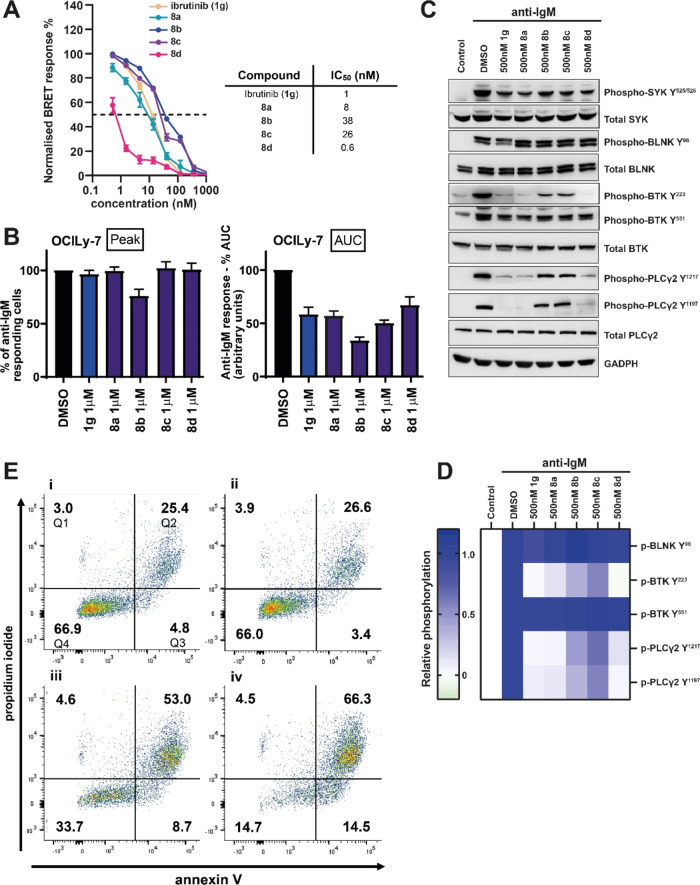
Target engagement in cells and mechanistic studies: (A) BTK dose–response inhibition and IC50 determinations for Ibrutinib (1g) and derivatives 8ad, determined by NanoBRET. Left panel: % remaining BTK activity in HEK293 cells for all the compounds at a concentration range of 1–1000 nM by duplicate (left panel) and IC50 calculation (right panel). (B) Effect of compounds on anti-IgM-induced signaling in OCI-LY7 cells. The cells were pretreated with compounds (1000 nM) or DMSO for 1 h before analysis of anti-IgM-induced Ca2+ fluxes. Figures show representative results (from 3 to 7 separate determinations) for effects on peak (maximum number of responding cells) and duration (area under the curve, AUC). (C) OCI-LY7 cells were pretreated with the indicated compounds (500 nM) or DMSO for 1 h and then treated with anti-IgM or control antibody for 30 s. Expression of the indicated proteins was analyzed by immunoblotting. Representative results (C) and heat map (D) show relative phosphorylation with values for anti-IgM/DMSO-treated cells set to 1.0 (from 2 or 3 independent experiments). See Figure S3A for additional quantification. (E) Apoptotic activity: TMD8 cells were treated with compounds for 72 h before cell viability was analyzed using annexin V/PI staining. Representative results for cells treated with DMSO (i) or compound 8d at 10 (ii), 100 (iii), or 1000 nM (iv); See Figure S4 for additional quantification.
Figure 4
Figure 4
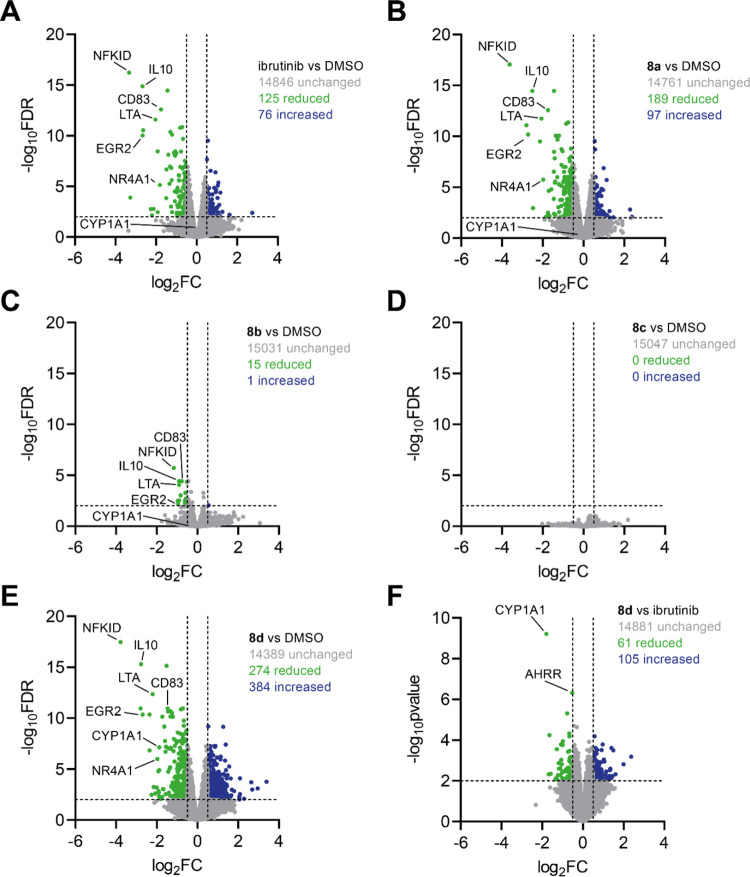
Effect of compounds on gene expression in TMD8 cells. Volcano plots showing changes in gene expression in TMD8 cells in response to treatment (1 μM, 8-h incubation) with (A) Ibrutinib (1g), (B) 8a, (C) 8b, (D) 8c, and (E) 8d. Difference in gene expression profiles between 8d and Ibrutinib (1g). In all panels, significantly downregulated genes are colored green and significantly upregulated genes are colored blue. Cut-offs are log2FC ← 0.5/>0.5 and FDR < 0.01 (AE) or p-value <0.01 (F).

References

    1. Lonsdale R.; Ward R. A. Structure-based design of targeted covalent inhibitors. Chem. Soc. Rev. 2018, 47 (11), 3816–3830. 10.1039/C7CS00220C. - DOI - PubMed
    1. Singh J.; Petter R. C.; Baillie T. A.; Whitty A. The resurgence of covalent drugs. Nat. Rev. Drug Discovery 2011, 10 (4), 307–317. 10.1038/nrd3410. - DOI - PubMed
    1. Krishnan S.; Miller R. M.; Tian B.; Mullins R. D.; Jacobson M. P.; Taunton J. Design of Reversible, Cysteine-Targeted Michael Acceptors Guided by Kinetic and Computational Analysis. J. Am. Chem. Soc. 2014, 136 (36), 12624–12630. 10.1021/ja505194w. - DOI - PMC - PubMed
    1. Lonsdale R.; Burgess J.; Colclough N.; Davies N. L.; Lenz E. M.; Orton A. L.; Ward R. A. Expanding the Armory: Predicting and Tuning Covalent Warhead Reactivity. J. Chem. Inf. Model. 2017, 57 (12), 3124–3137. 10.1021/acs.jcim.7b00553. - DOI - PubMed
    1. Ravasco J. M. J. M.; Faustino H.; Trindade A.; Gois P. M. P. Bioconjugation with Maleimides: A Useful Tool for Chemical Biology. Chem. – Eur. J. 2019, 25 (1), 43–59. 10.1002/chem.201803174. - DOI - PubMed

Publication types

MeSH terms

LinkOut - more resources