


The effect of early childhood non-nutritive sucking behavior including pacifiers on malocclusion: a randomized controlled trial
- PMID: 39119981
- PMCID: PMC11310778
- DOI: 10.1093/ejo/cjae024
The effect of early childhood non-nutritive sucking behavior including pacifiers on malocclusion: a randomized controlled trial
Abstract
Background/rationale: Systematic reviews on the effects of pacifiers on occlusion have highlighted the need for quality RCTs.
Trial design: Single region, three parallel-armed, prospective, randomized controlled trial.
Objectives: To investigate the correlations between early childhood non-nutritive sucking habits and malocclusion. Specifically to test whether the use of a study pacifier has differing effects compared to other pacifiers and control, and whether the duration of pacifier use or digit sucking influence the occlusion.
Participants: The subjects were firstborn children, born in 2008 in Vantaa, Finland.
Intervention: One-third of participants were offered study pacifiers, free of charge, from birth up to 2 years of age. The history of the subjects' sucking habits, including pacifier use was screened in a questionnaire at the age of 2 years, and clinical examinations were performed at the age of 7 years. In addition, the subjects were divided into groups that were equally matched regarding their mother's level of education.
Outcomes: Posterior crossbite, anterior crossbite, overjet, deep bite, open bite, and crowding.
Randomization method: Three districts were randomly allocated to three study groups by drawing lots.
Blinding: It was not possible to blind the clinicians or parents from the intervention. Blinding during data analysis was performed.
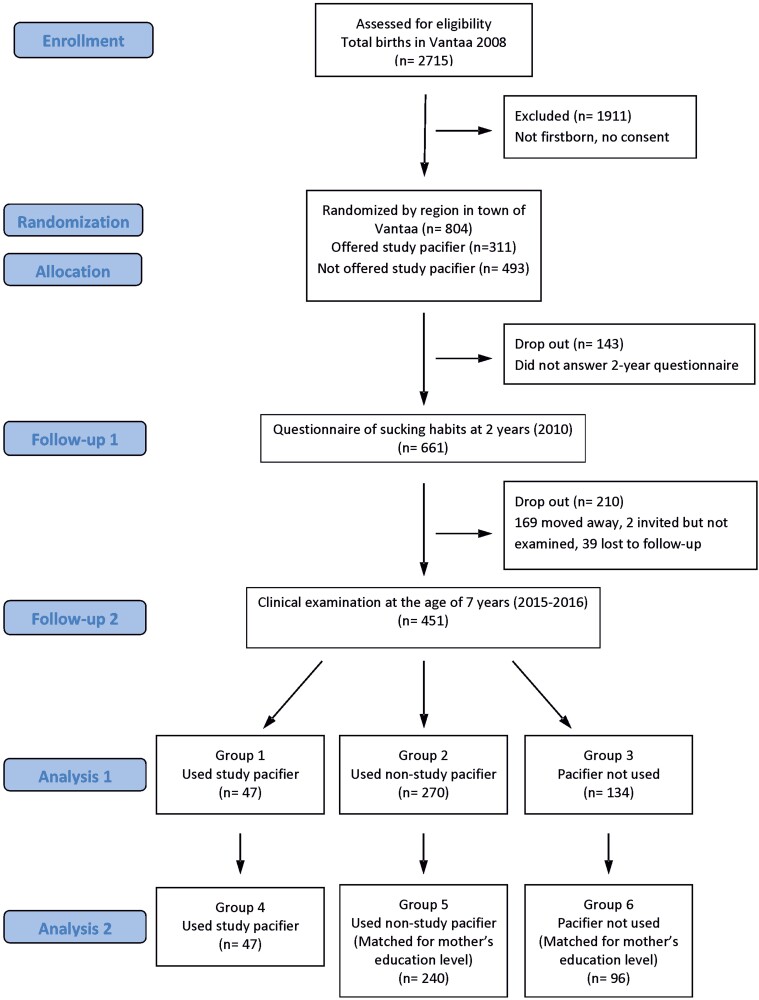
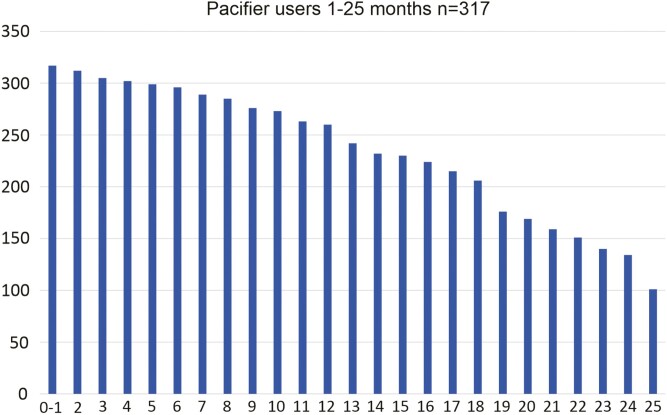
Results: From the original cohort of 2715 children born in the town of Vantaa, 1911 were excluded and 353 were lost to follow-up. The remaining 451 children were divided into three groups according to the use of pacifiers. The prevalence of posterior crossbite at the age of 7 years was higher if a non-study pacifier had been used (P = .005) even when matched for the mother's level of education (P = .029). The prevalence of posterior crossbite was higher if the pacifier habit had continued for 12 months or more compared to 11 months or less, 7% and 1%, respectively, (P = .003). Digit sucking for 12 months or more was associated with crowding (P = .016). The prevalence of crossbite in the study pacifier group was less than in control pacifiers.
Harms: No adverse harms were reported other than effects on the dentition.
Conclusion: The use of pacifiers is associated with the posterior crossbite, especially if their use continues for a year or more. Parents/guardians should be advised to stop the use or reduce the use of pacifiers to a minimum after their child's first birthday.
Trial registration: ClinicalTrials.gov NCT01854502.
Keywords: digit sucking; malocclusion; non-nutritive sucking habit; pacifier sucking.
© The Author(s) 2024. Published by Oxford University Press on behalf of the European Orthodontic Society.
Conflict of interest statement
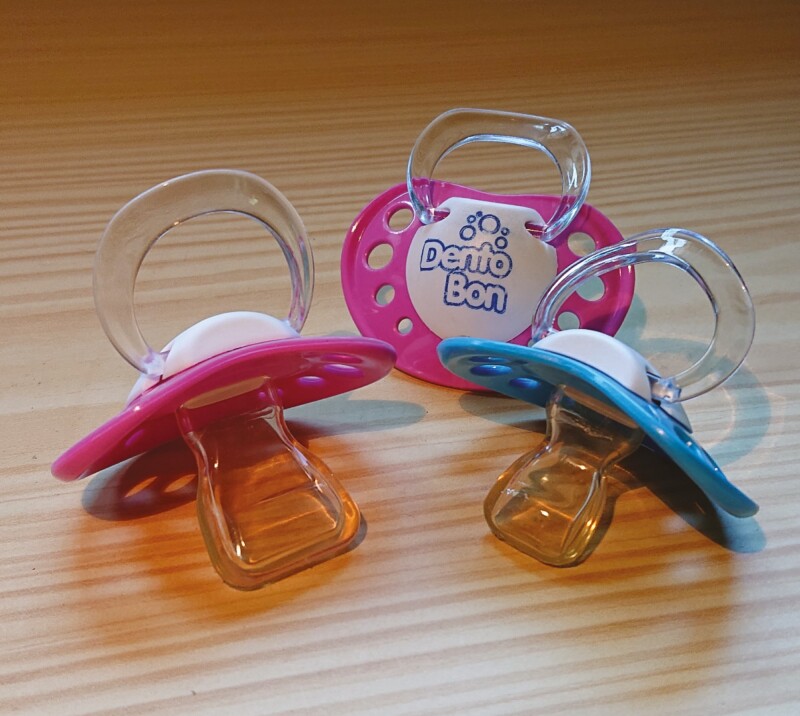
The study pacifier (DentoBon) was designed at the University of Turku.
Figures
References
-
- Larsson E. The prevalence and etiology of prolonged dummy and finger-sucking habits. European Journal of Orthodontics 1985;7:172–6. - PubMed
-
- Myllarniemi S. Oral and dental state in Helsinki preschool children. 3. Prevalence of dummy and finger sucking habits. Proceedings of the Finnish Dental Society. 1973;69:47–51. - PubMed
-
- Adair SM, Milano M, Dushku JC.. Evaluation of the effects of orthodontic pacifiers on the primary dentitions of 24- to 59-month-old children: preliminary study. Pediatric Dentistry 1992;14:13–8. - PubMed
Publication types
MeSH terms
Associated data
Grants and funding
LinkOut - more resources
Full Text Sources
Medical
