. 2024 Sep;300(9):107642.
doi: 10.1016/j.jbc.2024.107642. Epub 2024 Aug 8.

SOX2 represses c-MYC transcription by altering the co-activator landscape of the c-MYC super-enhancer and promoter regions

Affiliations

SOX2 represses c-MYC transcription by altering the co-activator landscape of the c-MYC super-enhancer and promoter regions

Briana D Ormsbee Golden et al. J Biol Chem. 2024 Sep.

Abstract

Our previous studies determined that elevating SOX2 in a wide range of tumor cells leads to a reversible state of tumor growth arrest. Efforts to understand how tumor cell growth is inhibited led to the discovery of a SOX2:MYC axis that is responsible for downregulating c-MYC (MYC) when SOX2 is elevated. Although we had determined that elevating SOX2 downregulates MYC transcription, the mechanism responsible was not determined. Given the challenges of targeting MYC clinically, we set out to identify how elevating SOX2 downregulates MYC transcription. In this study, we focused on the MYC promoter region and an upstream region of the MYC locus that contains a MYC super-enhancer encompassing five MYC enhancers and which is associated with several cancers. Here we report that BRD4 and p300 associate with each of the MYC enhancers in the upstream MYC super-enhancer as well as the MYC promoter region and that elevating SOX2 decreases the recruitment of BRD4 and p300 to these sites. Additionally, we determined that elevating SOX2 leads to increases in the association of SOX2 and H3K27me3 within the MYC super-enhancer and the promoter region of MYC. Importantly, we conclude that the increases in SOX2 within the MYC super-enhancer precipitate a cascade of events that culminates in the repression of MYC transcription. Together, our studies identify a novel molecular mechanism able to regulate MYC transcription in two distinctly different tumor types and provide new mechanistic insights into the molecular interrelationships between two master regulators, SOX2 and MYC, widely involved in multiple cancers.

Keywords: A-485; BRD4; RNA polymerase II; SOX2; c-MYC; colorectal cancer; medulloblastoma; p300; super-enhancer; transcription.


Conflict of interest statement

Conflicts of interest The authors declare that they have no conflicts of interest with the contents of this article.

Figures
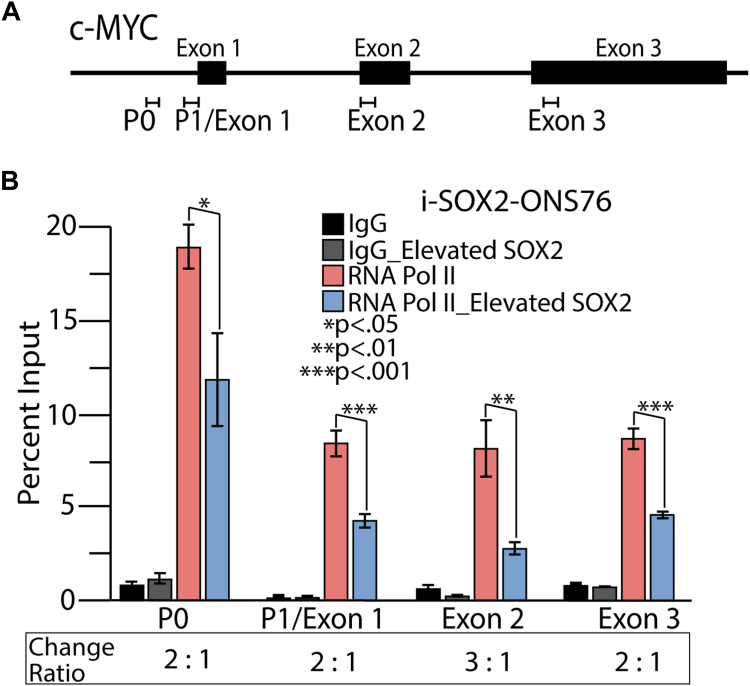
Figure 1
Figure 1
RNA Pol II association with the MYC promoter region and the MYC gene body before and after elevation of SOX2.A, the MYC gene within the 3 Mb MYC locus consists of promoter regions designated P0 and P1, as well as three exons, for which primer sets (regions represented by bracketed horizontal lines) were utilized to test for the presence of different transcription machinery by ChIP-qPCR. B, i-SOX2-ONS76 control cells and cells induced for elevated SOX2 with 48 h of 200 ng/ml Doxycycline were processed for ChIP-qPCR with an IgG control antibody and RNA Pol II antibody. Enrichment was determined as compared to the Input and p values by t test for two tails, two sample equal variance, n = 3.
Figure 2
Figure 2
The levels of histone H3K4me3 and BRD4 association at the P0 and P1 MYC promoters and nuclear protein levels of BRD4 before and after elevation of SOX2. i-SOX2-ONS76 control cells and cells treated with 200 ng/ml Dox for 48 h were processed for ChIP-qPCR with an IgG control antibody and an antibody against (A) H3K4me3 and (B) BRD4. Enrichment was determined as compared to the Input and p values by t test for two tails, two sample equal variance, n = 3. C, Western blot analysis to measure BRD4 protein levels in nuclear extracts prepared from i-SOX2-ONS76 and i-SOX2-HCT116 cells after 48 h treatment at the indicated Dox dosage followed by benzonase treatment of the isolated nuclei. Western blot analysis of BRD4 was repeated and similar results were obtained. Dox, doxycycline.
Figure 3
Figure 3
Acetylation of histone H3K27 and binding of p300 at the P0 and P1 promoters of the MYC gene, and p300 nuclear protein levels before and after SOX2 elevation. i-SOX2-ONS76 control cells and cells induced to elevate SOX2 using 200 ng/ml Dox for 48 h were processed for ChIP-qPCR with an IgG control antibody and an (A) H3K27ac antibody, as well as a (B) p300 antibody. Enrichment was determined as compared to the Input and p values by t test for two tails, two sample equal variance, n = 3. C, Western blot analysis of nuclear extracts prepared from i-SOX2-ONS76 control cells and cells cultured for 48 h in the indicated doses of Dox was conducted following the benzonase treatment of the nuclei to ensure inclusion of chromatin-bound protein. Western blot analysis of p300 was repeated and similar results were obtained. Dox, doxycycline.
Figure 4
Figure 4
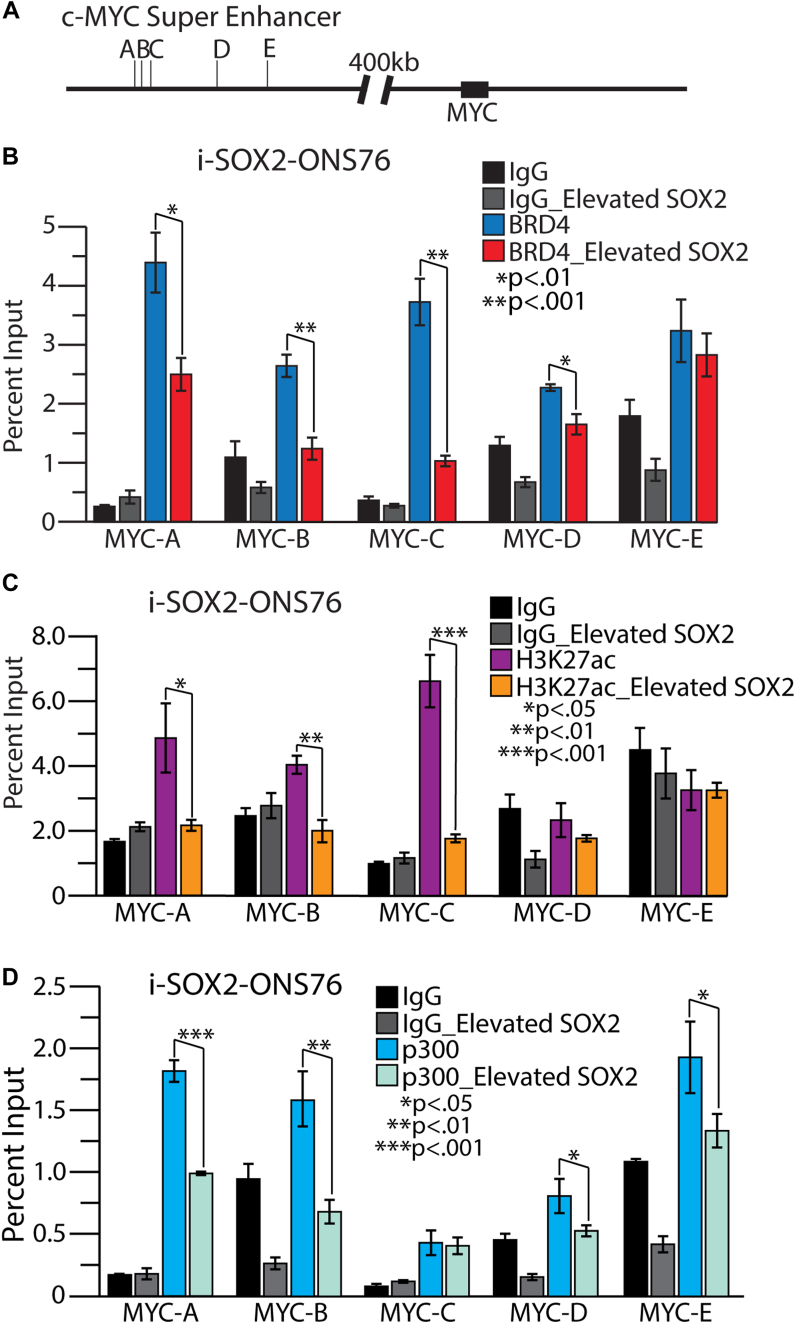
BRD4, acetylated histone H3K27, and p300 association with the MYC super-enhancer before and after elevation of SOX2.A, the MYC super-enhancer consists of a cluster of five MYC enhancers, A-E denoted here by vertical lines at the approximate primer set sites, located more than 400 kb upstream of the MYC gene body. i-SOX2-ONS76 control cells and cells cultured for 48 h with 200 ng/ml Doxycycline were processed for ChIP-qPCR with an IgG control antibody and an antibody against (B) BRD4, (C) H3K27ac, and (D) p300. Enrichment was determined as compared to the Input and p values by t test for two tails, two sample equal variance, n = 3.
Figure 5
Figure 5
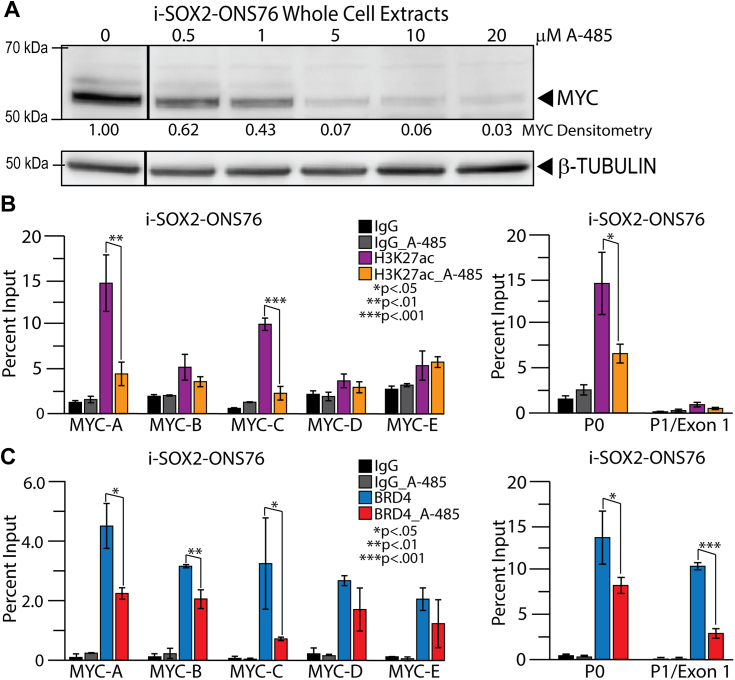
MYC protein expression, histone modification, and BRD4 association with the MYC super-enhancer before and after inhibition of p300 in i-SOX2-ONS76 cells.A, control cells and cells inhibited for 19 h with A-485 at increasing concentrations were processed for Western blot analysis. An unrelated lane, between the first and second lane in the figure, was spliced out to simplify the figure as it contained a cell sample of Dox treatment without A-485 that served as additional confirmation of MYC downregulation upon SOX2 elevation, which we provided with another experiment in Fig. S1A. Control cells and cells inhibited with 10 μM A-485 were processed for ChIP-qPCR with an IgG control antibody and antibodies to determine the status of (B) H3K27ac and (C) BRD4 binding. Enrichment was determined as compared to the Input and p values by t test for two tails, two sample equal variance, n = 3.
Figure 6
Figure 6
Association of SOX2 and histone H3K27me3 at the MYC locus before and after SOX2 elevation. i-SOX2-ONS76 control cells and cells induced to elevate SOX2 using 200 ng/ml Dox for 48 h were processed for ChIP-qPCR with an IgG control antibody and antibodies against (A) SOX2 and (B) H3K27me3. Enrichment was determined as compared to the Input and p values by t test for two tails, two sample equal variance, n = 3. C, RNA isolation and RT-qPCR analysis of MYC levels of i-SOX2-ONS76 control cells and cells in the absence and presence of either or both 200 ng/ml Dox and 10 μM EPZ-6438 treatment for 48 h. D, i-SOX2-ONS76 cells induced to elevate SOX2 using 200 ng/ml Dox alone or in combination with 10 μM EPZ-6438 for 48 h were processed for ChIP-qPCR with an IgG control antibody and an antibody against H3K27me3. Enrichment was determined as compared to the Input and p values by t test for two tails, two sample equal variance, n = 3. Dox, doxycycline.
Figure 7
Figure 7
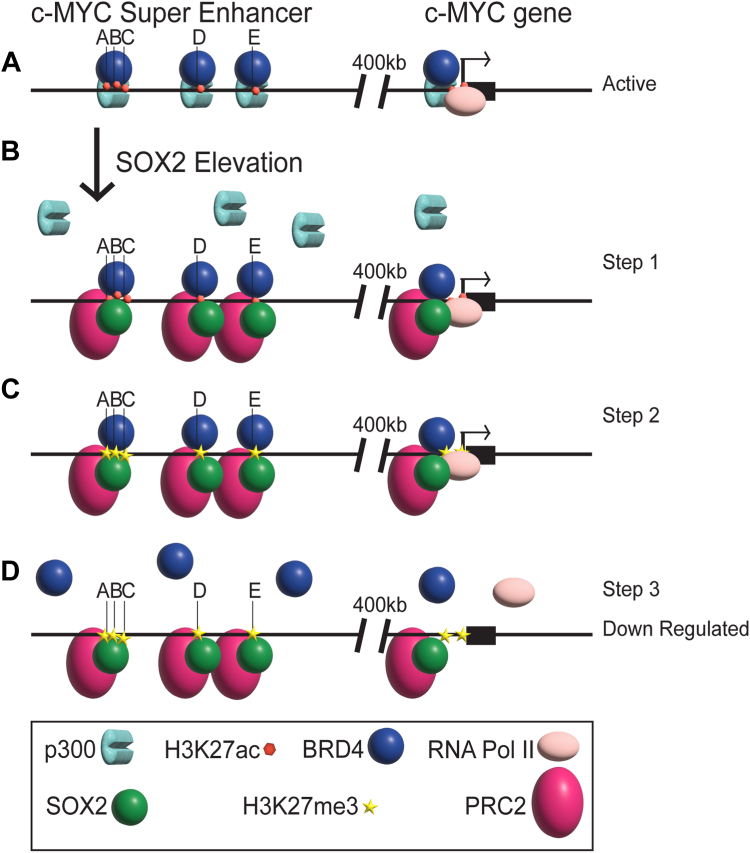
Model of co-activator and histone modification status at the MYC super-enhancer and MYC promoter region when SOX2 is elevated.A, The actively transcribed state of the MYC gene in tumor cells; presence of p300, H3K27ac, and BRD4 within the MYC super-enhancer, and p300, BRD4, H3K27ac along with RNA Pol II at the MYC promoter region. B, step1: SOX2 elevation leads to a decrease in p300 association and newly associated SOX2, along with other complex proteins (such as PRC2). C, step 2: lower levels of H3K27ac due to the decrease in p300, while H2K27me3 increased in its stead, likely due to the new presence of SOX2’s recruited partner complexes, such as PRC2. D, step 3: decreased recruitment of BRD4 to the MYC super-enhancer and promoter region, and less RNA Pol II at the MYC promoter region, leading to repression of MYC transcription.
Supplemental Fig S1
Supplemental Fig S1
Supplemental Fig S2
Supplemental Fig S2
Supplemental Fig S3
Supplemental Fig S3
Supplemental Fig S4
Supplemental Fig S4
Supplemental Fig S5
Supplemental Fig S5
Supplemental Fig S6
Supplemental Fig S6
Supplemental Fig S7
Supplemental Fig S7

References

    1. Dang C.V. MYC on the path to cancer. Cell. 2012;149:22–35. - PMC - PubMed
    1. Jha R.K., Kouzine F., Levens D. MYC function and regulation in physiological perspective. Front. Cell Dev. Biol. 2023;11 - PMC - PubMed
    1. Duffy M.J., O’Grady S., Tang M., Crown J. MYC as a target for cancer treatment. Cancer Treat. Rev. 2021;94 - PubMed
    1. Madden S.K., De Araujo A.D., Gerhardt M., Fairlie D.P., Mason J.M. Taking the Myc out of cancer: toward therapeutic strategies to directly inhibit c-Myc. Mol. Cancer. 2021;20:3. - PMC - PubMed
    1. Metz E.P., Wilder P.J., Popay T.M., Wang J., Liu Q., Kalluchi A., et al. Elevating SOX2 downregulates MYC through a SOX2:MYC signaling Axis and induces a slowly cycling proliferative state in human tumor cells. Cancers. 2022;14:1946. - PMC - PubMed

MeSH terms

LinkOut - more resources