


Chronic stress deficits in reward behaviour co-occur with low nucleus accumbens dopamine activity during reward anticipation specifically
- PMID: 39123076
- PMCID: PMC11316117
- DOI: 10.1038/s42003-024-06658-9
Chronic stress deficits in reward behaviour co-occur with low nucleus accumbens dopamine activity during reward anticipation specifically
Abstract
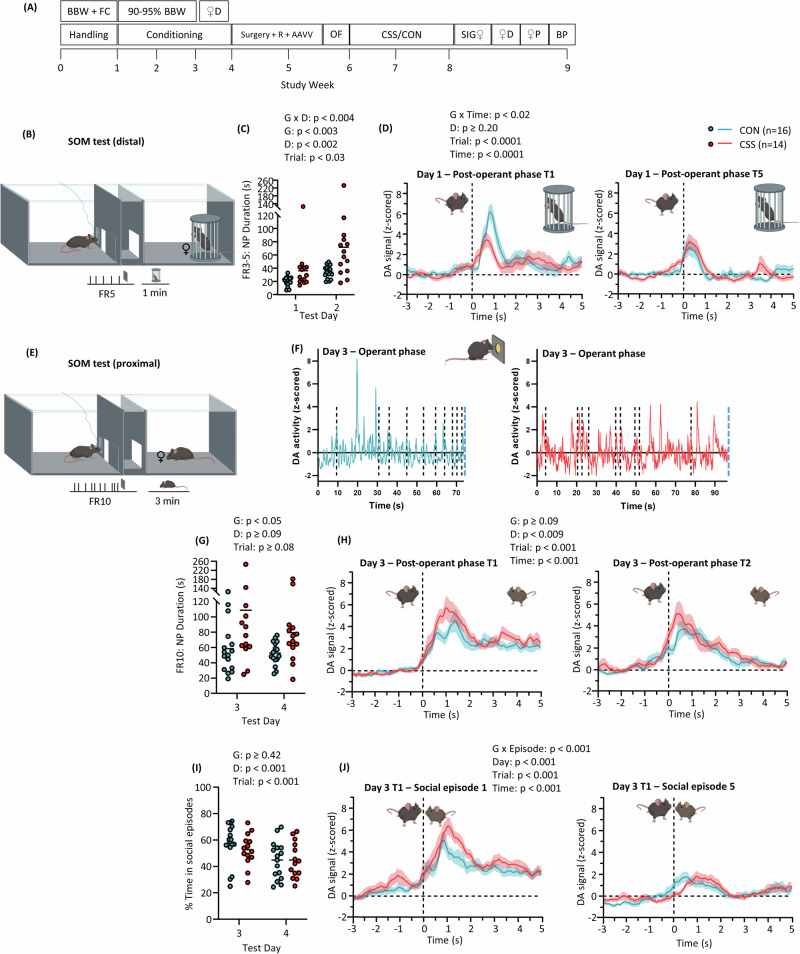
Whilst reward pathologies are major and common in stress-related neuropsychiatric disorders, their neurobiology and treatment are poorly understood. Imaging studies in human reward pathology indicate attenuated BOLD activity in nucleus accumbens (NAc) coincident with reward anticipation but not reinforcement; potentially, this is dopamine (DA) related. In mice, chronic social stress (CSS) leads to reduced reward learning and motivation. Here, DA-sensor fibre photometry is used to investigate whether these behavioural deficits co-occur with altered NAc DA activity during reward anticipation and/or reinforcement. In CSS mice relative to controls: (1) Reduced discriminative learning of the sequence, tone-on + appetitive behaviour = tone-on + sucrose reinforcement, co-occurs with attenuated NAc DA activity throughout tone-on and sucrose reinforcement. (2) Reduced motivation during the sequence, operant behaviour = tone-on + sucrose delivery + sucrose reinforcement, co-occurs with attenuated NAc DA activity at tone-on and typical activity at sucrose reinforcement. (3) Reduced motivation during the sequence, operant behaviour = appetitive behaviour + sociosexual reinforcement, co-occurs with typical NAc DA activity at female reinforcement. Therefore, in CSS mice, low NAc DA activity co-occurs with low reward anticipation and could account for deficits in learning and motivation, with important implications for understanding human reward pathology.
© 2024. The Author(s).
Conflict of interest statement
G.A-L. and B.H. are employees of Boehringer Ingelheim Pharma GmbH & Co KG. C.R.P. has received funding from Boehringer Ingelheim Pharma GmbH & Co KG. All other authors report no biomedical financial interests or potential competing interests.
Figures



References
Publication types
MeSH terms
Substances
Grants and funding
LinkOut - more resources
Full Text Sources
Medical
Molecular Biology Databases
