


Autologous Fat Grafting (AFG): A Systematic Review to Evaluate Oncological Safety in Breast Cancer Patients
- PMID: 39124636
- PMCID: PMC11313166
- DOI: 10.3390/jcm13154369
Autologous Fat Grafting (AFG): A Systematic Review to Evaluate Oncological Safety in Breast Cancer Patients
Abstract
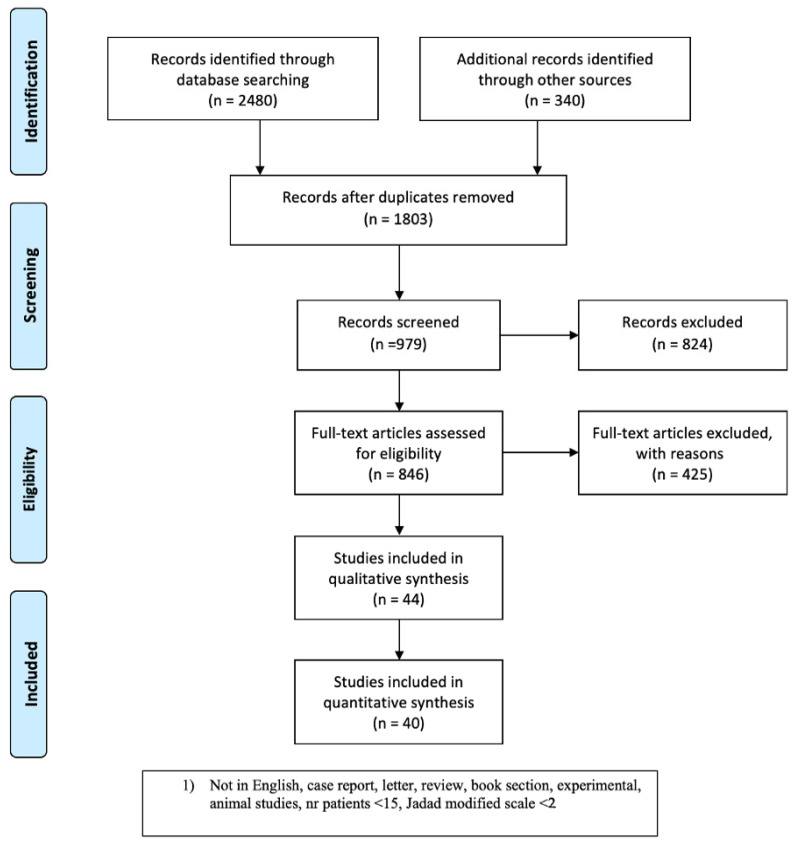
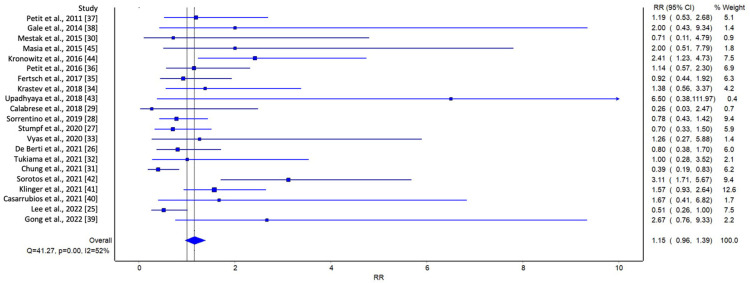
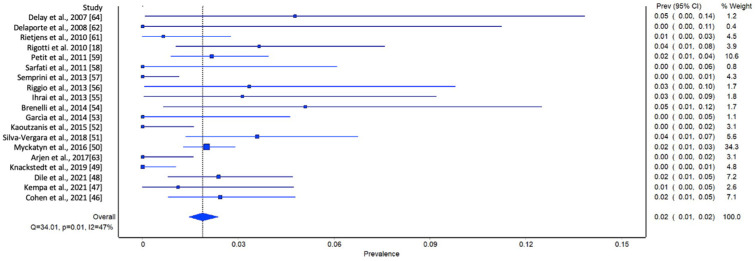
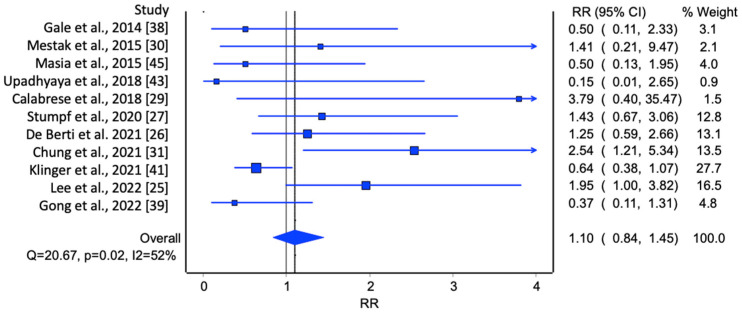
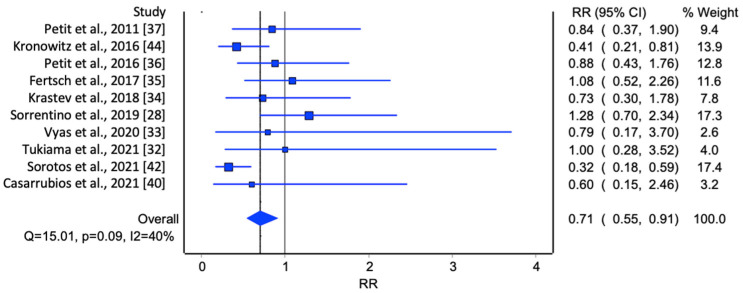
Background: Autologous fat grafting (AFG) has emerged as a useful technique in breast reconstruction. Utilizing a patient's own fat from areas like the abdomen or thighs, AFG serves various reconstruction needs. Nevertheless, the oncological safety of AFG in breast cancer patients has become a contentious issue. Concerns about its influence on cancer recurrence and detention have led to significant clinical debate and the need for thorough investigation. Methods: To determine the impact of autologous fat grafting (AFG) on loco-regional recurrence (LRR) in breast cancer survivors undergoing reconstruction, a comprehensive search of databases including PubMed, Medline, Web of Science, and Cochrane libraries was conducted from November 2023 through March 2024. This search adhered to the PRISMA guidelines and aimed to identify all the relevant studies on AFG in the context of breast reconstruction post cancer treatment. A meta-analysis was performed. Results: Out of the studies reviewed, 40 met the inclusion criteria, with a total patient cohort of 14,078. The analysis revealed that AFG had no significant association with increased rates of LRR. Conclusions: According to the available literature, AFG is a safe reconstructive option for breast cancer patients and does not increase the risk of loco-regional recurrence. Nevertheless, further well-structured long-term prospective studies are required, since heterogeneity of available studies is high and requires standardization.
Keywords: LRR; autologous fat grafting; breast cancer; breast reconstruction; lipofilling; recurrence.
Conflict of interest statement
The authors declare no conflicts of interest.
Figures
References
-
- Calabrese C., Casella D., Di Taranto G., Marcasciano M., Kothari A., Sordi S., Barellini L., Torto F.L., Tarallo M., Perra A., et al. Oncoplastic conservative surgery for breast cancer: Long-term outcomes of our first ten years experience. Eur. Rev. Med. Pharmacol. Sci. 2018;22:7333–7342. doi: 10.26355/eurrev_201811_16270. - DOI - PubMed
-
- Hanson S.E., Lei X., Roubaud M.S., DeSnyder S.M., Caudle A.S., Shaitelman S.F., Hoffman K.E., Smith G.L., Jagsi R., Peterson S.K., et al. Long-term Quality of Life in Patients with Breast Cancer after Breast Conservation vs. Mastectomy and Reconstruction. JAMA Surg. 2022;157:e220631. doi: 10.1001/jamasurg.2022.0631. - DOI - PMC - PubMed
Publication types
LinkOut - more resources
Full Text Sources
Miscellaneous
