


A Systematic Review and Meta-Analysis of the Diagnostic Value of Galectin-3 in Acute Coronary Syndrome
- PMID: 39124770
- PMCID: PMC11313188
- DOI: 10.3390/jcm13154504
A Systematic Review and Meta-Analysis of the Diagnostic Value of Galectin-3 in Acute Coronary Syndrome
Abstract
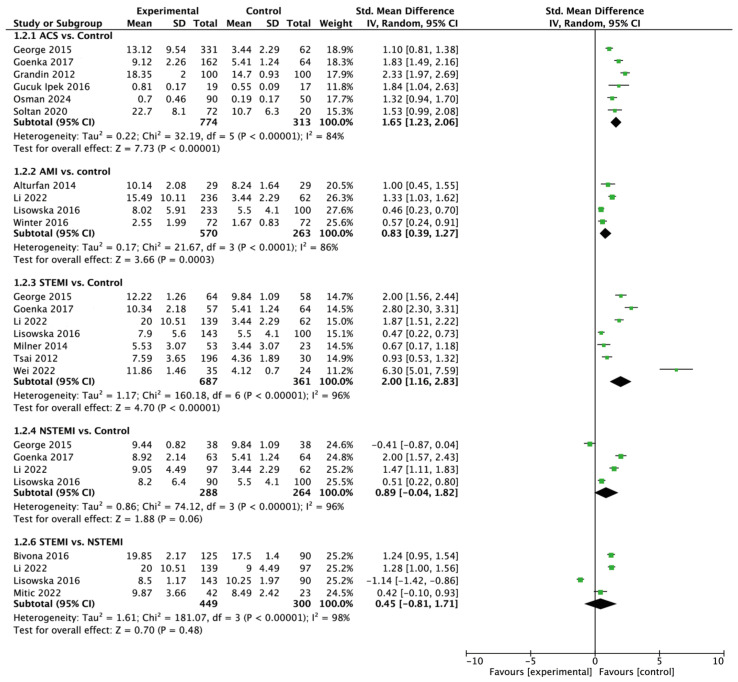
Background/Objectives: We investigated the potential diagnostic role of galectin-3 (Gal-3) in patients presenting with suspected acute coronary syndromes (ACS). Methods: We searched PubMed Central, Scopus, EMBASE, and the Cochrane Library from inception until 20 June 2024. We measured effect sizes using odds ratios (OR) with 95% CIs for dichotomous data and mean differences (MD) with CIs for continuous data. Random synthesis analysis was performed if I2 was less than 50% or Q test p values were less than 0.05. Otherwise, a fixed pooled meta-analysis was performed. Results: The meta-analysis includes 15 eligible studies. Gal-3 levels were substantially higher in the ACS group (12.84 ± 8.48 ng/mL) compared to the control group (7.23 ± 6.05 ng/mL; MD = 3.89; 95% CI: 2.83 to 4.95; p < 0.001). Gal-3 levels in acute myocardial infarction (AMI) and control groups differed (10.09 ± 8.16 vs. 4.64 ± 3.07 ng/mL, MD = 4.30; 95% CI: 0.41 to 8.18; p < 0.001). Statistical analysis revealed significant differences in Gal-3 levels between ST-elevated myocardial infarction (STEMI) and control groups (10.62 ± 7.34 vs. 5.54 ± 2.96 ng/mL; MD = 5.54; 95% CI: 3.12 to 7.97; p < 0.001). No significant differences were found between the non-ST-elevated myocardial infarction (NSTEMI) vs. control groups or patients with STEMI vs. patients with NSTEMI. Conclusions: Gal-3 may be beneficial for detecting acute coronary syndromes but not NSTEMI or differentiating between ACS types. This meta-analysis is promising, but further research is needed to prove Gal-3's potential diagnostic value, exact cut-offs, and advantages over cardiospecific troponins. Gal-3 may be a useful diagnostic biomarker; however, more clinical trials are needed to prove its utility.
Keywords: acute coronary syndrome; biomarker; diagnosis; galectin-3; inflammation.
Conflict of interest statement
Author Michal Pruc, Zuzanna Gaca, Damian Swieczkowski and Lukasz Szarpak were employed by the LUX MED Group. The remaining authors declare that the research was conducted in the absence of any commercial or financial relationships that could be construed as a potential conflict of interest.
Figures
References
-
- Bettinger N., Palmerini T., Caixeta A., Dressler O., Litherland C., Francese D.P., Giustino G., Mehran R., Leon M.B., Stone G.W., et al. Risk stratification of patients undergoing medical therapy after coronary angiography. Eur. Heart J. 2016;37:3103–3110. doi: 10.1093/eurheartj/ehv674. - DOI - PubMed
-
- Moumneh T., Sun B.C., Baecker A., Park S., Redberg R., Ferencik M., Lee M.S., Douillet D., Roy P.M., Sharp A.L. Identifying Patients with Low Risk of Acute Coronary Syndrome Without Troponin Testing: Validation of the HEAR Score. Am. J. Med. 2021;134:499–506.e2. doi: 10.1016/j.amjmed.2020.09.021. - DOI - PubMed
-
- Tscherny K., Kienbacher C., Fuhrmann V., van Tulder R., Schreiber W., Herkner H., Roth D. Risk stratification in acute coronary syndrome: Evaluation of the GRACE and CRUSADE scores in the setting of a tertiary care centre. Int. J. Clin. Pract. 2020;74:e13444. doi: 10.1111/ijcp.13444. - DOI - PMC - PubMed
LinkOut - more resources
Full Text Sources
