. 2025 Dec 8;136(5-6):1251-1263.
doi: 10.1093/aob/mcae131.

Anatomical and physiological responses of roots and rhizomes in Oryza longistaminata to soil water gradients

Affiliations

Anatomical and physiological responses of roots and rhizomes in Oryza longistaminata to soil water gradients

Zhiwei Song et al. Ann Bot. .

Abstract

Background and aims: Roots and rhizomes are crucial for the adaptation of clonal plants to soil water gradients. Oryza longistaminata, a rhizomatous wild rice, is of particular interest for perennial rice breeding owing to its resilience in abiotic stress conditions. Although root responses to soil flooding are well studied, rhizome responses to water gradients remain underexplored. We hypothesize that physiological integration of Oryza longistaminata mitigates heterogeneous water-deficit stress through interconnected rhizomes, and both roots and rhizomes respond to contrasting water conditions.

Methods: We investigated the physiological integration between mother plants and ramets, measuring key photosynthetic parameters (photosynthetic and transpiration rates and stomatal conductance) using an infrared gas analyser. Moreover, root and rhizome responses to three water regimes (flooding, well watered and water deficit) were examined by measuring radial water loss and apparent permeance to O2, along with histochemical and anatomical characterization.

Key results: Our experiment highlights the role of physiological integration via interconnected rhizomes in mitigating water-deficit stress. Severing rhizome connections from mother plants or ramets exposed to water-deficit conditions led to significant decreases in key photosynthetic parameters, underscoring the importance of rhizome connections in bidirectional stress mitigation. Additionally, O. longistaminata rhizomes exhibited constitutive suberized and lignified apoplastic barriers, and such barriers were induced in roots in water stress. Anatomically, both rhizomes and roots respond in a similar manner to water gradients, showing smaller diameters in water-deficit conditions and larger diameters in flooding conditions.

Conclusion: Our findings indicate that physiological integration through interconnected rhizomes helps to alleviate water-deficit stress when either the mother plant or the ramet is experiencing water deficit, while the counterpart is in control conditions. Moreover, O. longistaminata can adapt to various soil water regimes by regulating anatomical and physiological traits of roots and rhizomes.

Keywords: Apparent permeance to O2; cortex to stele ratio; drought; flooding; large gas spaces; number of vascular bundles; perennial rice; physiological integration; radial water loss; red rice; root porosity; tissue diameter.


Conflict of interest statement

None declared.

Figures
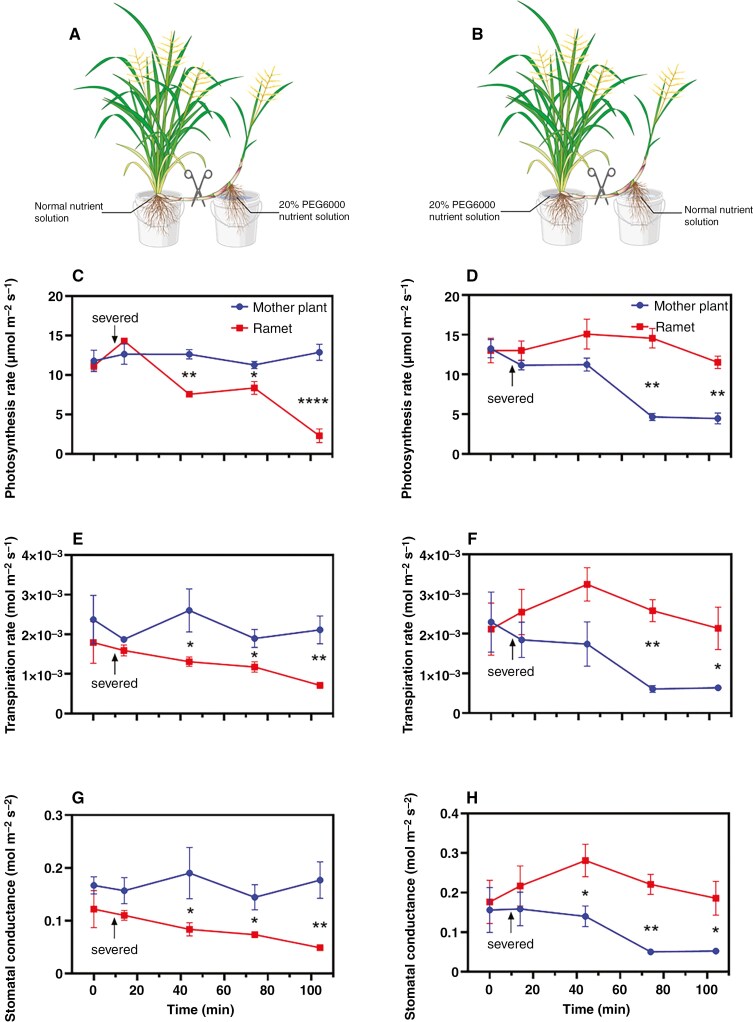
Fig. 1.
Fig. 1.
Response of key photosynthetic parameters to interconnected rhizome cutting. (A) Cutting the interconnected rhizome when the ramet is exposed to water deficit and mother plant is in control solution. (B) Cutting the interconnected rhizome when the mother plant is exposed to water deficit and the ramet is in control solution. (C, D) Photosynthetic rate. (E, F) Transpiration rate. (G, H) Stomatal conductance. Mother plant or ramet had been exposed to severe water deficit for 2 weeks, and key photosynthetic parameters were measured before and after cutting the interconnected rhizome. Black arrows indicate the time when the interconnected rhizomes were severed. Data are means ± s.e., n = 3. The statistical comparisons were conducted with repeated-measures ANOVA (P < 0.01; see Supplementary Data Table S1) followed by Šídák’s test (*P ≤ 0.05; **P ≤ 0.01; ****P ≤ 0.0001). Panels A and B created with Biorender.com.
Fig. 2.
Fig. 2.
(A) Root cross-sections of Orya longistaminata grown in flooding, well-watered or water-deficit conditions. (B–E) Root porosity (B), root diameter (C), number of cell files (D) and cortex to stele ratio (E). Measurements were collected longitudinally at 5, 20, 40, 60 and 80 mm behind the root tip. In B, root porosity refers to both aerenchyma and small intercellular air spaces. Data are means ± s.e., n = 5. The statistical comparisons were conducted using two-way ANOVA (P < 0.01; see Supplementary Data Table S2) followed by Tukey’s test (different letters indicate significant difference, P < 0.05), and all data passed the Shapiro–Wilk normality test. In B, PT = 0.0226, PP < 0.0001 and PT×P = 0.0489. In C, PT < 0.0001, PP = 0.0014 and PT×P = 0.8465. In D, PT = 0.0024, PP = 0.0403 and PT×P = 0.6660. In E, PT < 0.0001, PP = 0.0191 and PT×P = 0.8690. Abbreviations: P, position; T, treatment; T × P, treatment and position interaction. Scale bars in A: 200 µm.
Fig. 3.
Fig. 3.
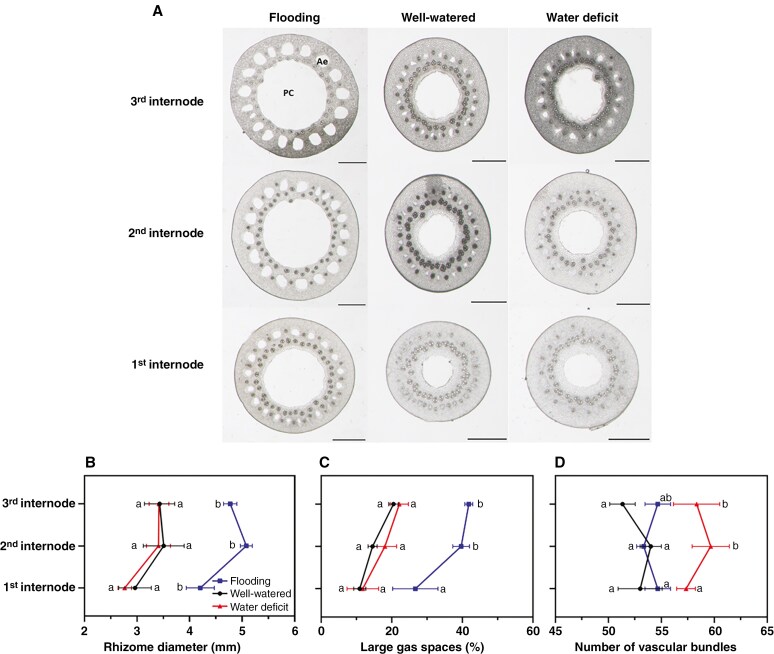
(A) Rhizome cross-sections of Oryza longistaminata grown in flooding, well-watered or water-deficit conditions. (B–D) Rhizome diameter (B), large gas spaces (C) and number of vascular bundles (D). Measurements were collected longitudinally at the first, second and third rhizome internodes. Refer to Supplementary Data Figure S3 for the longitudinal variation in these traits along different internodes. In C, the large gas spaces refer to both cortical aerenchyma and the pith cavity. Data are means ± s.e., n = 3. The statistical comparisons were conducted with two-way ANOVA (P < 0.01; see Supplementary Data Table S3) followed by Tukey’s test (different letters indicate significant difference, P < 0.05), and all data passed the Shapiro–Wilk normality test. In B, PT = 0.0054, PP = 0.0007 and PT×P = 0.6208. In C, PT = 0.0036, PP = 0.0008 and PT×P = 0.2165. In D, PT = 0.0110, PP = 0.6611 and PT×P = 0.5312. Abbreviations: Ae, aerenchyma; P, position; PC, pith cavity; T, treatment; T × P, treatment and position interaction. Scale bars in A: 1 mm.
Fig. 4.
Fig. 4.
The radial water loss (RWL) and the apparent permeance to O2 of roots and rhizomes in Oryza longistaminata grown in flooding, well-watered or water-deficit conditions. (A–C) Cumulative water loss. (D–H) Time trace of O2 intrusion (D–F), RWL (G) and apparent permeance to O2 (H). The RWL values for roots were extracted at the time point at which 15 % cumulative water loss had occurred (dashed line in A and Supplementary Data Fig. S4). For rhizome internodes and apexes, RWL values were extracted at the time at which 2 % cumulative water loss had occurred (dashed line in B, C and Supplementary Data Fig. S4). For apparent permeance to O2, root segments of 15–20 mm, corresponding to positions at 35–50 mm behind the root tip, and rhizomes of 20–25 mm in length from the second internode or the apex were used. The statistical comparisons were conducted using two-way ANOVA (see Supplementary Data Tables S5 and S6; P < 0.01) followed by Tukey’s test (different letters indicate significant difference, P < 0.05), and all data passed the Shapiro–Wilk normality test. Data are means ± s.e., n = 5. Mean, +; median, horizontal line; second and third quartiles, box; minimum and maximum values, whisker. Abbreviation: b.d., below detection limit (i.e. pO2 < 0.02 kPa).
Fig. 5.
Fig. 5.
Patterns of lignification, suberization and permeability to apoplastic tracer of roots (A) and rhizomes (B) of Oryza longistaminata grown in flooding, well-watered or water-deficit conditions. Root cross-sections were taken at 40 mm behind the root tip and rhizome cross-sections at the second internode. Black arrowheads point at lignified exodermal and sclerenchyma cells in roots and at epidermal and sub-epidermal cells of rhizomes. Yellow arrowheads point at suberized exodermal cells in roots and at epidermal and sub-epidermal cells in rhizomes. Abbreviations: CO, cortex; EP, epidermis; EX, exodermis; SCL, sclerenchyma; Sub-EP, sub-epidermis. Scale bars in A and B: 100 µm.

References

    1. Armstrong J, Armstrong W, Beckett PM. 1992. Phragmites australis: venturi- and humidity-induced pressure flows enhance rhizome aeration and rhizosphere oxidation. New Phytologist 120: 197–207.
    1. Armstrong J, Afreen-Zobayed F, Blyth S, Armstrong W. 1999. Phragmites australis: effects of shoot submergence on seedling growth and survival and radial oxygen loss from roots. Aquatic Botany 64: 275–289.
    1. Armstrong W, Cousins D, Armstrong J, Turner DW, Beckett PM. 2000. Oxygen distribution in wetland plant roots and permeability barriers to gas-exchange with the rhizosphere: a microelectrode and modelling study with Phragmites australis. Annals of Botany 86: 687–703.
    1. Azhiri-Sigari T, Yamauchi A, Kamoshita A, Wade LJ. 2000. Genotypic variation in response of rainfed lowland rice to drought and rewatering: II. Root growth. Plant Production Science 3: 180–188.
    1. Bessho-Uehara K, Nugroho JE, Kondo H, Angeles-Shim RB, Ashikari M. 2018. Sucrose affects the developmental transition of rhizomes in Oryza longistaminata. Journal of Plant Research 131: 693–707. - PMC - PubMed

LinkOut - more resources