


Effects of aging of radioactive fallout on timely decontamination of concrete using low and mild pressure washing
- PMID: 39130465
- PMCID: PMC11315177
- DOI: 10.1016/j.heliyon.2024.e34447
Effects of aging of radioactive fallout on timely decontamination of concrete using low and mild pressure washing
Abstract
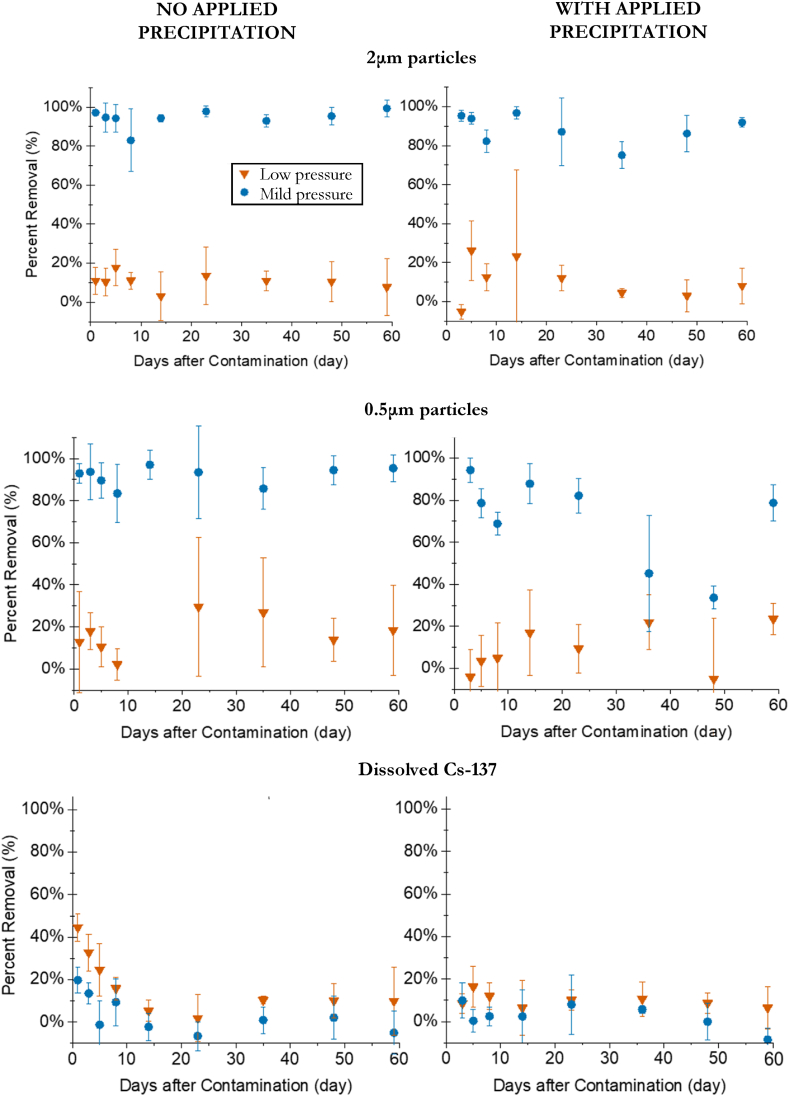
Timely decontamination will reduce the consequences of a radiological contamination event. For this purpose, pressure washing can be rapidly deployed, but its effectiveness will change if the interactions between the surface and radionuclides changes as the contamination "ages" under the influence of time and precipitation. While effects of this aging have been reported for dissolved cesium, they have not been studied for radionuclides present as particulate, e.g., fallout. This work studied the effects of aging on decontamination with low (<280 kPa/40 psi) and mild (14,000 kPa/2000 psi) pressure washing, on concrete contaminated with surrogate fallout consisting of soluble Cs-137, 0.5 μm silica particles, and 2 μm silica particles. The samples were aged up to 59 days (time between contamination and decontamination) with and without simulated precipitation. The percent removal following decontamination of the soluble cesium decreased over the first ten days of aging until the removals were less than 10 % for both low and mild pressure washing. The particle decontamination was independent of aging time but decontaminating via mild pressure washing (>80 % particle removal) significantly outperformed decontaminating by low pressure washing by flowing solution across (parallel to) the contaminated surface (<25 % particle removal). The observed changes in decontamination efficacy are explained via measurements of the penetration depth of contaminants. For soluble cesium, the results compared favorably with prior studies and theoretical treatment of cesium penetration, and they yielded additional insight into the effect of washing pressures on decontamination. There are no comparable studies for particulate contamination, so this study resulted in several novel observations which are operationally important for timely decontamination of surfaces following a radiological incident. It also suggests an evidence-based pressure washing procedure for timely decontamination of soluble and insoluble radionuclides which can be used throughout the emergency phase and into the early recovery phase.
Keywords: Contaminant aging; Decontamination; Radioactive cesium; Radioactive fallout; Radiological recovery.
© 2024 Published by Elsevier Ltd.
Conflict of interest statement
The authors declare that they have no known competing financial interests or personal relationships that could have appeared to influence the work reported in this paper.
Figures



References
-
- IAEA . The Chernobyl Forum. International Atomic Energy Agency; Vienna, Austria: 2005. Chernobyl's legacy: health, environmental and socio-economic impacts and recommendations to the governments of Belarus, the Russian federation and Ukraine. INIS-XA–798.
-
- IAEA . Non-serial Publications, STI/PUB/1710. International Atomic Energy Agency; Vienna: 2015. The Fukushima Daiichi accident.
-
- Nisbet J., Brown A.L., Jones H., Rochford D.J. HPA-RPD-064. Health Protection Agency; 2009. UK recovery handbooks for radiation incidents.
-
- Brown K., Mortimer K., Andersson T., Duranova A., Hänninen R., Ikäheimonen G., Kirchner V., Gallay F. Generic handbook for assisting in the management of contaminated inhabited areas in Europe following a radiological emergency. EURANOS(CAT1)-TN(06)-09-02, Version 2, Health Protection Agency. 2007 Chilton, Oxfordshire, pp. 483.
-
- IAEA . Technical Reports Series No. 300. International Atomic Energy Agency; Vienna: 1989. Cleanup of large areas contaminated as a result of a nuclear accident.
LinkOut - more resources
Full Text Sources
