. 2024 Jul 4;33(9):2233-2242.
doi: 10.1007/s10068-024-01641-w. eCollection 2024 Jul.

Lactobacillus plantarum LPYC225 mixture partially modulates the vaginal bacterial community of Gardnerella vaginalis-infected bacterial vaginosis in mice

Affiliations

Lactobacillus plantarum LPYC225 mixture partially modulates the vaginal bacterial community of Gardnerella vaginalis-infected bacterial vaginosis in mice

Hyun Ju Kim et al. Food Sci Biotechnol. .

Abstract

Bacterial vaginosis (BV) is defined as dysbiosis of the vaginal microbiome associated with the depletion of Lactobacilli and excessive growth of commensal or pathogenic bacteria. This study investigated the effects of lactic acid bacteria (LAB) mixture (LM; InoRexyne™) on the vaginal bacterial community of Gardnerella vaginalis (G. vaginalis)-infected BV mice. Single LAB and LM exhibited antibacterial and anti-inflammatory effects by inhibiting G. vaginalis growth and pro-inflammatory markers in RAW 264.7 cells. Administering LM did not significantly alter the vaginal architecture or fecal short-chain fatty acids but did significantly inhibit the vaginal interleukin-6 levels in the high LM group compared to the GV group. LM administration decreased the relative abundances of Enterobacter, Escherichia coli, and Bacteroides vulgatus in vaginal flushing fluids compared to the GV group. LM partially alleviated BV by inhibiting G. vaginalis growth and modulating the vaginal bacterial community, providing new insights into its modulatory effects on the vaginal microbiome in BV.

Supplementary information: The online version contains supplementary material available at 10.1007/s10068-024-01641-w.

Keywords: Bacterial vaginosis; Inflammation; Lactobacillus; Vaginal bacterial community.


Conflict of interest statement

Conflict of interestOn behalf of all authors, the corresponding author states that there is no conflict of interest.

Figures

Fig. 1
Fig. 1
Anti-bacterial activity of LAB and LM. LCR L. crispatus, LF L. fermentum, LP L. plantarum, LA L. acidophillus, L. reu L. reuteri, L. rhm L. rhamnosus. C2 (LCR01:LF05:LPYC225 = 5:1:4), C4 (LCR01:LF05:LPYC225 = 4:1:5), C6 (LCR01:LF05:LPYC225 = 3:1:6), C8 (InoRexyne-LCR01:LF05:LPYC225 = 2:1:7), UREX (L. reuteri: L. rhamnosus). Anti-bacterial activity of A single LAB and B combination of single LAB against G. vaginalis (KCTC5096) and C single LAB and D combination of single LAB against G. vaginalis (KCTC5097). Data are presented as the mean ± SD and were analyzed by one-way ANOVA, followed by Dunnett’s multiple comparison post hoc test. n.s not significant, *p < 0.05, **p < 0.01, ***p < 0.001 versus L. reu or UREX.###p < 0.001 versus L. rham
Fig. 2
Fig. 2
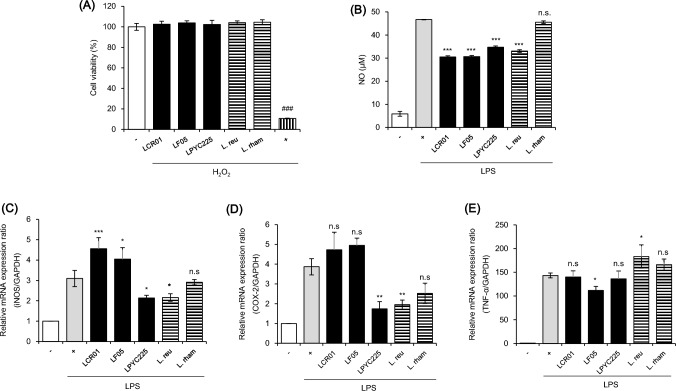
Cell viability, NO level, and anti-inflammatory effect of LAB. A Cell viability, B NO levels, C iNOS, D COX-2, and E TNF-α mRNA expression in LPS-induced RAW 264.7 cells. Data are presented as the mean ± SD and were analyzed by one-way ANOVA, followed by Dunnett’s multiple comparison post hoc test. n.s not significant, *p < 0.05, **p < 0.01, ***p < 0.001 versus LPS-treated control cells. ###p < 0.001 versus Blank
Fig. 3
Fig. 3
Cell viability, NO level, and anti-inflammatory effect of LM. A Cell viability, B NO levels, C iNOS, D COX-2, and E TNF-α mRNA expression in LPS-induced RAW 264.7 cells. Data are presented as the mean ± SD and were analyzed by one-way ANOVA, followed by Dunnett’s multiple comparison post hoc test. n.s not significant, *p < 0.05, **p < 0.01, ***p < 0.001 versus LPS-treated control cells. ###p < 0.001 versus Blank
Fig. 4
Fig. 4
Vaginal histology and IL-6 levels in G. vaginalis-infected mice. A The experimental design of the present study. Briefly, 108 CFU of G. vaginalis was inoculated vaginally to establish the BV mouse model. B Representative images of the vagina and uterus in different groups. C Representative H&E staining (100×), D vaginal epithelial thickness, E exfoliation score (n = 5), and F IL-6 levels in vaginal tissue (n = 6–8). Data represent the mean ± SD (n = 5–8). Statistical significance was calculated using GraphPad Prism 9. *p < 0.05, **p < 0.01, ***p < 0.001
Fig. 5
Fig. 5
Fecal SCFAs of LM. A Acetate, B Propionate, C Isobutyrate, and D Butyrate in feces. Data represent the mean ± SD (n = 6–8). Statistical significance was calculated using GraphPad Prism 9. n.s not significant, *p < 0.05
Fig. 6
Fig. 6
Administration of LM alters the vaginal bacterial community. A Relative abundance of the main phyla. B β-diversity of gut microbiota was displayed by principal component analysis (PCoA) scatterplots. C Linear discriminant analysis (LDA) score of gut microbiota (with LDA score > 3) for each group at the genus level. The relative abundance of D Enterobacteriaceae, E Enterobacter, and F Lactobacillus. spp. Data represent the mean ± SD (n = 3). Statistical significance was calculated using Prism 9. *p < 0.05, **p < 0.01, ***p < 0.001, ****p < 0.0001

References

    1. Aldunate M, Srbinovski D, Hearps AC, Latham CF, Ramsland PA, Gugasyan R, Cone RA, Tachedjian G. Antimicrobial and immune modulatory effects of lactic acid and short chain fatty acids produced by vaginal microbiota associated with eubiosis and bacterial vaginosis. Frontiers in Physiology. 6: 164 (2015) 10.3389/fphys.2015.00164 - DOI - PMC - PubMed
    1. Ansari A, Son D, Hur YM, Park S, You YA, Kim SM, Lee G, Kang S, Chung Y, Lim S, Kim YJ. Lactobacillus probiotics improve vaginal dysbiosis in asymptomatic women. Nutrients. 15(8): 1862 (2023) 10.3390/nu15081862 - DOI - PMC - PubMed
    1. Anton L, Ferguson B, Friedman ES, Gerson KD, Brown AG, Elovitz MA. Gardnerella vaginalis alters cervicovaginal epithelial cell function through microbe-specific immune responses. Microbiome. 10: 119 (2022) 10.1186/s40168-022-01317-9 - DOI - PMC - PubMed
    1. Borges S, Silva J, Teixeira P. The role of lactobacilli and probiotics in maintaining vaginal health. Archives of Gynecology and Obstetrics. 289: 479-489 (2014) 10.1007/s00404-013-3064-9 - DOI - PubMed
    1. Choi SI, Won G, Kim Y, Kang CH, Kim GH. Lactobacilli strain mixture alleviates bacterial vaginosis through antibacterial and antagonistic activity in Gardnerella vaginalis-infected C57BL/6 mice. Microorganisms. 10: 10 (2022) 10.3390/microorganisms10020471 - DOI - PMC - PubMed

LinkOut - more resources