


Evaluation of Emerging Predictors for Contrast-Induced Nephropathy in High-Risk Patients Undergoing Percutaneous Coronary Intervention
- PMID: 39130830
- PMCID: PMC11316681
- DOI: 10.7759/cureus.64363
Evaluation of Emerging Predictors for Contrast-Induced Nephropathy in High-Risk Patients Undergoing Percutaneous Coronary Intervention
Abstract
Objective: The objective of this study is to investigate the occurrence and factors that influence the development of contrast-induced nephropathy (CIN) in high-risk patients undergoing angioplasty and to evaluate the effectiveness of the Mehran risk score in predicting CIN among this patient population.
Materials and method: This prospective, observational study enrolled patients undergoing elective coronary angiography or a percutaneous coronary intervention (PCI) procedure. The patients were stratified into four risk groups based on the Mehran risk score, a validated tool for predicting the risk of CIN. Univariate and multivariate analyses were conducted to evaluate the risk factors associated with the development of CIN. A p-value of <0.05 was considered to indicate statistical significance.
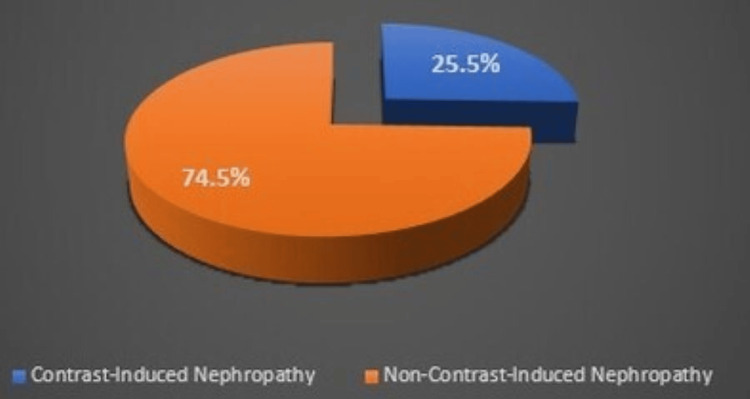
Results: During the study period, a total of 55 high-risk patients underwent PCI. The incidence of CIN was 25.5% (n=14). Univariate and multivariate analyses revealed that age >75 years and estimated glomerular filtration rate (eGFR) <60 (p<0.05) were independently associated with a significantly increased risk of developing CIN. A considerable proportion of patients (23; 41.8%) in the study were categorized as having an intermediate risk for CIN based on the Mehran risk score.
Conclusion: This study observed a high incidence of CIN and encourages the use of predictive tools like the Mehran risk score to assess the risk of CIN occurrence, with age over 70 years and eGFR less than 60 emerging as significant.
Keywords: angiography; contrast media; nephropathy; prevention; risk factors.
Copyright © 2024, Gupta et al.
Conflict of interest statement
Human subjects: Consent was obtained or waived by all participants in this study. Institutional Ethics Committee Medanta, Lucknow issued approval MED/IRB/0027. Animal subjects: All authors have confirmed that this study did not involve animal subjects or tissue. Conflicts of interest: In compliance with the ICMJE uniform disclosure form, all authors declare the following: Payment/services info: All authors have declared that no financial support was received from any organization for the submitted work. Financial relationships: All authors have declared that they have no financial relationships at present or within the previous three years with any organizations that might have an interest in the submitted work. Other relationships: All authors have declared that there are no other relationships or activities that could appear to have influenced the submitted work.
Figures
References
-
- Early diagnostic markers for contrast nephropathy in patients undergoing coronary angiography. Shaker OG, El-Shehaby A, El-Khatib M. Angiology. 2010;61:731–736. - PubMed
-
- A simple risk score for prediction of contrast-induced nephropathy after percutaneous coronary intervention: development and initial validation. Mehran R, Aymong ED, Nikolsky E, et al. J Am Coll Cardiol. 2004;44:1393–1399. - PubMed
-
- Hospital-acquired renal insufficiency. Nash K, Hafeez A, Hou S. Am J Kidney Dis. 2002;39:930–936. - PubMed
-
- Effect of statin therapy on contrast-induced nephropathy after coronary angiography: a meta-analysis. Pappy R, Stavrakis S, Hennebry TA, Abu-Fadel MS. Int J Cardiol. 2011;151:348–353. - PubMed
LinkOut - more resources
Full Text Sources
Research Materials
Miscellaneous