. 2024 Feb 15;3(3Part A):101307.
doi: 10.1016/j.jscai.2024.101307. eCollection 2024 Mar.

One-Year Clinical Outcomes Following Mechanical Thrombectomy for Deep Vein Thrombosis: A CLOUT Registry Analysis

Affiliations

One-Year Clinical Outcomes Following Mechanical Thrombectomy for Deep Vein Thrombosis: A CLOUT Registry Analysis

Mohannad B Bisharat et al. J Soc Cardiovasc Angiogr Interv. .

Abstract

Background: Mechanical thrombectomy is a promising treatment option for deep vein thrombosis; however, long-term data are lacking. Here, we report for the first time the 1-year clinical outcomes from the completely enrolled ClotTriever Outcomes (CLOUT) registry evaluating mechanical thrombectomy with the ClotTriever System (Inari Medical).

Methods: The CLOUT registry (NCT03575364) is a prospective, multicenter, single-arm study that enrolled 500 patients with proximal lower extremity deep vein thrombosis. Prespecified 1-year outcomes include Villalta score and corresponding postthrombotic syndrome (PTS) severity, duplex ultrasound findings of patency (defined as the presence of flow with normal or partial compressibility), Revised Venous Clinical Severity Score, and quality of life (QoL).

Results: In CLOUT, the median age was 61.9 years and 50.5% of patients were women. A total of 310 patients completed the 1-year visit. The 1-year PTS rate (Villalta score ≥ 5) was 19.3% and the moderate-to-severe PTS rate (Villalta score ≥ 10) was 8.8%. Median Villalta score decreased from 9.0 (IQR, 5.0-14.0) at baseline to 1.0 (IQR, 0.0-4.0) at 1 year (P < .0001). Similar rates of PTS and moderate-to-severe PTS were observed among limbs assessed at all study time points. Patency was observed in 94.2% of limbs. Median Revised Venous Clinical Severity Score was 6.0 (IQR, 3.0-9.0) at baseline and 3.0 (IQR, 1.0-4.0) at 1 year (P < .0001). Additionally, 90.4% of patients experienced improvements in QoL.

Conclusions: One-year outcomes from the CLOUT registry demonstrate low PTS rates and preserved patency accompanied by improved symptom relief and QoL. Study follow-up through 2 years is ongoing.

Keywords: deep vein thrombosis; intervention; lower extremity; mechanical thrombectomy; postthrombotic syndrome; prospective studies; quality of life.


Figures

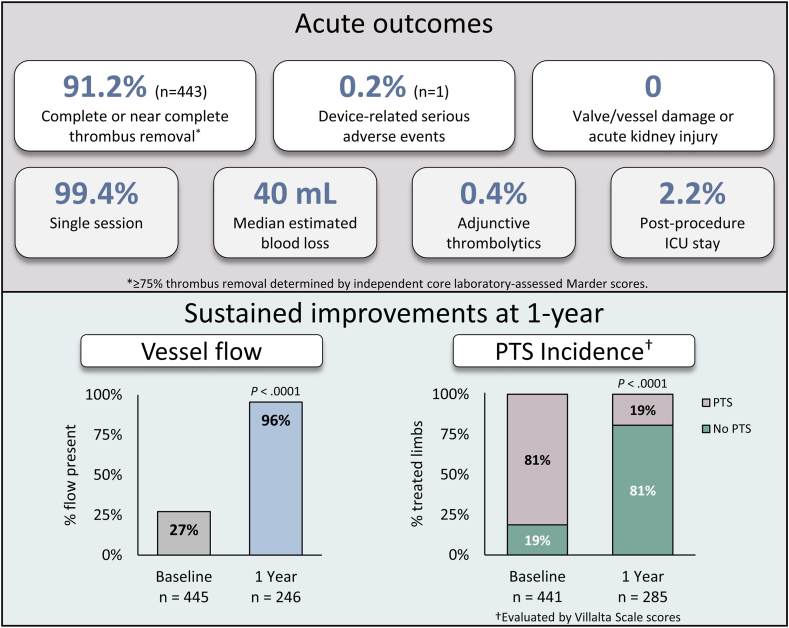
Central Illustration
Summary of acute procedural outcomes and vessel flow and postthrombotic syndrome (PTS) at 1 year.
Figure 1
Figure 1
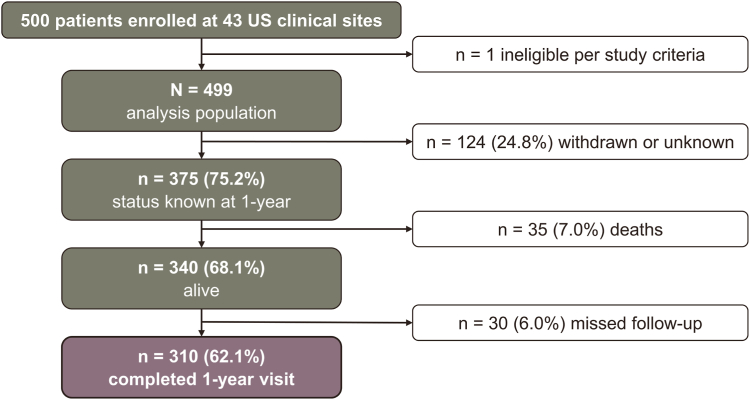
Patient disposition flowchart. One year following treatment for proximal lower extremity deep vein thrombosis.
Figure 2
Figure 2
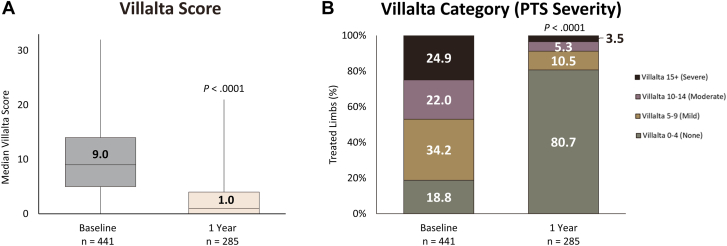
Summary of Villalta and postthrombotic syndrome (PTS) severity outcomes. At 1-year follow-up, patients in the CLOUT registry had significant reductions in (A) median Villalta score and (B) PTS severity when compared with baseline. Most patients (80.7%) had no PTS 1 year posttreatment, whereas 8.8% had moderate or severe PTS. Boxes represent IQR (Q1, Q3) with horizontal bars representing median values and vertical lines representing 1.5× (Q1-Q3). P values comparing values between baseline and 1-year visit derived from the Wilcoxon signed-rank test for the Villalta score and the McNemar-Bowker test for PTS severity.
Figure 3
Figure 3
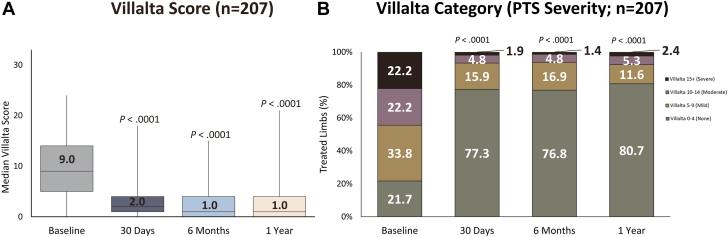
Progression in Villalta and postthrombotic syndrome (PTS) severity among the same population. Improvements in (A) median Villalta score and (B) PTS severity from baseline were observed at 30 days, 6 months, and 1 year among limbs assessed at all study time points. Boxes represent IQR (Q1, Q3) with horizontal bars representing median values and vertical lines representing 1.5× (Q1-Q3). P values comparing follow-up and baseline assessment values were derived from the Wilcoxon signed-rank test for the Villalta score and the McNemar-Bowker test for PTS severity.
Figure 4
Figure 4
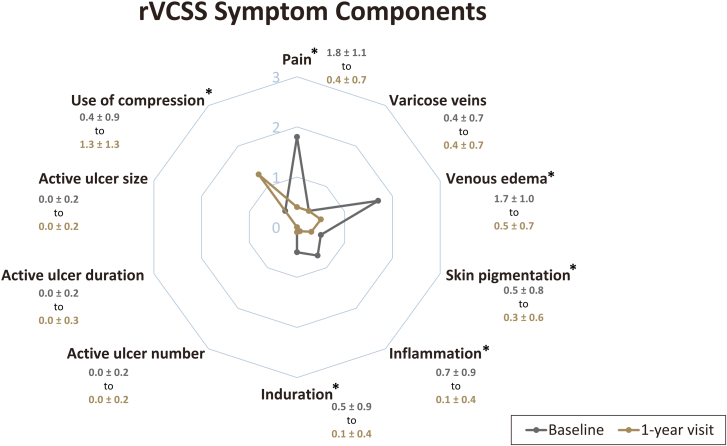
Summary of changes in Revised Venous Clinical Severity Score (rVCSS) components. Assessments of mean ± SD symptom severity scores (0 = none, 1 = mild, 2 = moderate, 3 = severe) for each rVCSS component indicate significant improvements in pain, venous edema, skin pigmentation, inflammation, and induration at 1 year. The use of compression therapy significantly increased from baseline to 1-year visit. n = 433-442 at baseline and n = 283-285 at 1-year visit. ∗P < .0001; P values are derived from the Wilcoxon signed-rank test with comparison against baseline values.
Figure 5
Figure 5
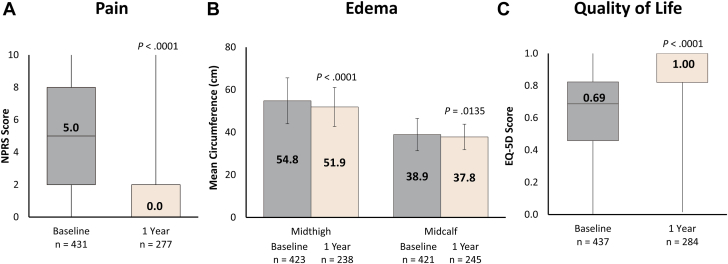
Summary of symptom relief and quality of life (QoL) outcomes. At 1-year follow-up, patients had significant improvements from baseline in (A) median numeric pain rating scale (NPRS) score indicating pain relief, (B) mean midcalf and midthigh measurements showing edema reduction, and (C) median EuroQoL Group 5-dimension questionnaire (EQ-5D) score demonstrating improved QoL. Boxes represent IQR (Q1, Q3) with horizontal bars representing median values and vertical lines representing 1.5 × (Q1-Q3). P values are derived from the Wilcoxon signed-rank test with comparison against baseline values.

References

    1. Kahn S.R., Galanaud J.P., Vedantham S., Ginsberg J.S. Guidance for the prevention and treatment of the post-thrombotic syndrome. J Thromb Thrombolysis. 2016;41(1):144–153. doi: 10.1007/s11239-015-1312-5. - DOI - PMC - PubMed
    1. Braekkan S.K., Grosse S.D., Okoroh E.M., et al. Venous thromboembolism and subsequent permanent work-related disability. J Thromb Haemost. 2016;14(10):1978–1987. doi: 10.1111/jth.13411. - DOI - PMC - PubMed
    1. Polak M.W., Siudut J., Plens K., Undas A. Prothrombotic clot properties can predict venous ulcers in patients following deep vein thrombosis: a cohort study. J Thromb Thrombolysis. 2019;48(4):603–609. doi: 10.1007/s11239-019-01914-w. - DOI - PMC - PubMed
    1. Jaff M.R., McMurtry M.S., Archer S.L., et al. Management of massive and submassive pulmonary embolism, iliofemoral deep vein thrombosis, and chronic thromboembolic pulmonary hypertension: a scientific statement from the American Heart Association. Circulation. 2011;123(16):1788–1830. doi: 10.1161/CIR.0b013e318214914f. - DOI - PubMed
    1. Mazzolai L., Aboyans V., Ageno W., et al. Diagnosis and management of acute deep vein thrombosis: a joint consensus document from the European Society of Cardiology working groups of aorta and peripheral vascular diseases and pulmonary circulation and right ventricular function. Eur Heart J. 2018;39(47):4208–4218. doi: 10.1093/eurheartj/ehx003. - DOI - PubMed

LinkOut - more resources