


Sex-Specific Clinical Outcomes After Treatment of Left Main Coronary Artery Disease. A NOBLE Substudy
- PMID: 39131931
- PMCID: PMC11308852
- DOI: 10.1016/j.jscai.2022.100338
Sex-Specific Clinical Outcomes After Treatment of Left Main Coronary Artery Disease. A NOBLE Substudy
Abstract
Background: While female sex has been associated with worse outcomes following coronary revascularization, previous analyses in left main coronary artery (LMCA) disease have been conflicting. In addition, a signal that increased mortality may be specific to women treated with percutaneous coronary intervention (PCI) requires further investigation.
Methods: Nordic-Baltic-British left main revascularization study (NOBLE) was a randomized trial comparing PCI to coronary artery bypass surgery (CABG) in patients with LMCA disease. The primary endpoint was a composite of all-cause mortality, nonprocedural myocardial infarction, repeat revascularization, and stroke (major adverse cardiovascular and cerebrovascular events [MACCE]). We report the 5-year sex-specific outcomes.
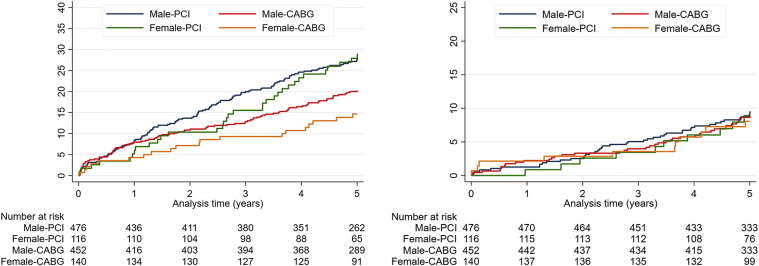
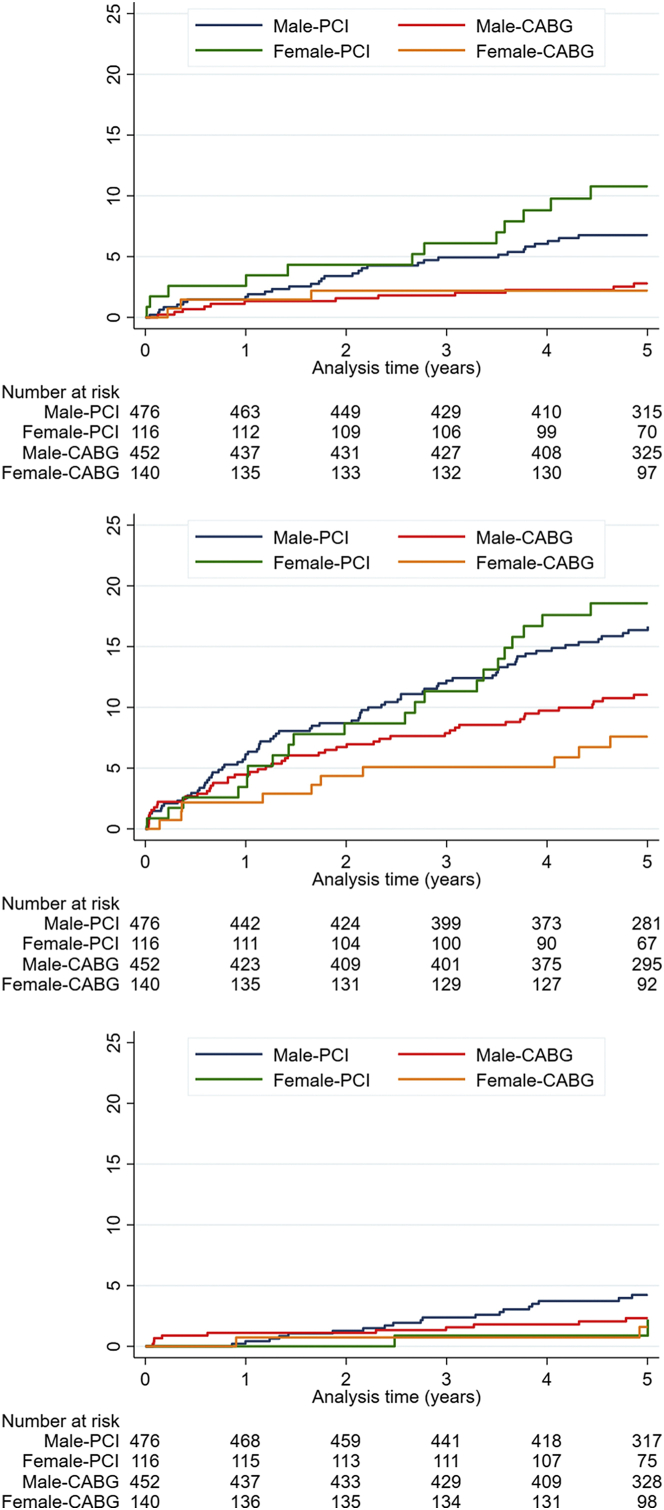
Results: Of 1184 patients analyzed, 256 (22%) were female and 928 (78%) were male. There were no significant within-sex differences in baseline characteristics, disease location, or complexity between those treated with PCI and those with CABG. The 5-year MACCE rates were 29% and 15% in females and 28% and 20% in males treated with PCI and CABG, respectively. Within both sexes, there was an increased risk of MACCE with PCI compared with CABG, but no difference in all-cause mortality. On multivariate analysis, female sex was not an independent predictor of MACCE.
Conclusions: Following the treatment of LMCA disease, long-term outcomes favored CABG over PCI in both sexes. Importantly, there was no difference in all-cause mortality in females or males at 5 years.
Keywords: Female; coronary artery bypass surgery; left main coronary artery disease; percutaneous coronary intervention.
© 2022 The Authors.
Conflict of interest statement
Dr McEntegart has received consultancy fees from Abbott Vascular and Boston Scientific. Dr Holm has received institutional research grants from 10.13039/501100008877Biosensors, 10.13039/100001316Abbott, 10.13039/100015305Reva Medical, Medis Medical Imaging, and 10.13039/100008497Boston Scientific and speaker fees from Terumo, Abbott, Reva Medical, and Medis Medical Imaging. Dr Oldroyd has received speaker fees from Biosensors and Abbott Vascular. Dr Erglis has received institutional research grants from 10.13039/100011949Abbott Vascular and 10.13039/100008497Boston Scientific and consultancy fees from Abbott Vascular, Biosensors, Boston Scientific, Cordis J&J, and Medtronic. Dr Christiansen has received grants from 10.13039/501100008877Biosensors. None of the other authors have any conflicts of interest.
Figures



References
-
- Stone G.W., Sabik J.F., Serruys P.W., et al. Everolimus-eluting stents or bypass surgery for left main coronary artery disease. N Engl J Med. 2016;375:2223–2235. - PubMed
-
- Mäkikallio T., Holm N.R., Lindsay M., et al. Percutaneous coronary angioplasty versus coronary artery bypass grafting in treatment of unprotected left main stenosis (NOBLE): a prospective, randomised, open-label, non-inferiority trial. Lancet. 2016;388:2743–2752. - PubMed
-
- Palmerini T., Serruys P., Kappetein A.P., et al. Clinical outcomes with percutaneous coronary revascularization vs coronary artery bypass grafting surgery in patients with unprotected left main coronary artery disease: a meta-analysis of 6 randomized trials and 4,686 patients. Am Heart J. 2017;190:54–63. - PubMed
-
- Bertaina M., De Filippo O., Iannaccone M., et al. Percutaneous coronary intervention or coronary artery bypass graft in left main coronary artery disease: a comprehensive meta-analysis of adjusted observational studies and randomized controlled trials. J Cardiovasc Med. 2018;19:554–563. - PubMed
-
- Sabatine M.S., Bergmark B.A., Murphy S.A., et al. Percutaneous coronary intervention with drug-eluting stents versus coronary artery bypass grafting in left main coronary artery disease: an individual patient data meta-analysis. Lancet. 2021;398:2247–2257. doi: 10.1016/S0140-6736(21)02334-5. - DOI - PubMed
LinkOut - more resources
Full Text Sources
Miscellaneous
