


Radiation Exposure Using Rampart vs Standard Lead Aprons and Shields During Invasive Cardiovascular Procedures
- PMID: 39131978
- PMCID: PMC11308832
- DOI: 10.1016/j.jscai.2023.101184
Radiation Exposure Using Rampart vs Standard Lead Aprons and Shields During Invasive Cardiovascular Procedures
Abstract
Background: Radiation exposure during invasive cardiovascular procedures remains an important health care issue. Lead aprons and shields (LAS) are used to decrease radiation exposure but leave large portions of the body unshielded. The Rampart IC M1128 is a portable radiation shielding system that may significantly attenuate radiation exposure.
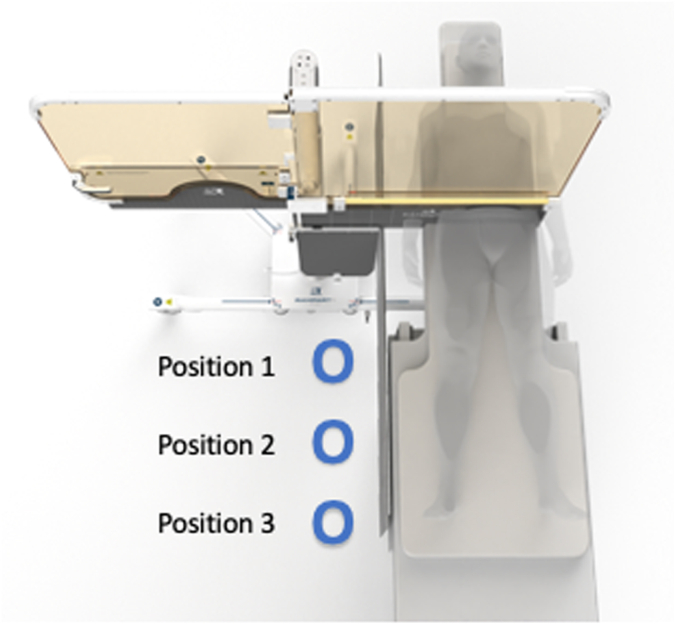
Methods: Catheterization laboratory teams were randomized in a 1:1 fashion to perform elective invasive cardiovascular procedures utilizing either traditional LAS or the Rampart IC M1128. Radiation exposure was measured using real-time dosimetry monitoring in prespecified anatomic locations on 3 operators (position 1: first operator/fellow; position 2: second operator/attending; and position 3: catheterization laboratory nurse/technologist). Radiation exposure was measured on a per-case basis.
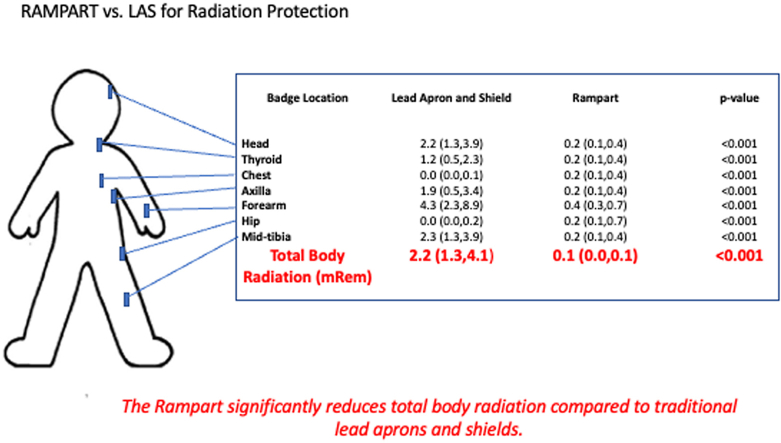
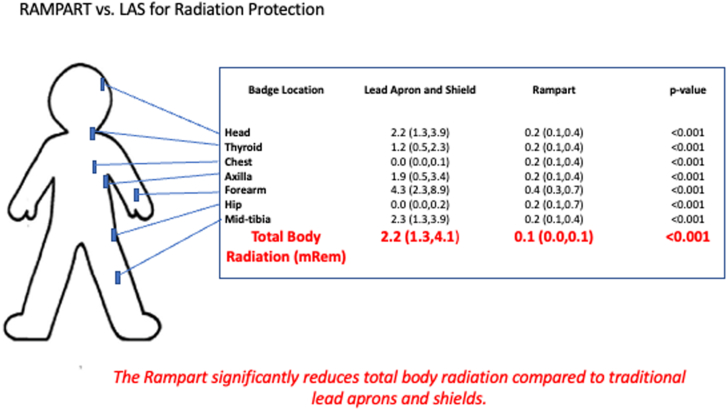
Results: In total, 100 consecutive cases were randomized in this study (47 Rampart; 53 LAS). There was no difference in fluoroscopy time (12.3 minutes for Rampart vs 15.4 minutes for LAS; P = .52), dose area product (288 Gy⋅cm2 for Rampart vs 376.5 Gy⋅cm2 for LAS; P = .52), or scatter radiation (38.8 mRem for Rampart vs 46.8 mRem for LAS; P = .61) between the groups. There was significantly lower total body radiation (in milliroentgen equivalent man) exposure using the Rampart than that using LAS for each team member: position 1-0.1 mRem for Rampart vs 2.2 mRem for LAS; P < .001; position 2-0.1 mRem Rampart vs 3.2 mRem LAS; P < .001; and position 3-0.0 mRem for Rampart vs 0.8 mRem for LAS; P < .001.
Conclusions: During routine clinical procedures, the Rampart system significantly decreases total body radiation exposure compared with traditional LAS.
Keywords: invasive cardiology; left heart catheterization; radiation safety.
© 2023 The Author(s).
Figures
References
-
- Klein L.W., Tra Y., Garratt K.N., et al. Occupational health hazards of interventional cardiologists in the current decade: results of the 2014 SCAI membership survey. Catheter Cardiovasc Interv. 2015;86(5):913–924. - PubMed
-
- Kobayashi T., Hirshfeld J.W., Jr. Radiation exposure in cardiac catheterization: operator behavior matters. Circ Cardiovasc Interv. 2017;10(8) - PubMed
-
- Dixon S.R., Rabah M., Emerson S., Schultz C., Madder R.D. A novel catheterization laboratory radiation shielding system: results of pre-clinical testing. Cardiovasc Revasc Med. 2022;36:51–55. - PubMed
-
- Klein L.W., Goldstein J.A., Haines D., et al. SCAI multi-society position statement on occupational health hazards of the catheterization laboratory: shifting the paradigm for Healthcare Workers' Protection. Catheter Cardiovasc Interv. 2020;95(7):1327–1333. - PubMed
-
- Andreassi M.G., Piccaluga E., Guagliumi G., Del Greco M., Gaita F., Picano E. Occupational health risks in cardiac catheterization laboratory workers. Circ Cardiovasc Interv. 2016;9(4) - PubMed
LinkOut - more resources
Full Text Sources
Medical
