Review
. 2024 May 15;3(7):102143.
doi: 10.1016/j.jscai.2024.102143. eCollection 2024 Jul.

Long-Term Outcomes of Transcatheter vs Surgical Aortic Valve Replacement: Meta-analysis of Randomized Trials

Affiliations
Review

Long-Term Outcomes of Transcatheter vs Surgical Aortic Valve Replacement: Meta-analysis of Randomized Trials

Giuseppe Talanas et al. J Soc Cardiovasc Angiogr Interv. .

Abstract

Background: We aimed to perform a meta-analysis of randomized trials comparing long-term outcomes of patients undergoing transcatheter aortic valve replacement (TAVR) vs surgical aortic valve replacement (SAVR) for severe aortic stenosis. The short-term efficacy and safety of TAVR are proven, but long-term outcomes are unclear.

Methods: We included randomized controlled trials comparing TAVR vs SAVR at the longest available follow-up. The primary end point was death or disabling stroke. Secondary end points were all-cause mortality, cardiac mortality, stroke, pacemaker implantation, valve thrombosis, valve gradients, and moderate-to-severe paravalvular leaks. The study is registered with PROSPERO (CRD42023481856).

Results: Seven trials (N = 7785 patients) were included. Weighted mean trial follow-up was 5.76 ± 0.073 years. Overall, no significant difference in death or disabling stroke was observed with TAVR vs SAVR (HR, 1.02; 95% CI, 0.93-1.11; P = .70). Mortality risks were similar. TAVR resulted in higher pacemaker implantation and moderate-to-severe paravalvular leaks compared to SAVR. Results were consistent across different surgical risk profiles. As compared to SAVR, self-expanding TAVR had lower death or stroke risk (P interaction = .06), valve thrombosis (P interaction = .06), and valve gradients (P interaction < .01) but higher pacemaker implantation rates than balloon-expandable TAVR (P interaction < .01).

Conclusions: In severe aortic stenosis, the long-term mortality or disabling stroke risk of TAVR is similar to SAVR, but with higher risk of pacemaker implantation, especially with self-expanding valves. As compared with SAVR, the relative reduction in death or stroke risk and valve thrombosis was greater with self-expanding than with balloon-expandable valves.

Keywords: meta-analysis; randomized trials; surgical aortic valve replacement; transcatheter aortic valve replacement.


Figures

Figure 1
Figure 1
Study selection. TAVR, transcatheter aortic valve replacement; SAVR, surgical aortic valve replacement.
Figure 2
Figure 2
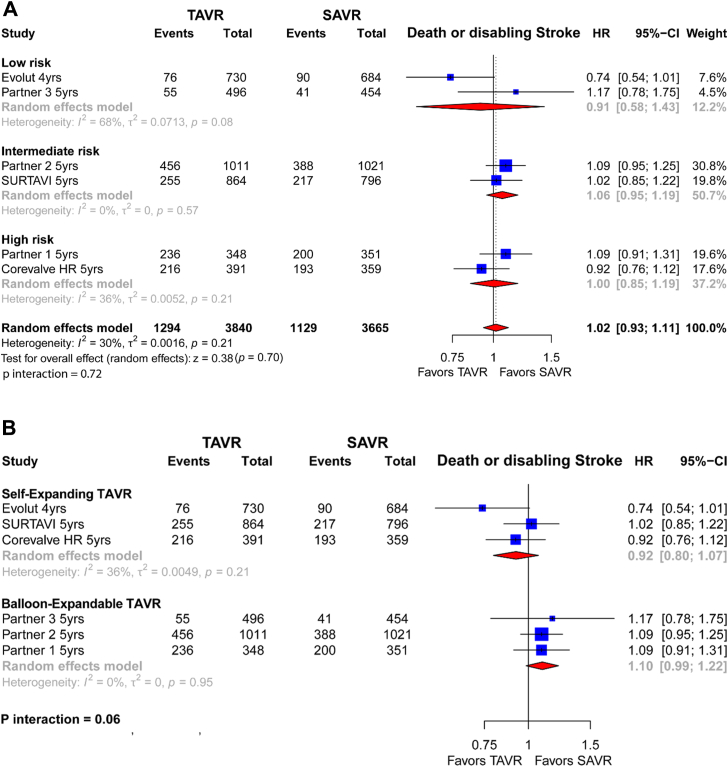
Individual and summary hazard ratios (HR) with their CIs for mortality or disabling stroke of studies comparing transcatheter aortic valve replacement (TAVR) vs surgical aortic valve replacement (SAVR). Results are stratified by surgical risk (A) and TAVR valve type (B).
Figure 3
Figure 3
Individual and summary hazard ratios (HR) with their CI for mortality of studies comparing transcatheter aortic valve replacement (TAVR) vs surgical aortic valve replacement (SAVR). Results are stratified by surgical risk (A) and TAVR valve type (B).
Figure 4
Figure 4
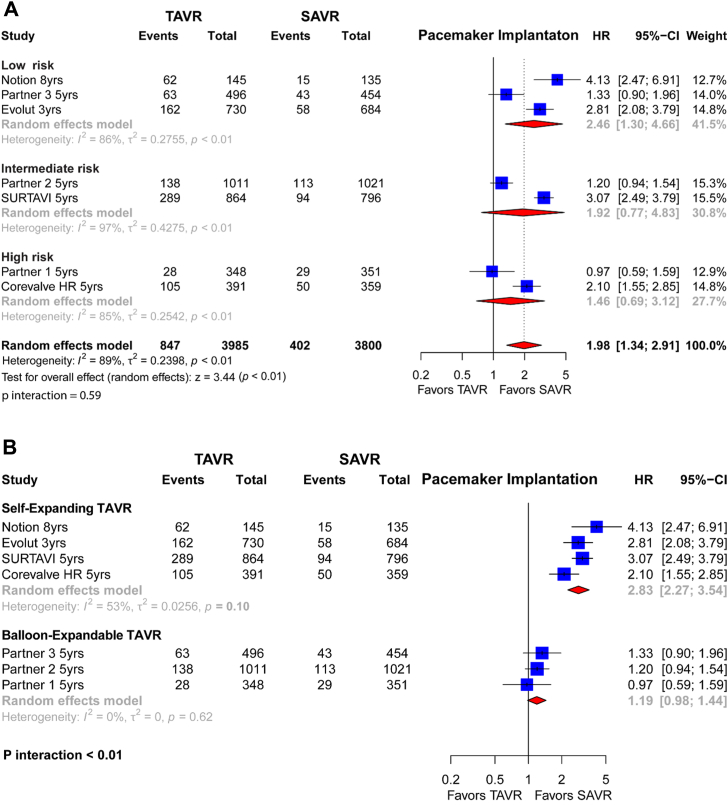
Individual and summary hazard ratios (HR) with their CIs for pacemaker implantation of studies comparing transcatheter aortic valve replacement (TAVR) vs surgical aortic valve replacement (SAVR). Results are stratified by surgical risk (A) and TAVR valve type (B).
Figure 5
Figure 5
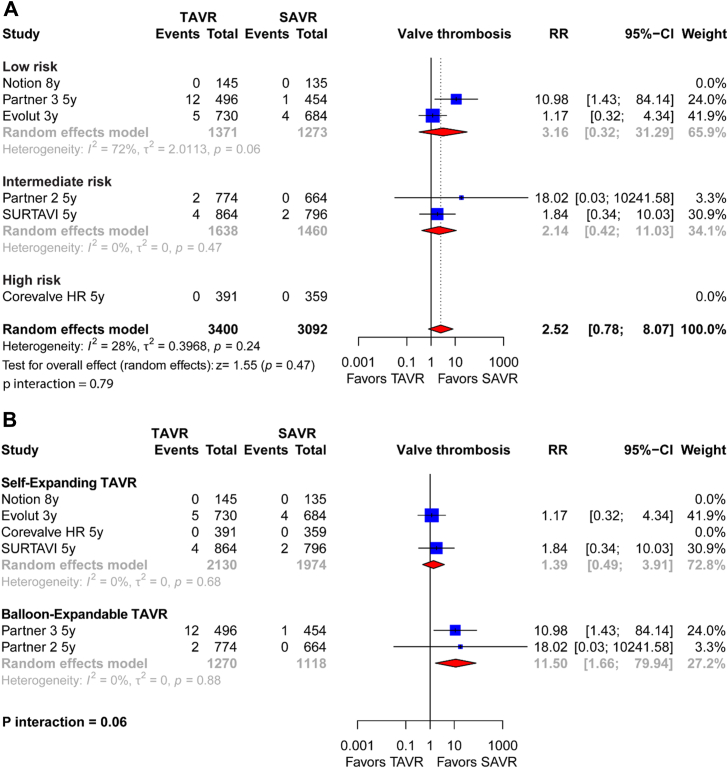
Individual and summary risk ratios (RR) with their CI for valve thrombosis of studies comparing transcatheter aortic valve replacement (TAVR) vs surgical aortic valve replacement (SAVR). Results are stratified by surgical risk (A) and TAVR valve type (B).
Figure 6
Figure 6
Individual and summary mean differences (MD) with their standard deviations (SD) for valve gradients of studies comparing transcatheter aortic valve replacement (TAVR) vs surgical aortic valve replacement (SAVR). Results are stratified by surgical risk (A) and TAVR valve type (B).
Central Illustration
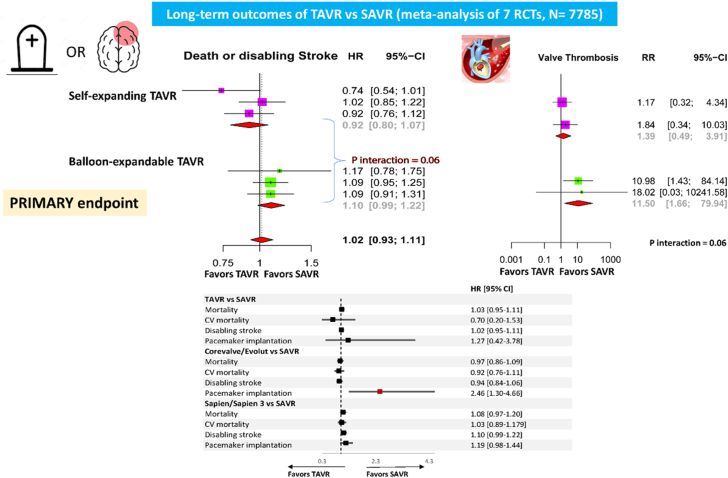
Major findings on long-term effects of transcatheter aortic valve replacement (TAVR) vs surgical aortic valve replacement (SAVR). Stratified analyses are applied by surgical risk and TAVR types. Long-term risk of mortality or disabling stroke are comparable between TAVR and SAVR (upper left); however, TAVR increases the likelihood of pacemaker implantation (bottom panel). Compared with SAVR, the relative reduction in death or stroke risk was greater with self-expanding than with balloon-expandable valves (upper panel) and may reflect the lower risk of valve thrombosis following self-expanding valves (top right panel). CV, cardiovascular; HR, hazard ratio; RCT, randomized controlled trials.

References

    1. Kalogeropoulos A.S., Redwood S.R., Allen C.J., et al. A 20-year journey in transcatheter aortic valve implantation: Evolution to current eminence. Front Cardiovasc Med. 2022;9 doi: 10.3389/fcvm.2022.971762. - DOI - PMC - PubMed
    1. Otto C.M., Prendergast B. Aortic-valve stenosis — from patients at risk to severe valve obstruction. N Engl J Med. 2014;371(8):744–756. doi: 10.1056/NEJMra1313875. - DOI - PubMed
    1. Arnold S.V., Zhang Y., Baron S.J., et al. Impact of short-term complications on mortality and quality of life after transcatheter aortic valve replacement. JACC Cardiovasc Interv. 2019;12(4):362–369. doi: 10.1016/j.jcin.2018.11.008. - DOI - PMC - PubMed
    1. Popma J.J., Deeb G.M., Yakubov S.J., et al. Transcatheter aortic-valve replacement with a self-expanding valve in low-risk patients. N Engl J Med. 2019;380(18):1706–1715. doi: 10.1056/NEJMoa1816885. - DOI - PubMed
    1. Mack M.J., Leon M.B., Thourani V.H., et al. Transcatheter aortic-valve replacement with a balloon-expandable valve in low-risk patients. N Engl J Med. 2019;380(18):1695–1705. doi: 10.1056/NEJMoa1814052. - DOI - PubMed

LinkOut - more resources