This is a preprint.
A double-blind trial of decoded neurofeedback intervention for specific phobias
- PMID: 39132473
- PMCID: PMC11312662
- DOI: 10.1101/2023.04.25.23289107
A double-blind trial of decoded neurofeedback intervention for specific phobias
Update in
-
A double-blind trial of decoded neurofeedback intervention for specific phobias.Psychiatry Clin Neurosci. 2024 Nov;78(11):678-686. doi: 10.1111/pcn.13726. Epub 2024 Sep 2. Psychiatry Clin Neurosci. 2024. PMID: 39221769 Free PMC article. Clinical Trial.
Abstract
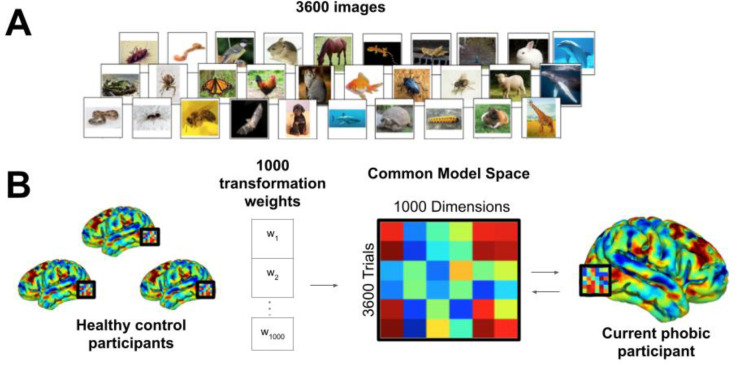
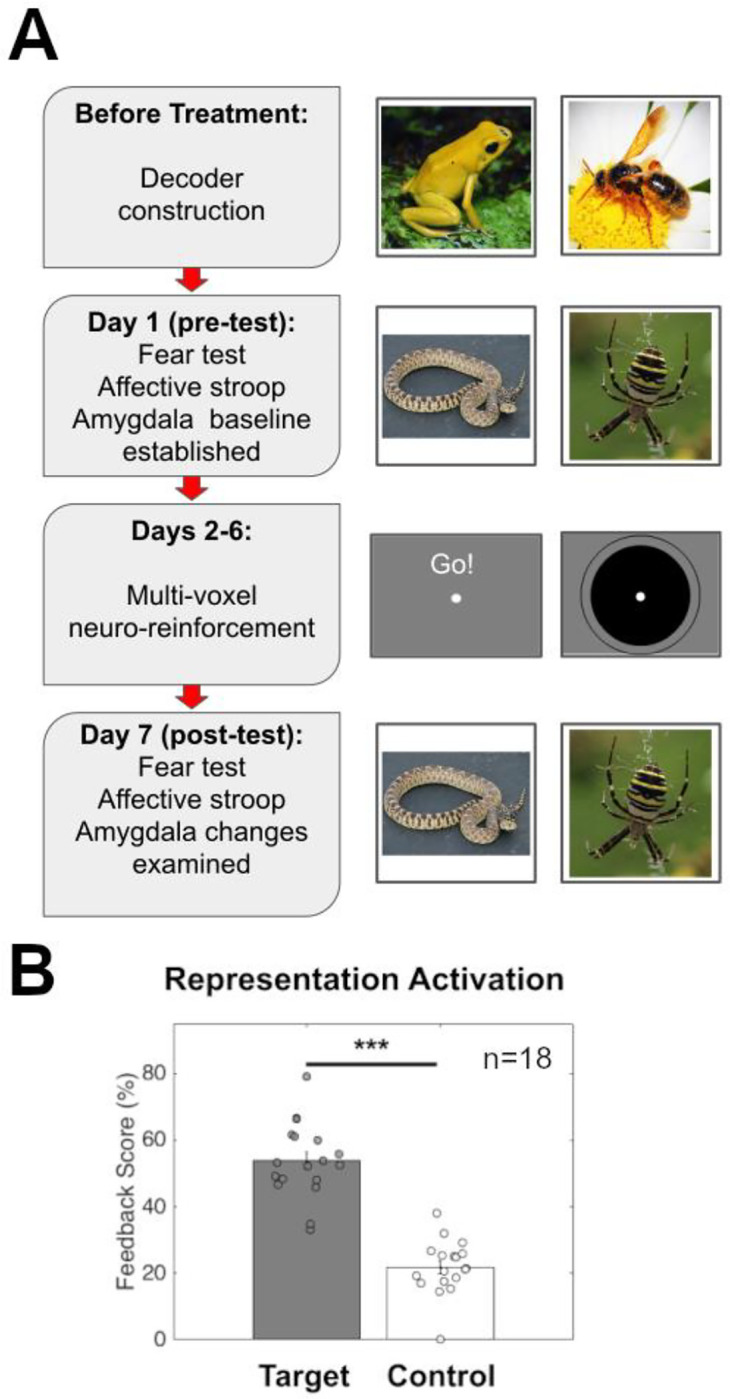
Aim: A new closed-loop fMRI method called multi-voxel neuro-reinforcement has the potential to alleviate the subjective aversiveness of exposure-based interventions by directly inducing phobic representations in the brain, outside of conscious awareness. The current study seeks to test this method as an intervention for specific phobia.
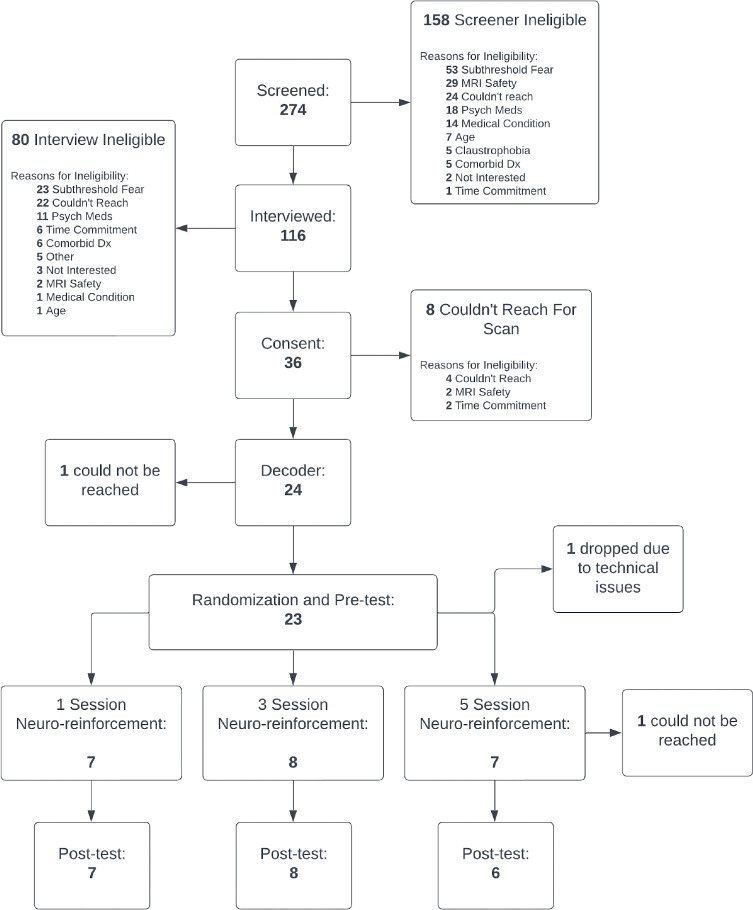
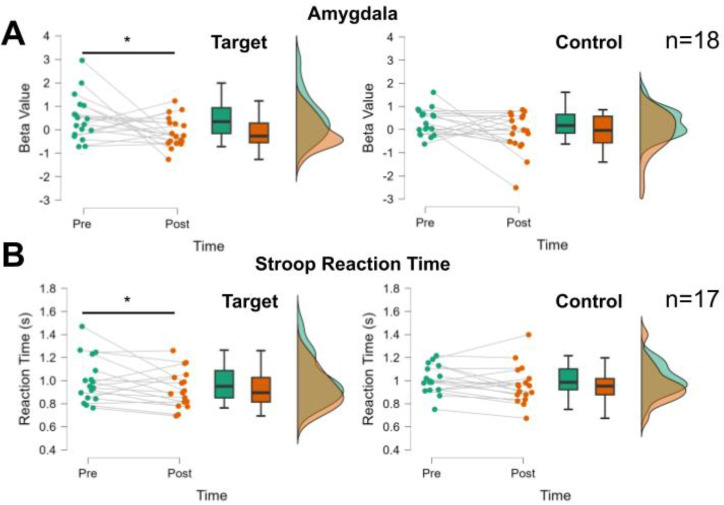
Methods: In a randomized, double-blind, controlled single-university trial, individuals diagnosed with at least two (1 target, 1 control) animal subtype specific phobias were randomly assigned (1:1:1) to receive 1, 3, or 5 sessions of multi-voxel neuro-reinforcement in which they were rewarded for implicit activation of a target animal representation. Amygdala response to phobic stimuli was assessed by study staff blind to target and control animal assignments. Pre-treatment to post-treatment differences were analyzed with a 2-way repeated-measures ANOVA.
Results: A total of 23 participants (69.6% female) were randomized to receive 1 (n=8), 3 (n=7), or 5 (n=7) sessions of multi-voxel neuro-reinforcement. Eighteen (n=6 each group) participants were analyzed for our primary outcome. After neuro-reinforcement, we observed an interaction indicating a significant decrease in amygdala response for the target phobia but not the control phobia. No adverse events or dropouts were reported as a result of the intervention.
Conclusion: Results suggest multi-voxel neuro-reinforcement can specifically reduce threat signatures in specific phobia. Consequently, this intervention may complement conventional psychotherapy approaches with a non-distressing experience for patients seeking treatment. This trial sets the stage for a larger randomized clinical trial to replicate these results and examine the effects on real-life exposure.
Clinical trial registration: The now-closed trial was prospectively registered at ClinicalTrials.gov with ID NCT03655262.
Keywords: decoding; fMRI; neurofeedback; phobia; reinforcement.
Conflict of interest statement
Disclosures Author MK is an inventor of patents owned by the Advanced Telecommunications Research Institute International related to the present work (PCT/JP2012/078136 [WO2013/06 871 9517] and PCT/JP2014/61543 [WO2014/178322]). CAC, HL, MGC, and VT-D have no conflicts to declare.
Figures
References
-
- Craske MG, Kircanski K, Zelikowsky M, Mystkowski J, Chowdhury N, Baker A. Optimizing inhibitory learning during exposure therapy. Behav Res Ther. 2008. Jan;46(1):5–27. - PubMed
-
- Loerinc AG, Meuret AE, Twohig MP, Rosenfield D, Bluett EJ, Craske MG. Response rates for CBT for anxiety disorders: Need for standardized criteria. Clin Psychol Rev. 2015. Dec;42:72–82. - PubMed
-
- Zayfert C, DeViva JC, Becker CB, Pike JL, Gillock KL, Hayes SA. Exposure utilization and completion of cognitive behavioral therapy for PTSD in a “real world” clinical practice. Journal of Traumatic Stress. 2005;18(6):637–45. - PubMed
-
- Eftekhari A, Ruzek JI, Crowley JJ, Rosen CS, Greenbaum MA, Karlin BE. Effectiveness of National Implementation of Prolonged Exposure Therapy in Veterans Affairs Care. JAMA Psychiatry. 2013. Sep 1;70(9):949–55. - PubMed
-
- Powers MB, Emmelkamp PMG. Virtual reality exposure therapy for anxiety disorders: A meta-analysis. Journal of Anxiety Disorders. 2008. Apr 1;22(3):561–9. - PubMed
Publication types
Associated data
Grants and funding
LinkOut - more resources
Full Text Sources
Medical