This is a preprint.
Genetic associations with human longevity are enriched for oncogenic genes
- PMID: 39132489
- PMCID: PMC11312667
- DOI: 10.1101/2024.07.30.24311226
Genetic associations with human longevity are enriched for oncogenic genes
Update in
-
Rare genetic associations with human lifespan in UK Biobank are enriched for oncogenic genes.Nat Commun. 2025 Feb 28;16(1):2064. doi: 10.1038/s41467-025-57315-6. Nat Commun. 2025. PMID: 40021682 Free PMC article.
Abstract
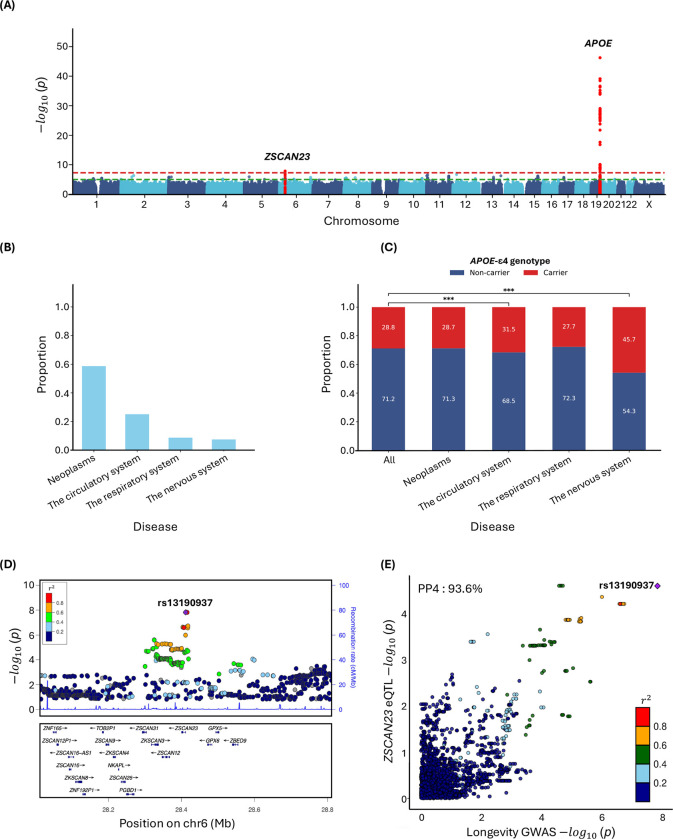
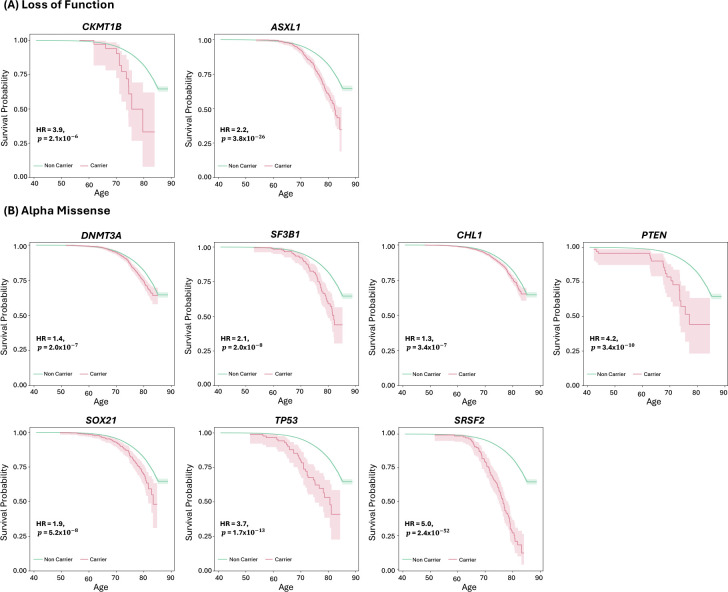
Human lifespan is shaped by both genetic and environmental exposures and their interaction. To enable precision health, it is essential to understand how genetic variants contribute to earlier death or prolonged survival. In this study, we tested the association of common genetic variants and the burden of rare non-synonymous variants in a survival analysis, using age-at-death (N = 35,551, median [min, max] = 72.4 [40.9, 85.2]), and last-known-age (N = 358,282, median [min, max] = 71.9 [52.6, 88.7]), in European ancestry participants of the UK Biobank. The associations we identified seemed predominantly driven by cancer, likely due to the age range of the cohort. Common variant analysis highlighted three longevity-associated loci: APOE, ZSCAN23, and MUC5B. We identified six genes whose burden of loss-of-function variants is significantly associated with reduced lifespan: TET2, ATM, BRCA2, CKMT1B, BRCA1 and ASXL1. Additionally, in eight genes, the burden of pathogenic missense variants was associated with reduced lifespan: DNMT3A, SF3B1, CHL1, TET2, PTEN, SOX21, TP53 and SRSF2. Most of these genes have previously been linked to oncogenic-related pathways and some are linked to and are known to harbor somatic variants that predispose to clonal hematopoiesis. A direction-agnostic (SKAT-O) approach additionally identified significant associations with C1orf52, TERT, IDH2, and RLIM, highlighting a link between telomerase function and longevity as well as identifying additional oncogenic genes. Our results emphasize the importance of understanding genetic factors driving the most prevalent causes of mortality at a population level, highlighting the potential of early genetic testing to identify germline and somatic variants increasing one's susceptibility to cancer and/or early death.
Conflict of interest statement
Competing interests The authors declare that they have no competing interests.
Figures

References
-
- v, B.H.J., et al. , Genetic influence on human lifespan and longevity. Hum Genet, 2006. 119(3): p. 312–21. - PubMed
Publication types
Grants and funding
LinkOut - more resources
Full Text Sources
Research Materials
Miscellaneous