


doi: 10.1002/ctm2.1803.
Oseltamivir (Tamiflu), a commonly prescribed antiviral drug, mitigates hearing loss in mice
Affiliations
- PMID: 39133201
- PMCID: PMC11318337
- DOI: 10.1002/ctm2.1803
Item in Clipboard
Oseltamivir (Tamiflu), a commonly prescribed antiviral drug, mitigates hearing loss in mice
Clin Transl Med.
2024 Aug.
No abstract available
Conflict of interest statement
T.T. and J.Z. are inventors of provisional patent applications filed for the use of oseltamivir in hearing protection #18/129267, #18/106918, and are co‐founders of Ting Therapeutics LLC. All other authors declare that they have no competing interests.
Figures

Oseltamivir, an antiviral neuraminidase inhibitor, reduces cisplatin‐induced cell death in murine cochlear explants and does not interfere with cisplatin's tumour killing ability in three lung carcinoma and three neuroblastoma cell lines. (A) Dose–response relationship of the pro‐drug, oseltamivir phosphate and outer hair cell (OHC) count in P3 FVB pup cochlear explants treated with cisplatin. Black: media alone; white: cisplatin alone; gold: oseltamivir phosphate alone; blue: cisplatin (150 µM) and oseltamivir phosphate (.05–10 µM) cotreatment. Cotreated samples were pretreated with oseltamivir phosphate for 1 h prior to cisplatin treatment, and then cultured in oseltamivir phosphate‐ and cisplatin‐treated media for 24 h. Numbers within bars denote number of explants per treatment. Samples were then stained with phalloidin with OHC counts per 160 µm taken from the cochlear middle turn. (B) Molecular structure of the prodrug, oseltamivir phosphate and its active antiviral metabolite, oseltamivir carboxylate. Hydrolysis of the circled ether group by hepatic esterase yields oseltamivir carboxylate, a sialic acid analogue and viral neuraminidase inhibitor. (C) Dose–response relationship of the metabolite oseltamivir carboxylate and OHC count in P3 FVB pup cochlear explants treated with cisplatin. Black: media alone; white: cisplatin alone; gold: oseltamivir carboxylate alone; blue: cisplatin (150 µM) and oseltamivir carboxylate (.001–10 µM) cotreatment. (D and E) Representative confocal images of explants treated with medium alone, 100 µM oseltamivir phosphate (D) or oseltamivir carboxylate (E), 150 µM cisplatin, and 3 µM oseltamivir phosphate (D) or 1 µM oseltamivir carboxylate (E) + 150 µM cisplatin. Data shown as means ± SEM, *
p < .05, **
p < .01, ***
p < .001 compared to cisplatin alone (red) and medium alone (black) by one‐way analysis of variance (ANOVA) with Bonferroni post hoc test. (F–K) Three neuroblastoma and three lung carcinoma cell lines were treated with cisplatin and six varying oseltamivir concentrations and then the Cell Titer‐Glo assay was performed to determine cell viability. Cell viability graphs after cisplatin and oseltamivir treatment for the (F) H1155, (G) SHP‐77, (H) A549, (I) Kelly, (J) SK‐N‐AS and (K) SH‐SY5Y cell lines are shown. Medium alone (black), cisplatin alone (red), oseltamivir alone (dark blue) and oseltamivir + cisplatin (light blue). Data shown as means ± SEM, compared to cisplatin alone by one‐way ANOVA with Bonferroni post hoc test. n = 6 wells.

Oseltamivir protects mice from cisplatin‐induced hearing loss and outer hair cell (OHC) loss after a single, high dose of cisplatin, and protects mice from cisplatin‐induced hearing loss and OHC death in a clinically relevant, multicycle cisplatin treatment protocol. (A) Treatment schedule in which mice were treated with a single dose of 30 mg/kg cisplatin and 50 mg/kg oseltamivir twice a day, once in morning and once at night, for 3 days. (B) Representative auditory brainstem response (ABR) traces after the treatment protocol in (A) at the 32 kHz frequency of carrier alone, cisplatin alone and cisplatin + oseltamivir‐treated mice. (C) ABR threshold shifts following treatment protocol in (A). Carrier alone (black), cisplatin alone (red) and oseltamivir + cisplatin (blue). Data shown as means ± SEM, compared to cisplatin alone by two‐way analysis of variance (ANOVA) with Bonferroni post hoc test. ***
p < .001. (D) Representative whole mount cochlear images stained with myosin VI following treatment protocol in (A). Cochlear whole mount sections from the apical, middle and basal regions were imaged. (E) Quantification of images shown in (D). The number of OHCs per 160 µm was counted per sample in each region. Oseltamivir alone (white), cisplatin alone (red) and oseltamivir + cisplatin (blue). (F) Treatment protocol where mice were treated with 3 mg/kg in the morning for 4 days and then treated with 50, 10 or 2 mg/kg oseltamivir in the morning and night for 5 days. A 9‐day recovery period occurred and then this cycle was repeated two more times for a total of three cycles. (G) ABR threshold shifts following protocol in (F). (H) Representative ABR traces after the treatment protocol in (F) at the 32 kHz frequency of cisplatin alone and cisplatin + 10 mg/kg oseltamivir treated mice. (I) Distortion product otoacoustic emission (DPOAE) threshold shifts following treatment protocol in (F). Carrier (black), oseltamivir alone (orange), cisplatin alone (red), 50 mg/kg oseltamivir + cisplatin (blue), 10 mg/kg oseltamivir + cisplatin (green) and 2 mg/kg oseltamivir + cisplatin (purple). Data shown as means ± SEM, compared to cisplatin alone by two‐way ANOVA with Bonferroni post hoc test. n = 9–17. (J) Representative whole mount cochlear images stained with myosin VI following treatment protocol in (F). n = 5 (K) Quantification of OHC counts per 160 µm of images shown in (J). Oseltamivir alone (black), cisplatin alone (red), 50 mg/kg oseltamivir + cisplatin (blue) and 10 mg/kg oseltamivir + cisplatin (green). Data shown as means ± SEM, compared to cisplatin alone by one‐way ANOVA with Bonferroni post hoc test. *
p < .05, **
p < .01. (L) ABR wave 1 amplitude of different treatment groups in (G) at the 16 kHz region. (M) Percent weight loss of all treatment groups following treatment protocol in (F). Mice were weighed everyday throughout the 42‐day treatment protocol. Data shown as means ± SEM, compared to cisplatin alone by one‐way ANOVA with Bonferroni post hoc test. *
p < .05, **
p < .01. n = 9–17 mice.

The 100 and 50 mg/kg oral oseltamivir therapy protects against noise‐induced auditory brainstem response (ABR) threshold shift, as well as the morphology and function of the auditory nerve synapse but does not rescue distortion product otoacoustic emission (DPOAE). (A) Schematic of the treatment schedule. (B) The 100 mg/kg oseltamivir treatment significantly protected hearing in noise‐exposed mice with an average reduction of ABR threshold shift of 20−25 dB sound pressure level (SPL) at 8, 16 and 32 kHz. Data shown as means ± SEM compared to carrier + noise by two‐way analysis of variance (ANOVA) with Bonferroni post hoc test. **
p < .01, ***
p < .001. (C) Representative ABR traces after the treatment protocol in (A) at the 16 kHz frequency of carrier alone, carrier + noise alone and noise + oseltamivir‐treated mice. (D) Results in (B) broken down by animal sex. (E) Mice treated with 50 mg/kg oseltamivir exhibited significantly lower ABR threshold shifts at 8 kHz when compared to noise‐exposed mice treated with carrier alone. Data shown as means ± SEM compared to carrier + noise by two‐way ANOVA with Bonferroni post hoc test. *
p < .05. (F) No protection was observed with 10 mg/kg oseltamivir. (G–I) DPOAE threshold shifts were also measured for mice treated with 100, 50 and 10 mg/kg, respectively; no significant protection was observed. Data shown as means ± SEM compared to carrier + noise by two‐way ANOVA with Bonferroni post hoc test. (J) ABR wave 1 amplitude for 100 mg/kg oseltamivir versus carrier treated mice, 16 kHz. (K and L) Quantification and imaging of Ctbp2 (auditory synapse) puncta in treated and untreated mice. Data shown as means ± SEM compared to carrier + noise by two‐way ANOVA with Bonferroni post hoc test. *
p < .05, ***
p < .001.
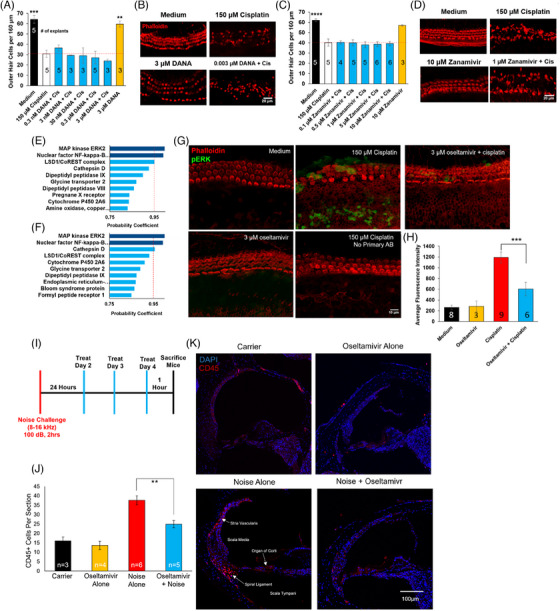
Molecular targets for oseltamivir in otoprotection and anti‐inflammatory role in mice: treatment with other neuraminidase inhibitors fails to mitigate outer hair cell (OHC) loss in cisplatin‐treated murine cochlear explants, indicating oseltamivir's otoprotective qualities are mediated through non‐neuraminidase targets as pERK and inflammation. (A and B) Dose–response relationship between 2,3‐dehydro‐2‐deoxy‐N‐acetylneuraminic acid (DANA) and OHC count in cisplatin‐treated murine cochlear explants; in (B), representative confocal images. DANA is a known inhibitor of mammalian neuraminidases NEU1‐4 (IC50 = 143, 43, 61 and 74 nM, respectively). (C and D) Dose–response relationship between zanamivir and OHCs count in cisplatin‐treated explants; in (D), representative confocal images. Zanamivir is an inhaled influenza neuraminidase inhibitor reported to weakly inhibit mammalian neuraminidases NEU1‐4 (IC50 = 2700, 16.4, 6.8 and 487 µM, respectively). Data shown are means ± SEM, **
p < .01, ***
p < .001 compared to cisplatin alone (white) by one‐way analysis of variance (ANOVA) with Bonferroni post hoc test. (E) Top 10 targets for the pro‐drug, oseltamivir phosphate, predicted by drug target prediction server SuperPred. (F) Top 10 targets predicted by SuperPred for the antiviral active metabolite, oseltamivir carboxylate. (G) Representative confocal images of cochlear explants immunostained with antibody anti‐pERK1/2 (green) and phalloidin (red) following treatment with medium alone, 150 µM cisplatin or 3 µM oseltamivir phosphate + 150 µM cisplatin. (H) Mean corrected total cell fluorescence (CTCF) of pERK1/2 expressing cells in explants following treatment with medium alone, 150 µM cisplatin in medium or 3 µM oseltamivir phosphate in combination with 150 µM cisplatin. Data shown as means ± SEM compared to cisplatin by one‐way ANOVA with Bonferroni post hoc test. ***
p < .001. (I) Noise exposure and treatment schedule. Mice were exposed to 100 dB noise for 2 h (8–16 kHz) and treated with oseltamivir for 3 days starting 24 h following noise exposure. Cochleae were collected 4 days post‐noise insult. (J) Representative confocal images of cochlear cryosections stained with CD45 (red) and DAPI (blue). (K) Quantification of CD45‐positive cells per cochlear section. Four treatment groups are carrier alone (black), oseltamivir alone (yellow), noise + carrier (red) and oseltamivir + noise (blue). Data shown as means ± SEM, **
p < .01 compared to noise alone by one‐way ANOVA with Bonferroni post hoc test. n = 3–6 mice.
Update of
-
Oseltamivir (Tamiflu), a Commonly Prescribed Antiviral Drug, Mitigates Hearing Loss in Mice.bioRxiv [Preprint]. 2024 May 8:2024.05.06.592815. doi: 10.1101/2024.05.06.592815. bioRxiv. 2024. Update in: Clin Transl Med. 2024 Aug;14(8):e1803. doi: 10.1002/ctm2.1803. PMID: 38765999 Free PMC article. Updated. Preprint.
References
Publication types
MeSH terms
Substances
Grants and funding
LinkOut - more resources
Full Text Sources