


Racial/ethnic differences in pre-pregnancy conditions and adverse maternal outcomes in the nuMoM2b cohort: A population-based cohort study
- PMID: 39133734
- PMCID: PMC11318875
- DOI: 10.1371/journal.pone.0306206
Racial/ethnic differences in pre-pregnancy conditions and adverse maternal outcomes in the nuMoM2b cohort: A population-based cohort study
Abstract
Objectives: To determine how pre-existing conditions contribute to racial disparities in adverse maternal outcomes and incorporate these conditions into models to improve risk prediction for racial minority subgroups.
Study design: We used data from the "Nulliparous Pregnancy Outcomes Study: Monitoring Mothers-to-be (nuMoM2b)" observational cohort study. We defined multimorbidity as the co-occurrence of two or more pre-pregnancy conditions. The primary outcomes of interest were severe preeclampsia, postpartum readmission, and blood transfusion during pregnancy or up to 14 days postpartum. We used weighted Poisson regression with robust variance to estimate adjusted risk ratios and 95% confidence intervals, and we used mediation analysis to evaluate the contribution of the combined effects of pre-pregnancy conditions to racial/ethnic disparities. We also evaluated the predictive performance of our regression models by racial subgroup using the area under the receiver operating characteristic curve (AUC) metric.
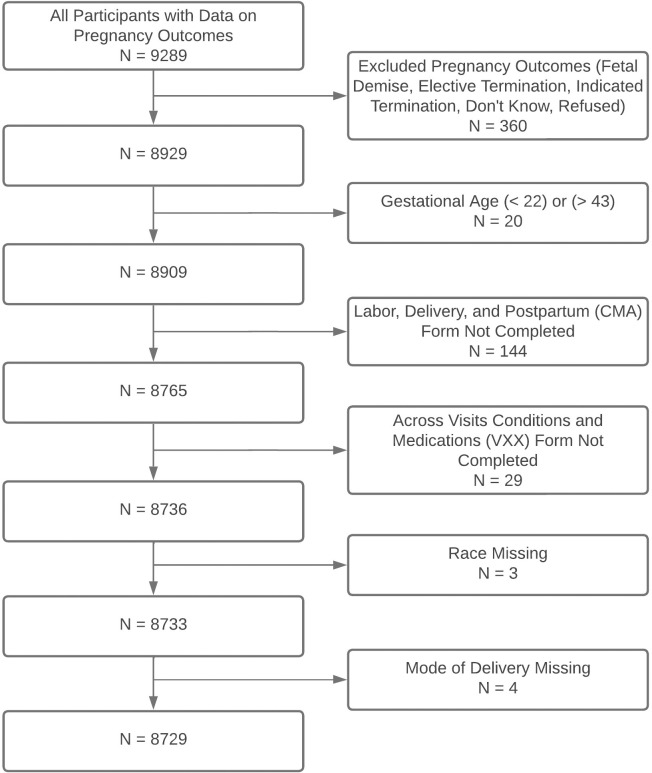
Results: In the nuMoM2b cohort (n = 8729), accounting for pre-existing conditions attenuated the association between non-Hispanic Black race/ethnicity and risk of severe preeclampsia. Cardiovascular and kidney conditions were associated with risk for severe preeclampsia among all women (aRR, 1.77; CI, 1.61-1.96, and aRR, 1.27; CI, 1.03-1.56 respectively). The mediation analysis results were not statistically significant; however, cardiovascular conditions explained 36.6% of the association between non-Hispanic Black race/ethnicity and severe preeclampsia (p = 0.07). The addition of pre-pregnancy conditions increased model performance for the prediction of severe preeclampsia.
Conclusions: Pre-existing conditions may explain some of the association between non-Hispanic Black race/ethnicity and severe preeclampsia. Specific pre-pregnancy conditions were associated with adverse maternal outcomes and the incorporation of comorbidities improved the performance of most risk prediction models.
Copyright: © 2024 Meredith et al. This is an open access article distributed under the terms of the Creative Commons Attribution License, which permits unrestricted use, distribution, and reproduction in any medium, provided the original author and source are credited.
Conflict of interest statement
The authors have declared that no competing interests exist.
References
-
- Pregnancy Mortality Surveillance System | Maternal and Infant Health | CDC n.d. https://www.cdc.gov/reproductivehealth/maternal-mortality/pregnancy-mort... (accessed May 18, 2022).
-
- Hoyert DL. Maternal mortality rates in the United States, 2021. 2023:2021. 10.15620/CDC:124678. - DOI
-
- Trost S, Beauregard J, Chandra G, Njie F, Berry J, Harvey A, et al. Pregnancy-Related Deaths: Data from Maternal Mortality Review Committees in 36 US States, 2017–2019. 2017.
Publication types
MeSH terms
Grants and funding
LinkOut - more resources
Full Text Sources
