


Perception of Medication Safety-Related Behaviors Among Different Age Groups: Web-Based Cross-Sectional Study
- PMID: 39133905
- PMCID: PMC11347903
- DOI: 10.2196/58635
Perception of Medication Safety-Related Behaviors Among Different Age Groups: Web-Based Cross-Sectional Study
Abstract
Background: Previous research and safety advocacy groups have proposed various behaviors for older adults to actively engage in medication safety. However, little is known about how older adults perceive the importance and reasonableness of these behaviors in ambulatory settings.
Objective: This study aimed to assess older adults' perceptions of the importance and reasonableness of 8 medication safety behaviors in ambulatory settings and compare their responses with those of younger adults.
Methods: We conducted a survey of 1222 adults in the United States using crowdsourcing to evaluate patient behaviors that may enhance medication safety in community settings. A total of 8 safety behaviors were identified based on the literature, such as bringing medications to office visits, confirming medications at home, managing medication refills, using patient portals, organizing medications, checking medications, getting help, and knowing medications. Respondents were asked about their perception of the importance and reasonableness of these behaviors on a 5-point Likert rating scale in the context of collaboration with primary care providers. We assessed the relative ranking of behaviors in terms of importance and reasonableness and examined the association between these dimensions across age groups using statistical tests.
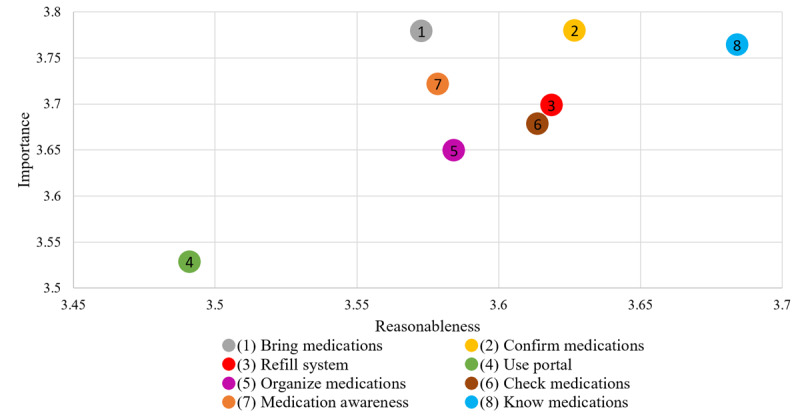
Results: Of 1222 adult participants, 125 (10.2%) were aged 65 years or older. Most participants were White, college-educated, and had chronic conditions. Older adults rated all 8 behaviors significantly higher in both importance and reasonableness than did younger adults (P<.001 for combined behaviors). Confirming medications ranked highest in importance (mean score=3.78) for both age groups while knowing medications ranked highest in reasonableness (mean score=3.68). Using patient portals was ranked lowest in importance (mean score=3.53) and reasonableness (mean score=3.49). There was a significant correlation between the perceived importance and reasonableness of the identified behaviors, with coefficients ranging from 0.436 to 0.543 (all P<.001).
Conclusions: Older adults perceived the identified safety behaviors as more important and reasonable than younger adults. However, both age groups considered a behavior highly recommended by professionals as the least important and reasonable. Patient engagement strategies, common and specific to age groups, should be considered to improve medication safety in ambulatory settings.
Keywords: Amazon Mechanical Turk; USA; United States; age; aged adults; community; correlation; crowdsourcing; elderly; engagement; medication; medication safety; medications; older adults; patient engagement; patient portal; primary care; safety; safety behavior; statistical test; survey; younger adults.
©Yan Lang, Kay-Yut Chen, Yuan Zhou, Ludmila Kosmari, Kathryn Daniel, Ayse Gurses, Richard Young, Alicia Arbaje, Yan Xiao. Originally published in the Interactive Journal of Medical Research (https://www.i-jmr.org/), 12.08.2024.
Conflict of interest statement
Conflicts of Interest: As per the University of Texas at Arlington policy, the following statement is included. K-YC has a potential research conflict of interest due to a financial interest with companies Hewlett-Packard Enterprise, Boostr, and DecisionNext. A management plan has been created to preserve objectivity in research in accordance with the University of Texas at Arlington policy. All other authors had neither competing financial interests nor other potential conflicts of interest.
Figures
References
-
- Sharma AE, Rivadeneira NA, Barr-Walker J, Stern RJ, Johnson AK, Sarkar U. Patient engagement in health care safety: an overview of mixed-quality evidence. Health Aff (Millwood) 2018;37(11):1813–1820. doi: 10.1377/hlthaff.2018.0716. https://europepmc.org/abstract/MED/30395509 - DOI - PMC - PubMed
-
- Hibbard JH, Collins PA, Mahoney E, Baker LH. The development and testing of a measure assessing clinician beliefs about patient self-management. Health Expect. 2010;13(1):65–72. doi: 10.1111/j.1369-7625.2009.00571.x. https://europepmc.org/abstract/MED/19906211 HEX571 - DOI - PMC - PubMed
-
- Batalden M, Batalden P, Margolis P, Seid M, Armstrong G, Opipari-Arrigan L, Hartung H. Coproduction of healthcare service. BMJ Qual Saf. 2016;25(7):509–517. doi: 10.1136/bmjqs-2015-004315. http://qualitysafety.bmj.com/lookup/pmidlookup?view=long&pmid=26376674 bmjqs-2015-004315 - DOI - PMC - PubMed
-
- Health Information National Trends Survey 5 (HINTS 5), Cycle 4 Methodology Report. Westat; [2023-06-18]. https://hints.cancer.gov/docs/methodologyreports/HINTS5_Cycle4_Methodolo... .
Grants and funding
LinkOut - more resources
Full Text Sources
