. 2024 Aug 12;14(1):18677.
doi: 10.1038/s41598-024-66311-7.

Cluster effect for SNP-SNP interaction pairs for predicting complex traits

Affiliations

Cluster effect for SNP-SNP interaction pairs for predicting complex traits

Hui-Yi Lin et al. Sci Rep. .

Abstract

Single nucleotide polymorphism (SNP) interactions are the key to improving polygenic risk scores. Previous studies reported several significant SNP-SNP interaction pairs that shared a common SNP to form a cluster, but some identified pairs might be false positives. This study aims to identify factors associated with the cluster effect of false positivity and develop strategies to enhance the accuracy of SNP-SNP interactions. The results showed the cluster effect is a major cause of false-positive findings of SNP-SNP interactions. This cluster effect is due to high correlations between a causal pair and null pairs in a cluster. The clusters with a hub SNP with a significant main effect and a large minor allele frequency (MAF) tended to have a higher false-positive rate. In addition, peripheral null SNPs in a cluster with a small MAF tended to enhance false positivity. We also demonstrated that using the modified significance criterion based on the 3 p-value rules and the bootstrap approach (3pRule + bootstrap) can reduce false positivity and maintain high true positivity. In addition, our results also showed that a pair without a significant main effect tends to have weak or no interaction. This study identified the cluster effect and suggested using the 3pRule + bootstrap approach to enhance SNP-SNP interaction detection accuracy.

Keywords: Cluster; False positivity; SNP interaction; Simulation.


Conflict of interest statement

The authors declare no competing interests.

Figures
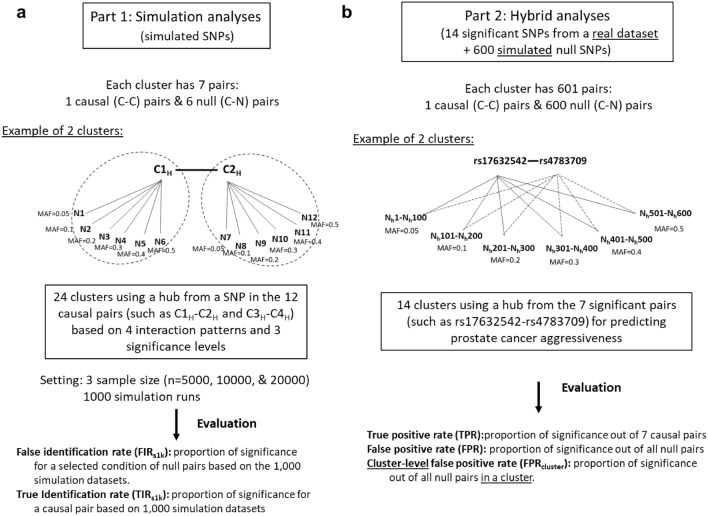
Figure 1
Figure 1
Summary of study design in the 2 study parts. (a) Simulation setting in Part 1: A cluster with 7 pairs: one causal (C–C) pair, and 6 with null (C–N) pairs. (b) Hybrid setting in Part 2: A cluster with 601 pairs: one observed causal pair and 600 simulated null pairs. MAF minor allele frequency, “C” represents a SNP from a causal pair; “N” represents a simulated null SNP.
Figure 2
Figure 2
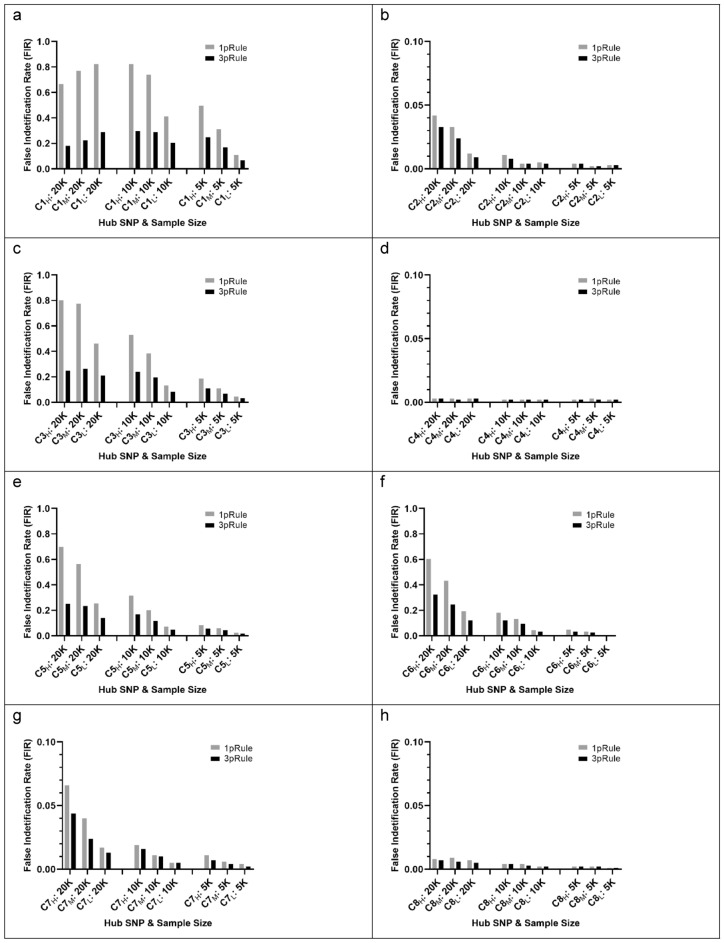
False identification rates (FIRs1k) for the 8 sets of clusters based on 1000 simulation runs. Each set had 3 clusters with a hub SNP with various significance levels, such as C1H, C1M, and C1L for C1 SNP with a high, medium, and low significance level, respectively. Sample size: 20 K (n = 20,000), 10 K (n = 10,000), and 5 K (n = 5000). Significance rules: 1pRule: p-pair < 2.7 × 10–7; 3pRule: p-pair < 2.7 × 10–7 and p-pair < p-main for SNP1, and p-pair < p-main for SNP2.
Figure 3
Figure 3
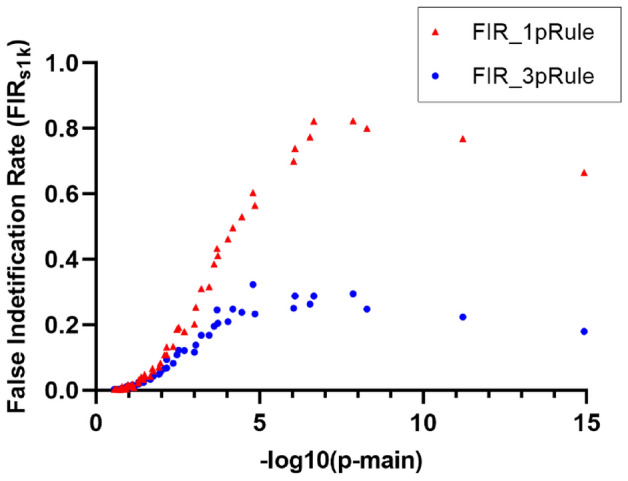
False identification rates (FIRs1k) by the hub SNP’s main effect (p-main) and the 2 significance rules. Results were based on the 1000 simulation runs of the 72 clusters and their hub SNPs. Two Significance rules: 1pRule: p-pair < 2.7 × 10–7 ; 3pRule: p-pair < 2.7 × 10–7 and p-pair < p-main for SNP1, and p-pair < p-main for SNP2.
Figure 4
Figure 4
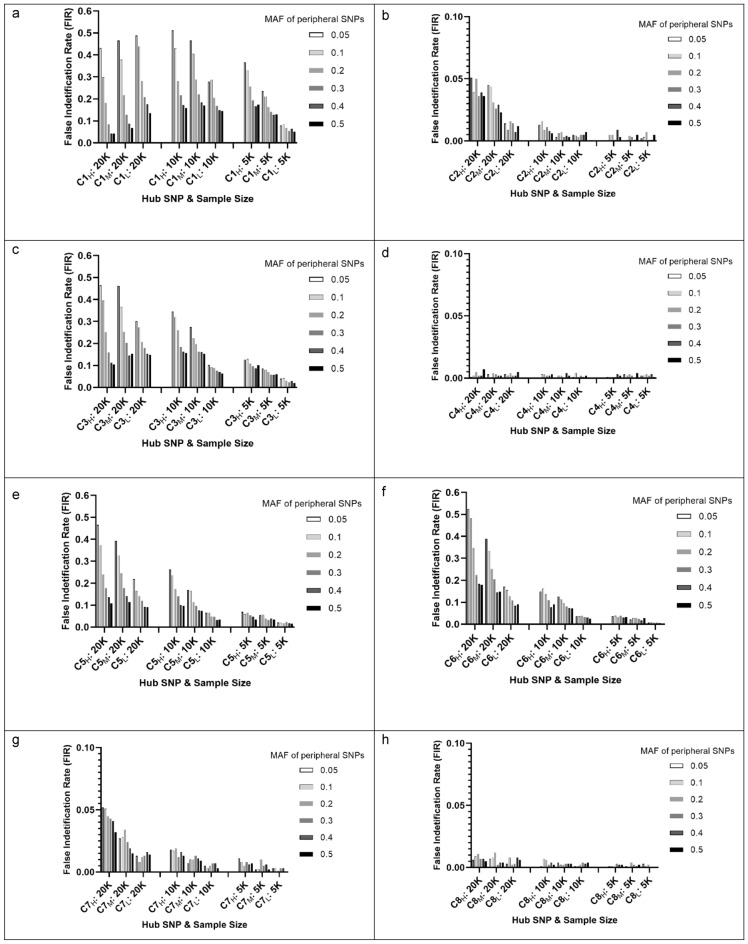
False identification rates (FIRs1k) for 8 sets of SNP–SNP interaction clusters based on 3pRule and 1000 runs. Each set had 3 clusters with a hub SNP with various significance levels, such as C1H, C1M, and C1L for C1 SNP with a high, medium, and low significance level, respectively. Sample size: 20 K (n = 20,000), 10 K (n = 10,000), and 5 K (n = 5000).
Figure 5
Figure 5
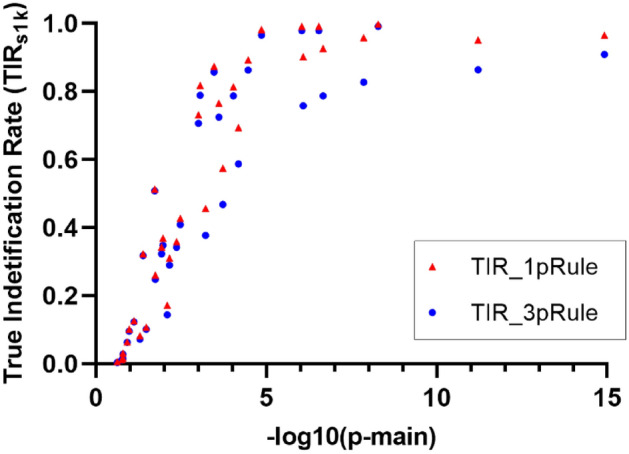
True identification rates (TIRs1k) by the hub SNP’s main effect (p-main) and the 2 significance rules. In this plot, the most significant SNP in a causal pair was used as a hub. Results were based on the 1000 simulation runs of the 36 clusters and their hub SNPs. Two Significance rules: 1pRule: p-pair < 2.7 × 10–7; 3pRule: p-pair < 2.7 × 10–7 and p-pair < p-main for SNP1, and p-pair < p-main for SNP2.

References

    1. Loos, R. J. F. 15 years of genome-wide association studies and no signs of slowing down. Nat. Commun.11, 5900. 10.1038/s41467-020-19653-5 (2020). 10.1038/s41467-020-19653-5 - DOI - PMC - PubMed
    1. Mortezaei, Z. & Tavallaei, M. Recent innovations and in-depth aspects of post-genome wide association study (Post-GWAS) to understand the genetic basis of complex phenotypes. Heredity (Edinb)127, 485–497. 10.1038/s41437-021-00479-w (2021). 10.1038/s41437-021-00479-w - DOI - PMC - PubMed
    1. Wray, N. R. et al. From basic science to clinical application of polygenic risk scores: A primer. JAMA Psychiatry78, 101–109. 10.1001/jamapsychiatry.2020.3049 (2021). 10.1001/jamapsychiatry.2020.3049 - DOI - PubMed
    1. Cordell, H. J. Detecting gene-gene interactions that underlie human diseases. Nat. Rev. Genet.10, 392–404 (2009). 10.1038/nrg2579 - DOI - PMC - PubMed
    1. Moore, J. H. The ubiquitous nature of epistasis in determining susceptibility to common human diseases. Hum. Hered.56, 73–82 (2003). 10.1159/000073735 - DOI - PubMed

LinkOut - more resources