Review
. 2024 Aug 8;44(1):04.
doi: 10.35946/arcr.v44.1.04. eCollection 2024.

Alcohol, HMGB1, and Innate Immune Signaling in the Brain

Affiliations
Review

Alcohol, HMGB1, and Innate Immune Signaling in the Brain

Fulton T Crews et al. Alcohol Res. .

Abstract

Purpose: Binge drinking (i.e., consuming enough alcohol to achieve a blood ethanol concentration of 80 mg/dL, approximately 4-5 drinks within 2 hours), particularly in early adolescence, can promote progressive increases in alcohol drinking and alcohol-related problems that develop into compulsive use in the chronic relapsing disease, alcohol use disorder (AUD). Over the past decade, neuroimmune signaling has been discovered to contribute to alcohol-induced changes in drinking, mood, and neurodegeneration. This review presents a mechanistic hypothesis supporting high mobility group box protein 1 (HMGB1) and Toll-like receptor (TLR) signaling as key elements of alcohol-induced neuroimmune signaling across glia and neurons, which shifts gene transcription and synapses, altering neuronal networks that contribute to the development of AUD. This hypothesis may help guide further research on prevention and treatment.

Search methods: The authors used the search terms "HMGB1 protein," "alcohol," and "brain" across PubMed, Scopus, and Embase to find articles published between 1991 and 2023.

Search results: The database search found 54 references in PubMed, 47 in Scopus, and 105 in Embase. A total of about 100 articles were included.

Discussion and conclusions: In the brain, immune signaling molecules play a role in normal development that differs from their functions in inflammation and the immune response, although cellular receptors and signaling are shared. In adults, pro-inflammatory signals have emerged as contributing to brain adaptation in stress, depression, AUD, and neurodegenerative diseases. HMGB1, a cytokine-like signaling protein released from activated cells, including neurons, is hypothesized to activate pro-inflammatory signals through TLRs that contribute to adaptations to binge and chronic heavy drinking. HMGB1 alone and in heteromers with other molecules activates TLRs and other immune receptors that spread signaling across neurons and glia. Both blood and brain levels of HMGB1 increase with ethanol exposure. In rats, an adolescent intermittent ethanol (AIE) binge drinking model persistently increases brain HMGB1 and its receptors; alters microglia, forebrain cholinergic neurons, and neuronal networks; and increases alcohol drinking and anxiety while disrupting cognition. Studies of human postmortem AUD brain have found elevated levels of HMGB1 and TLRs. These signals reduce cholinergic neurons, whereas microglia, the brain's immune cells, are activated by binge drinking. Microglia regulate synapses through complement proteins that can change networks affected by AIE that increase drinking, contributing to risks for AUD. Anti-inflammatory drugs, exercise, cholinesterase inhibitors, and histone deacetylase epigenetic inhibitors prevent and reverse the AIE-induced pathology. Further, HMGB1 antagonists and other anti-inflammatory treatments may provide new therapies for alcohol misuse and AUD. Collectively, these findings suggest that restoring the innate immune signaling balance is central to recovering from alcohol-related pathology.

Keywords: HMGB1 protein; alcohol; alcohol use disorder; chemokines; cholinergic neurons; cytokines; microglia; neuroinflammation.


Conflict of interest statement

Disclosures: The authors declare no competing financial or nonfinancial interests.

Figures
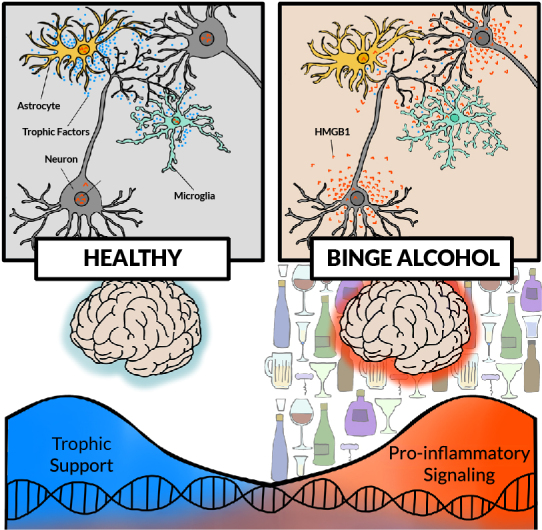
Figure 1
Figure 1. Effects of chronic alcohol activation of pro-inflammatory signaling in the brain
(Top left) In a “healthy” brain, neurons, astrocytes, and microglia release growth signals (i.e., trophic factors such as brain-derived neurotrophic factor [blue dots]) supporting neuronal and glial functions. (Top right) With chronic binge alcohol exposure, all cells show changes, such as reductions in soma and synapses. Other changes include increased high mobility group box protein 1 (HMGB1) release (orange dots) in neurons, hyper-ramification and pro-inflammatory activation of microglia, and activation of astrocytes. (Bottom) Without alcohol exposure, transcription of growth factors, such as brain-derived neurotrophic factor, is high, providing trophic support. In a brain exposed to chronic binge drinking, cellular transcription shifts, with increasing pro-inflammatory transcripts. Note: Not shown are other pro-inflammatory signals, although pro-inflammatory changes in transcription likely involve multiple signals; all brain cell types are proposed to change cellular transcriptomes and subtypes.
Figure 2
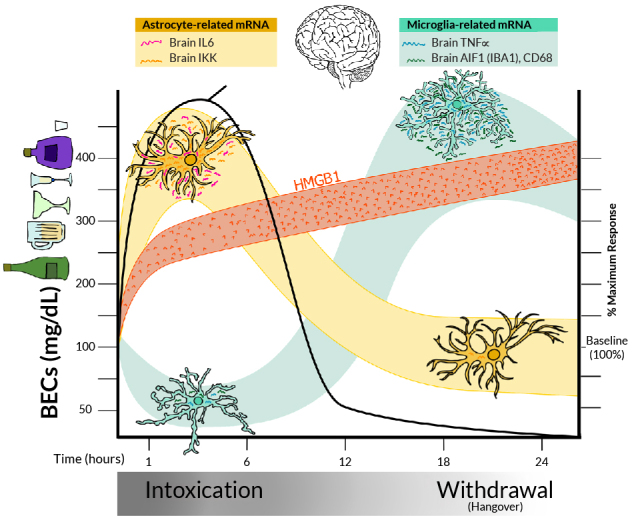
Figure 2. Model of acute binge-drinking–induced changes in pro-inflammatory signaling and other changes in the rat brain
After administration of an acute binge-drinking dose of ethanol, BECs (black line) rise rapidly within the first 6 hours, indicating intoxication, before declining again. Later timepoints (18–24 hours), when BECs return to zero, reflect acute withdrawal., Pro-inflammatory signaling responses include HMGB1 (orange), astrocyte (yellow), and microglial (green) responses. All three brain cell types (neurons, microglia, and astrocytes) show ethanol-induced HMGB1 release, resulting in rapid HMGB1 increases in blood and brain during intoxication that persist into acute withdrawal.,, Other pro-inflammatory cytokines in the brain show different patterns in response to alcohol. Levels of IL-6 and IKK, which are released by astrocytes, increase during intoxication, consistent with astrocyte pro-inflammatory activation, before declining again. In contrast, microglial markers, such as TNF-alpha, decrease during intoxication but increase during withdrawal from an acute binge. Thus, pro-inflammatory cytokines are increased during both intoxication and acute withdrawal, but responses are not homogeneous, highlighting both the importance of specifically determining gene responses and the difficulty in generalizing findings from a single pro-inflammatory marker as representative of all pro-inflammatory cytokines. Note: Aif1/Iba1, allograft inflammatory factor 1/ionized calcium-binding adapter molecule 1; BEC, blood ethanol concentration; HMGB1, high mobility group box protein 1; IKK, I-kappa-B kinase; IL-6, interleukin-6; mRNA, messenger RNA; TNF-alpha, tissue necrosis factor alpha.
Figure 3
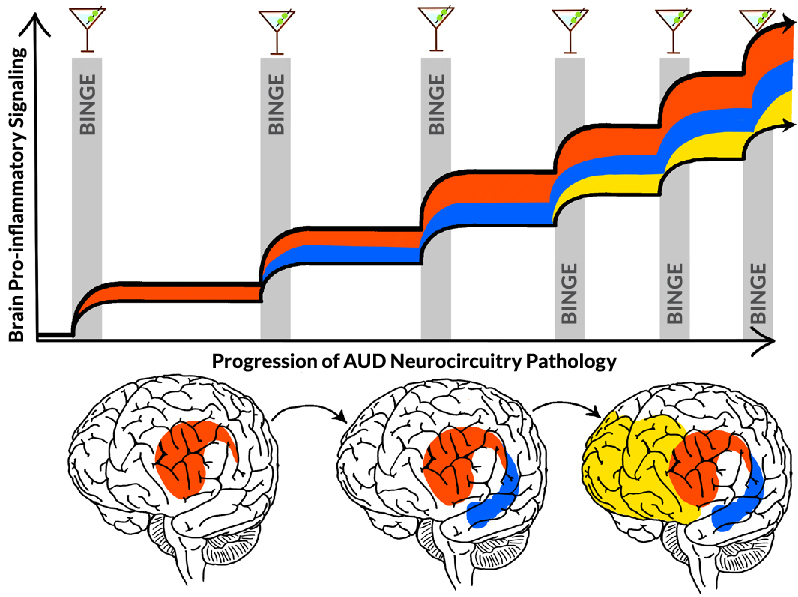
Figure 3. Hypothetic mechanism of cycles of binge drinking intoxication increasing pro-inflammatory gene transcription to increasingly compromise neuronal networks that drive the progression to alcohol use disorder (AUD)
With each binge drinking event (gray bars), pro-inflammatory gene induction and transcription changes increase (adapted from Koob and Volkow1). Initial stages of binge drinking increase HMGB1 release and other signals that sensitize microglia and activate reward and emotional salience networks (red). This activation spreads with further cycles, progressively increasing involvement of emotional-salience networks (blue) as binge drinking increases in frequency. Further cycles may increase pro-inflammatory signaling that compromises cortical executive function networks (yellow). Together, these networks affect domains associated with reward seeking, impulse inhibition, perseveration, and compulsion to drink that occur with AUD. It is unknown, however, whether networks become progressively involved with binge-drinking cycles as depicted here or if each network shows accumulation of pro-inflammatory and network dysfunction with cycles. Note: HMGB1, high mobility group box protein 1.

References

    1. Koob GF, Volkow ND. Neurobiology of addiction: A neurocircuitry analysis. Lancet Psychiatry. 2016;3(8):760–773. doi: 10.1016/S2215-0366(16)00104-8. - DOI - PMC - PubMed
    1. Crews FT, Sarkar DK, Qin L, Zou J, Boyadjieva N, Vetreno RP. Neuroimmune function and the consequences of alcohol exposure. Alcohol Res. 2015;37(2):331–341. 344–351. - PMC - PubMed
    1. Erickson EK, Grantham EK, Warden AS, Harris RA. Neuroimmune signaling in alcohol use disorder. Pharmacol Biochem Behav. 2019;177:34–60. doi: 10.1016/j.pbb.2018.12.007. - DOI - PMC - PubMed
    1. Meredith LR, Burnette EM, Grodin EN, Irwin MR, Ray LA. Immune treatments for alcohol use disorder: A translational framework. Brain Behav Immun. 2021;97:349–364. doi: 10.1016/j.bbi.2021.07.023. - DOI - PMC - PubMed
    1. Ramos A, Joshi RS, Szabo G. Innate immune activation: Parallels in alcohol use disorder and Alzheimer’s disease. Front Mol Neurosci. 2022;15:910298. doi: 10.3389/fnmol.2022.910298. - DOI - PMC - PubMed