


The history of smoking cessation support in Hungary: A narrative review
- PMID: 39135961
- PMCID: PMC11312381
- DOI: 10.18332/tpc/191141
The history of smoking cessation support in Hungary: A narrative review
Abstract
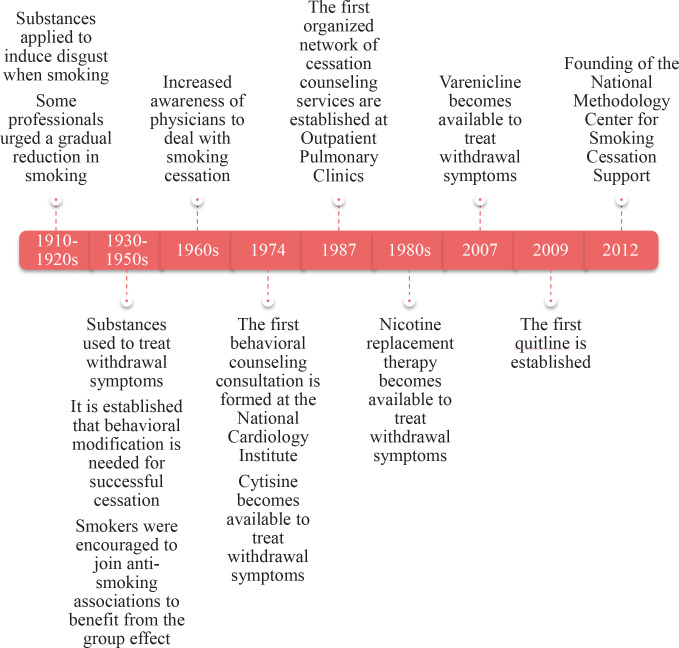
Tobacco use remains the largest preventable cause of death worldwide, including Hungary with a smoking-related death rate in 2019 of 360/100000 (age-standardized death rate), among the highest in the World Health Organization (WHO) European Region. Despite the well-formulated tobacco control interventions defined by the WHO Framework Convention on Tobacco Control (WHO FCTC) in place, smoking prevalence in 2019 was high (27%) and has not decreased since 2014. Therefore, greater emphasis should be placed on addressing and treating smokers. This narrative review summarizes the progress in smoking cessation support in Hungary to identify strengths and areas for improvement. A literature search was conducted in the Hungarian Arcanum Digital Science Library. After 2012, data were derived from the National Methodology Center for Cessation Support reports. The National Korányi Institute for Pulmonology established the first organized network of cessation counselling services in 1987 in outpatient pulmonary clinics (OPCs) sponsored by a State Insurance tender. By 1999, individual behavioral counselling with medication was accessible to 130 healthcare providers, due to the support of pharmaceutical companies. Since 2005, the National Health Insurance Fund has financed smoking cessation support in OPCs, albeit at a low value. Having recognized that OPCs are overburdened by the organizational tasks of cessation support and that funding is intermittent, from 2020, the counselling service has transferred to the existing network of health promotion offices, although without specific funding for cessation programs and communication. Adequate and regular funding for established counselling services and nicotine withdrawal treatment is essential to achieve progress in tobacco control. The role of healthcare professionals is outstanding; therefore, individual responsibilities should be recognized.
Keywords: Hungary; cessation support; smoking.
© 2024 Cselkó Z. et al.
Conflict of interest statement
The authors have completed and submitted the ICMJE Form for Disclosure of Potential Conflicts of Interest and none was reported.
Figures
References
-
- World Health Organization European Region . European Health Information Gateway. European Health for All Database. Accessed August 19, 2023. https://gateway.euro.who.int/en/datasets/european-health-for-all-database/
-
- Central Statistical Office . Smoking habits, 2019. Central Statistical Office, Budapest, 2021. November 23, 2021. Accessed August 19, 2023. https://www.ksh.hu/docs/hun/xftp/idoszaki/elef/dohanyzas_2019/index.html
-
- WHO Report on the Global Tobacco Epidemic: protect people from tobacco smoke, 2023. Geneva: World Health Organization. July 31, 2023. Accessed August 19, 2023. https://www.who.int/publications/i/item/9789240077164.
-
- Perkins KA, Conklin CA, Levine MD. Cognitive-Behavioral Therapy for Smoking Cessation. A Practical Guidebook to the Most Effective Treatments. New York, NY: Routledge Taylor & Francis Group.; 2008
-
- M.Á.S.T. Kft . Hungarian Adult Tobacco Survey, 2019. February, 2020. Accessed August 19, 2023. https://www.leszokastamogatas.hu/wp-content/uploads/2021/03/Osszefoglalo...
Publication types
LinkOut - more resources
Full Text Sources