


Evaluating the Effects of a Self-Help Mobile Phone App on Worry and Rumination Experienced by Young Adults: Randomized Controlled Trial
- PMID: 39137411
- PMCID: PMC11350318
- DOI: 10.2196/51932
Evaluating the Effects of a Self-Help Mobile Phone App on Worry and Rumination Experienced by Young Adults: Randomized Controlled Trial
Abstract
Background: Delivery of preventative interventions via mobile phone apps offers an effective and accessible way to address the global priority of improving the mental health of adolescents and young adults. A proven risk factor for anxiety and depression is elevated worry and rumination, also known as repetitive negative thinking (RNT).
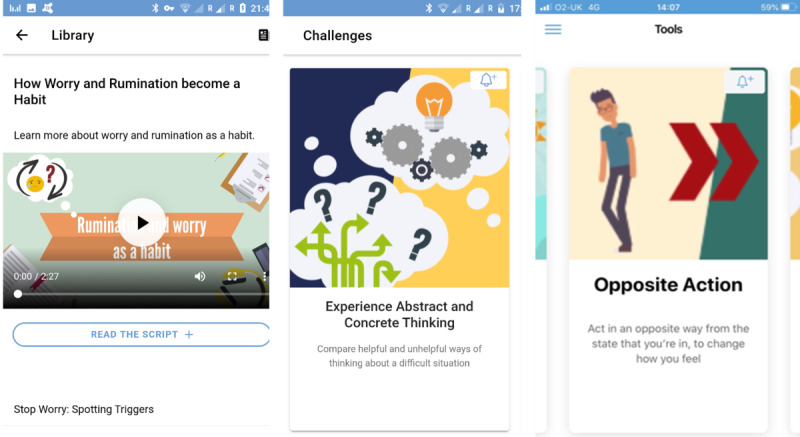
Objective: This was a prevention mechanism trial that aimed to investigate whether an RNT-targeting self-help mobile phone app (MyMoodCoach) reduces worry and rumination in young adults residing in the United Kingdom. A secondary objective was to test whether the app reduces symptoms of anxiety and depression and improves well-being.
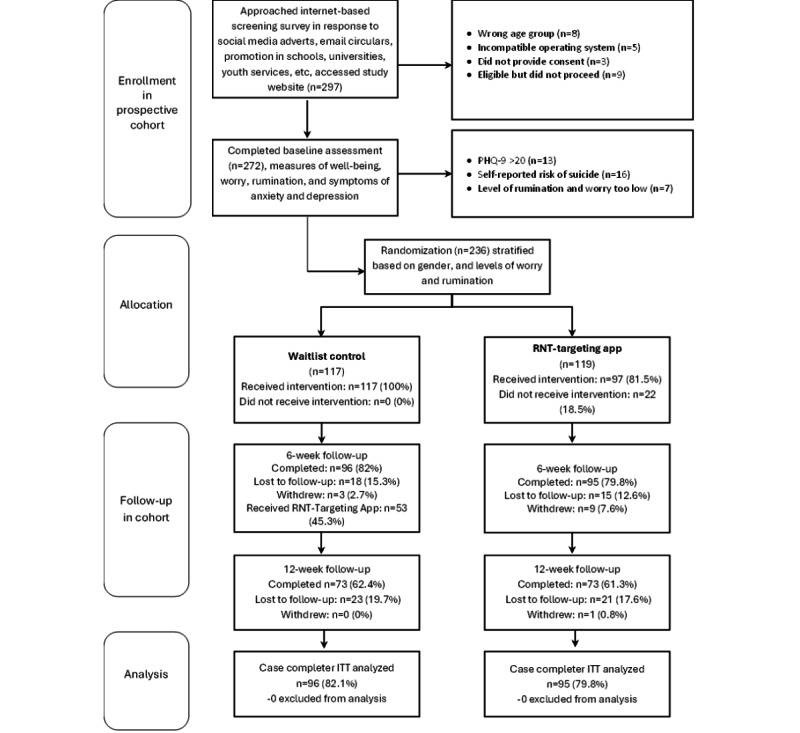
Methods: A web-based, single-blind, 2-arm parallel-group randomized controlled trial was conducted with 236 people aged between 16 and 24 years, who self-reported high levels of worry or rumination. Eligible participants were randomized to an active intervention group (usual practice, plus up to 6 weeks of using the RNT-targeting mobile app, n=119) or a waitlist control group (usual practice with no access to the app until after 6 weeks, n=117). The primary outcome was changes in worry and rumination 6 weeks after randomization. Secondary outcomes included changes in well-being and symptoms of anxiety and depression after 6 weeks and changes in all measures after 12 weeks.
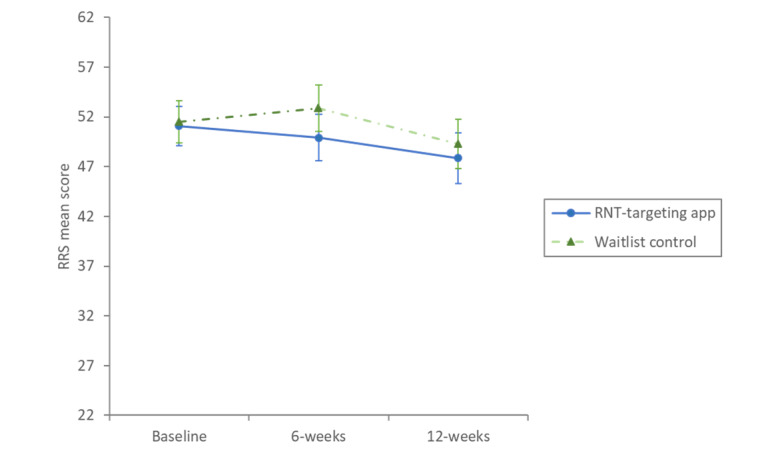
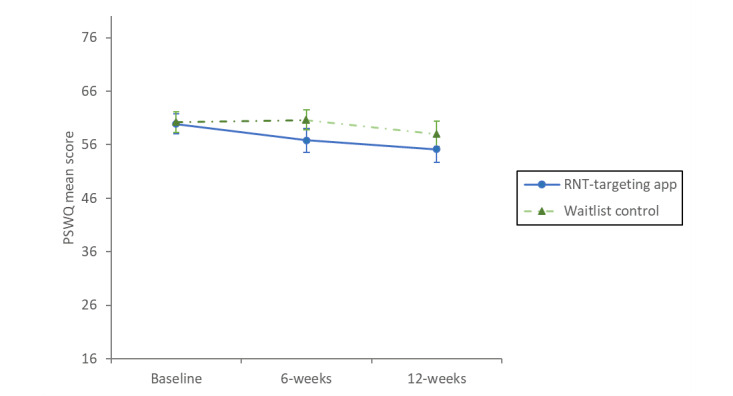
Results: Participants randomly allocated to use the RNT-targeting self-help app showed significantly lower levels of rumination (mean difference -2.92, 95% CI -5.57 to -0.28; P=.03; ηp2=0.02) and worry (mean difference -3.97, 95% CI -6.21 to -1.73; P<.001; ηp2=0.06) at 6-week follow-up, relative to the waitlist control. Similar differences were observed for well-being (P<.001), anxiety (P=.03), and depression (P=.04). The waitlist control group also showed improvement when given access to the app after 6 weeks. Improvements observed in the intervention group after 6 weeks of using the app were maintained at the 12-week follow-up point.
Conclusions: The MyMoodCoach app had a significant positive effect on worry and rumination, well-being, anxiety, and depression in young adults, relative to waitlist controls, providing proof-of-principle that an unguided self-help app can effectively reduce RNT. This app, therefore, has potential for the prevention of anxiety and depression although longer-term effects on incidence need to be directly evaluated.
Trial registration: ClinicalTrials.gov NCT04950257; https://www.clinicaltrials.gov/ct2/show/NCT04950257.
International registered report identifier (irrid): RR2-10.1186/s12888-021-03536-0.
Keywords: anxiety; app; application; depression; mobile health application; mobile phone; mobile-based interventions; prevention-mechanism; repetitive negative thinking; rumination; well-being; worry.
©Daniel Edge, Edward Watkins, Alexandra Newbold, Thomas Ehring, Mads Frost, Tabea Rosenkranz. Originally published in JMIR mHealth and uHealth (https://mhealth.jmir.org), 13.08.2024.
Conflict of interest statement
Conflicts of Interest: MF is a cofounder and shareholder of Monsenso, whose solution delivered the app. EW is the developer of Rumination-focused cognitive-behavioural therapy, which is the intervention used in the app and receives payment for training workshops and royalties from the treatment manual published by Guilford Press. The other authors declare no conflicts of interests.
Figures
References
-
- Thapar A, Collishaw S, Pine DS, Thapar AK. Depression in adolescence. Lancet. 2012;379(9820):1056–1067. doi: 10.1016/S0140-6736(11)60871-4. https://europepmc.org/abstract/MED/22305766 S0140-6736(11)60871-4 - DOI - PMC - PubMed
-
- Newby JM, McKinnon A, Kuyken W, Gilbody S, Dalgleish T. Systematic review and meta-analysis of transdiagnostic psychological treatments for anxiety and depressive disorders in adulthood. Clin Psychol Rev. 2015;40:91–110. doi: 10.1016/j.cpr.2015.06.002. https://linkinghub.elsevier.com/retrieve/pii/S0272-7358(15)00091-4 S0272-7358(15)00091-4 - DOI - PubMed
-
- Silva SA, Silva SU, Ronca DB, Gonçalves VSS, Dutra ES, Carvalho KMB. Common mental disorders prevalence in adolescents: a systematic review and meta-analyses. PLoS One. 2020;15(4):e0232007. doi: 10.1371/journal.pone.0232007. https://dx.plos.org/10.1371/journal.pone.0232007 PONE-D-19-22173 - DOI - DOI - PMC - PubMed
Publication types
MeSH terms
Associated data
LinkOut - more resources
Full Text Sources
Medical
Miscellaneous
