


Impact of a school-based food assistance program on household food insecurity in Greece, 2012-2019: a multi-year evaluation of the DIATROFI program
- PMID: 39139195
- PMCID: PMC11321317
- DOI: 10.1016/j.lanepe.2024.101004
Impact of a school-based food assistance program on household food insecurity in Greece, 2012-2019: a multi-year evaluation of the DIATROFI program
Abstract
Background: Childhood food insecurity can persist among low socioeconomic areas in high-income countries. Universal Free School Meal (UFSM) programs are designed to respond to this pressing issue. This study aimed to conduct a multi-year evaluation of the DIATROFI Program's impact on household food insecurity in Greece.
Methods: This study utilized data from 18,716 students (618 kindergarten to high schools), from low socioeconomic areas participating in the school-level UFSM Program DIATROFI between 2012 and 2019. Parents of students completed annual baseline and follow-up paper-based self-completed questionnaires. The primary outcome was household food insecurity, measured using the Food Security Survey Module (FSSM) at both questionnaires, and evaluated through mixed linear and logistic regression models with repeated measurements.
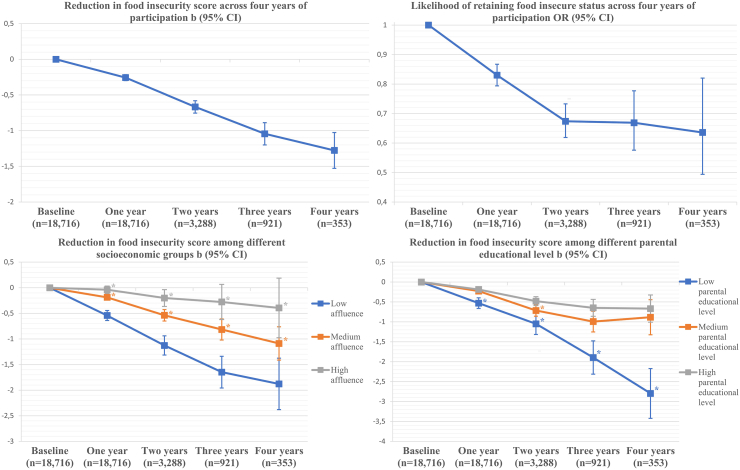
Findings: Students' median age was 9 years old (Interquartile range (IQR): 6.5, 12.0), 51.6% (n = 9658) were girls, and 82.2% (n = 15,382) lived in low/medium socioeconomic affluence households. Households with food insecurity reduced from 51.5% (n = 9630) to 47.6% (n = 8901) after one school year. Food insecurity score declined steadily for four years of consecutive participation, compared to baseline score (one-year b:-0.26; 95% Confidence Interval (CI):-0.30, -0.22, and four-year -1.28; -1.53, -1.03). The likelihood of retaining food insecure status reduced from 17% after one-year participation (Odds Ratio (OR): 0.83; 95% CI: 0.79, 0.87) to 36% after four-year participation (0.64; 0.49, 0.82). The Program's impact on household food insecurity alleviation was greater among households with low parental education and low socioeconomic affluence.
Interpretation: The DIATROFI Program effectively improved household food security during and after the Greek socioeconomic crisis. School-level UFSM programs targeting underprivileged students can improve household food insecurity, with a more pronounced effect with increased years of participation, and among economically disadvantaged households.
Funding: The DIATROFI Program was funded through various national and private organizations, including national prefecture authorities, Greek payment authorities, philanthropic/charitable organizations, and private companies.
Keywords: Food accessibility; Food assistance; Food security; Pediatric.
© 2024 The Authors.
Conflict of interest statement
Authors declare no competing interest.
Figures

References
-
- FAO I . FAO, IFAD, UNICEF, WFP, WHO; Rome, Italy: 2023. The State of Food Security and Nutrition in the World 2023: urbanization, agrifood systems transformation and healthy diets across the rural–urban continuum. - DOI
-
- Abraham S., Breeze P., Sutton A., Lambie-Mumford H. Household food insecurity and child health outcomes: a rapid review of mechanisms and associations. Lancet Lond Engl. 2023;402(Suppl 1):S16. - PubMed
-
- WHO . WHO Regional Office for Europe; Copenhagen: 2006. Food and nutrition policy for schools : a tool for the development of school nutrition programmes in the European Region.https://apps.who.int/iris/handle/10665/107797
LinkOut - more resources
Full Text Sources
