


Development and Validation of a Novel Multiplex Real-Time PCR Assay for Rapid Detection of Carbapenemase Genes in Carbapenem-Resistant Enterobacterales Isolates and Clinical Samples
- PMID: 39139626
- PMCID: PMC11321794
- DOI: 10.2147/IDR.S475630
Development and Validation of a Novel Multiplex Real-Time PCR Assay for Rapid Detection of Carbapenemase Genes in Carbapenem-Resistant Enterobacterales Isolates and Clinical Samples
Abstract
Purpose: Carbapenem-resistant Enterobacterales (CRE) infection is an urgent threat to human health. This study aimed to develop and validate a novel multiplex real-time PCR (multi-qPCR) assay for the detection of the blaKPC, blaNDM, blaIMP, blaOXA-48-like, and blaVIM genes in CRE isolates and clinical samples, as well as to compare it with three phenotypic methods.
Methods: The reliability and limit of detection (LOD) of the multi-qPCR assay were evaluated. PCR and DNA sequencing were used as the reference methods to identify carbapenemase genes in CRE isolates and clinical samples. The accuracy of the multi-qPCR assay, modified carbapenem inactivation and EDTA-modified carbapenem inactivation method (mCIMandeCIM), carbapenemase inhibitor-based combined disk test (CDT), and colloidal gold-based immunochromatographic test was compared with the reference methods with 182 isolates of CRE. Furthermore, 112 clinical samples were collected to validate the efficacy of this multi-qPCR assay.
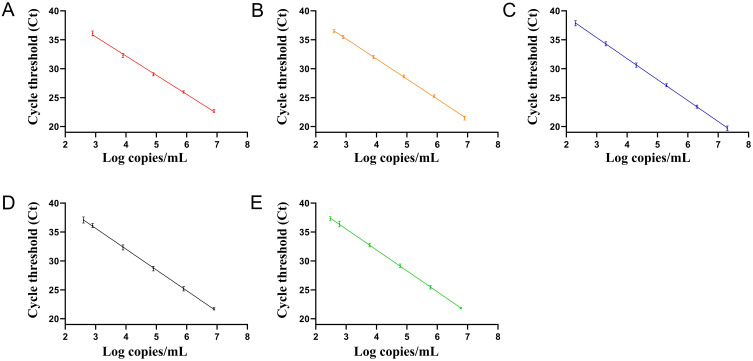
Results: The standard deviations (CVs) of intra-assay and inter-assay of the multi-qPCR assay were ≤ 0.53% and ≤ 2.04% for detecting the five major carbapenemase genes, respectively; while the LOD ranged from 2×10² copies/mL to 8×10² copies/mL. PCR and DNA sequencing confirmed 168 out of 182 CRE isolates producing carbapenemase(s): KPC (n = 93), NDM (n = 46), IMP (n = 8), OXA-48-like (n = 14), VIM (n = 1), KPC&NDM (n = 5), and KPC&NDM&IMP (n = 1). The accuracy of mCIMandeCIM, CDT, Colloidal Gold, and the multi-qPCR assay was 96.2%, 89.6%, 100%, and 100% respectively for detecting carbapenemase(s) producers. Moreover, the sensitivity and specificity of the multi-qPCR assay were all 100% for the detection of each carbapenemase gene in clinical samples, compared with PCR and sequencing.
Conclusion: For clinical isolate detection, the multi-qPCR assay is comparable to Colloidal Gold, and superior to mCIMandeCIM and CDT; while for clinical samples detection, it also shows excellent performance. Therefore, the multi-qPCR assay has great potential for clinical diagnosis.
Keywords: carbapenem-resistant Enterobacterales; carbapenemases detection; combined disk test; immunochromatographic test; mCIM/eCIM; multiplex real-time PCR assay.
© 2024 Wei et al.
Conflict of interest statement
The authors report no conflicts of interest in this work.
Figures
References
-
- World Health Organization (WHO). Global antimicrobial resistance surveillance system (GLASS) report: early implementation 2020; 2020. Available from: https://iris.who.int/bitstream/handle/10665/332081/9789240005587-eng.pdf.... Accessed 27, July 2024.
-
- O’Neill J Antimicrobial resistance: tackling a crisis for the health and wealth of nations. Review on Antimicrobial Resistance. 2016. Available from: https://iiif.wellcomecollection.org/file/b28552179_AMR%20Tackling%20a%20.... Accessed 27, July 2024.
-
- World Health Organization (WHO). WHO bacterial priority pathogens list, 2024: bacterial pathogens of public health importance, to guide research, development and strategies to prevent and control antimicrobial resistance. 2024. Available from: https://iris.who.int/bitstream/handle/10665/376776/9789240093461-eng.pdf.... Accessed 27, July 2024.
-
- US Centers for Disease Control and Prevention (CDC). Antibiotic resistance threats in the United States 2019. 2019. Available from: http://www.cdc.gov/drugresistance/pdf/threats-report/2019-ar-threats-rep.... Accessed 27 July 2024.
-
- China Antimicrobial Resistance Surveillance System. (CARSS). 2023. Available from: https://www.carss.cn/Report/Details?aId=917. Accessed 27, July 2024.
LinkOut - more resources
Full Text Sources
Miscellaneous
