


Level of medication adherence and its determinants of cardiovascular disease patients attending at specialized teaching hospitals of Amhara regional state, Ethiopia: a multicenter cross-sectional study
- PMID: 39139637
- PMCID: PMC11319153
- DOI: 10.3389/fphar.2024.1422703
Level of medication adherence and its determinants of cardiovascular disease patients attending at specialized teaching hospitals of Amhara regional state, Ethiopia: a multicenter cross-sectional study
Abstract
Background: Non-adherence to medication in patients with cardiovascular disease continues to be a main cause of suboptimal management, increased morbidity and mortality, and increased healthcare expenses. The present study assessed the level of medication adherence and its determinants of cardiovascular disease patients.
Methods: An institutional-based multicenter cross-sectional study was conducted with patients with cardiovascular disease in Northwest Ethiopian teaching hospitals. The level of medication adherence was evaluated using a standardized questionnaire of the Adherence in Chronic Disease Scale (ACDS). To find determinants of the level of medication adherence, an ordinal logistic regression model was employed. Statistics were significant when P ≤ 0.05 at a 95% confidence interval (CI).
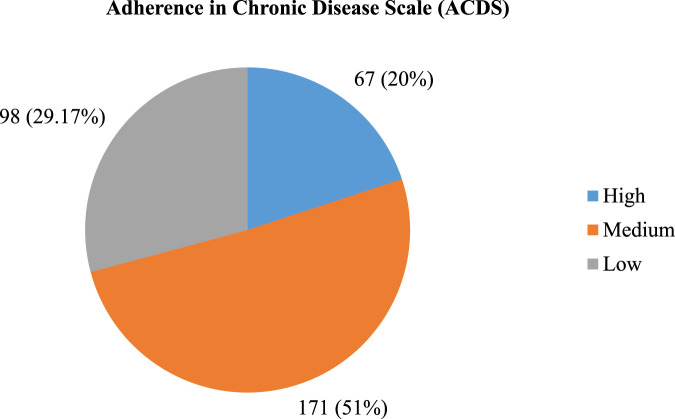
Results: In the end, 336 participants were included in the research. According to this study, one-third of patients had low medication adherence, half had medium adherence, and one-fifth had high medication adherence. Elderly patients [adjusted odds ratio (AOR) = 2.691; 95% confidence interval (CI), 1.704-4.251; P < 0.000], marital status (AOR = 1.921; 95% CI, 1.214-3.039; P = 0.005), alcoholic patients (AOR = 2.782; 95% CI, 1.745-4.435; P < 0.000), Patients without physical activity (AOR = 1.987; 95% CI 1.251-3.156; P = 0.004), non health insurances (AOR = 1.593; 95% CI 1.003-2.529; P = 0.049), sever Charles comorbidity index (AOR = 2.486; 95% CI 1.103-5.604; P = 0.028), patients with polypharmacy (AOR = 2.998 (1.817-4.947) P < 0.000) and, manypolypharmacy (AOR = 3.031 (1.331-6.898) P = 0.008) were more likely to have low medication adherence.
Conclusion: The current study concluded that one-third of study participants had low medication adherence. Older age, marital status, drinker, physical inactivity, drug source, comorbidity, and polypharmacy all contributed to the low level of medication adherence. To improve patients with cardiovascular disease's adherence to their medications, intervention is necessary.
Keywords: Ethiopia; adherence; cardiovascular; determinate factors; ordinal logistic regression.
Copyright © 2024 Dagnew, Wondm, Dagnew, Yimer, Wondmkun and Moges.
Conflict of interest statement
The authors declare that the research was conducted in the absence of any commercial or financial relationships that could be construed as a potential conflict of interest.
Figures
References
-
- Al-Tarawneh F., Ali T., Al-Tarawneh A., Altwalbeh D., Gogazeh E., Bdair O., et al. (2023). Study of adherence level and the relationship between treatment adherence, and superstitious thinking related to health issues among chronic disease patients in southern Jordan: cross-sectional study. Patient Prefer. adherence 17, 605–614. 10.2147/PPA.S390997 - DOI - PMC - PubMed
-
- Aminde L. N., Tindong M., Ngwasiri C. A., Aminde J. A., Njim T., Fondong A. A., et al. (2019). Adherence to antidiabetic medication and factors associated with non-adherence among patients with type-2 diabetes mellitus in two regional hospitals in Cameroon. BMC Endocr. Disord. 19, 35–39. 10.1186/s12902-019-0360-9 - DOI - PMC - PubMed
LinkOut - more resources
Full Text Sources
